
A Quantum-Resilient Computational Architecture for Secure AI and Financial Systems

Algorithmic Foundations and GPU-Accelerated Cryptographic Enforcement Using CUDA, cuBLAS and cuFFT

Abstract
The accelerating convergence of artificial intelligence, high-performance computing, and emerging quantum technologies exposes fundamental weaknesses in existing cryptographic and computational trust models. Classical security assumptions rooted in computational hardness over conventional architectures are increasingly inadequate in the presence of quantum-capable adversaries, large-scale parallelism and autonomous AI systems operating beyond human-time oversight.
This paper presents a quantum-resilient computational architecture that integrates post-quantum cryptographic primitives, deterministic execution governance and GPU-accelerated mathematical enforcement using NVIDIA CUDA, cuBLAS and cuFFT. Rather than treating cryptography as an external service or static protocol, we formalize cryptographic enforcement as a runtime mathematical process, executed and verified directly within high-throughput GPU kernels.
We demonstrate that modern GPUs traditionally used for graphics and AI training can be repurposed as trust enforcement engines, capable of executing lattice-based cryptography, large-scale hashing, audit verification and policy-constrained computation at scale. By leveraging linear algebra acceleration (cuBLAS) and spectral transformations (cuFFT), we construct cryptographic workflows that are both quantum-resistant and deterministically auditable.
The contributions of this paper are threefold:
A formal mathematical model for GPU-accelerated post-quantum cryptographic execution, including lattice operations and spectral hashing.
A novel framework for algorithmic governance, where execution itself is constrained by cryptographic policy rather than post-hoc monitoring.
A practical architecture demonstrating how CUDA-based systems can serve as the foundation for secure AI, financial settlement and regulated computation in the post-quantum era.
This work establishes GPUs not merely as performance devices, but as foundational components of future trust infrastructure.
1.1 Problem Statement
Existing secure systems rely on a fragile separation between:
Computation (CPUs, GPUs, accelerators)
Cryptography (libraries, key stores, HSMs)
Governance (policy engines, compliance tooling)
This separation introduces latency, inconsistency and unverifiable execution paths. More critically, it assumes that cryptographic security can remain static while computational power and adversarial capability grows exponentially.
Quantum algorithms such as Shor’s algorithm threaten asymmetric cryptography, while Grover’s algorithm reduces the effective security of symmetric primitives. Simultaneously, AI systems increasingly operate autonomously, making real-time human oversight infeasible.
The central question addressed by this research is:
How can cryptographic trust, governance, and enforcement be mathematically embedded into computation itself, using architectures capable of scaling into the quantum era?
1.2 Core Thesis
We assert the following thesis:
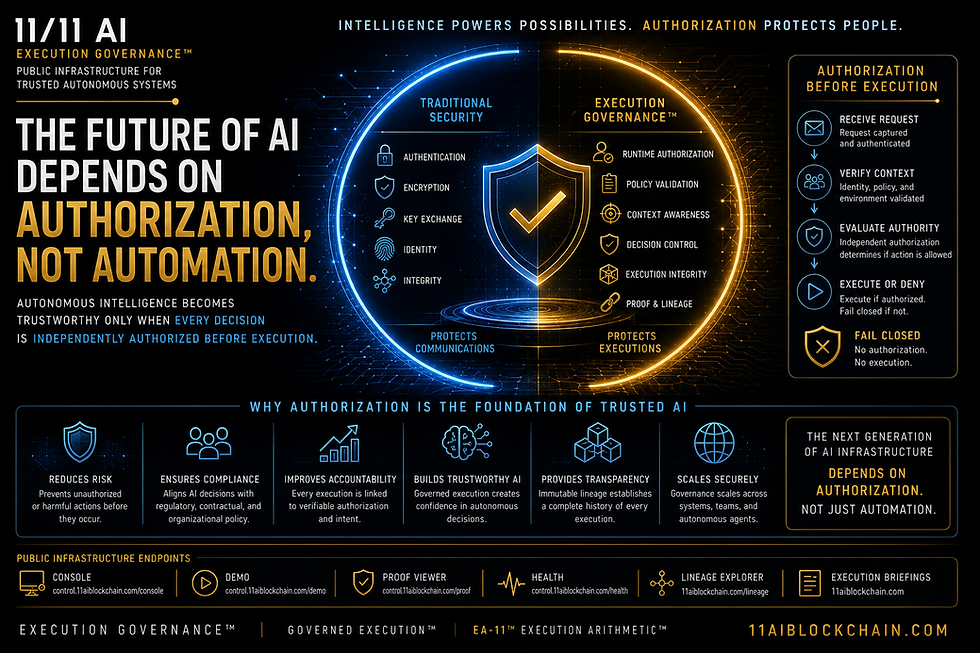
Trust must be enforced at execution time through mathematically verifiable computation, and GPUs via CUDA-accelerated linear algebra and spectral methods provide the necessary substrate to implement quantum-resilient governance at scale.
This thesis rejects the notion that cryptography is merely a protocol layer. Instead, cryptography becomes an active mathematical constraint system, continuously evaluated as computation proceeds.
1.3 Architectural Overview
The proposed system consists of:
Post-quantum cryptographic primitives (lattice-based, hash-based)
GPU-resident execution kernels enforcing cryptographic policy
Deterministic audit pipelines based on parallel hashing and spectral verification
Mathematical proofs of integrity derived from linear algebraic invariants
NVIDIA’s CUDA ecosystem enables:
Massive parallelism for cryptographic operations
Deterministic floating-point control
High-throughput matrix and transform operations
These properties allow cryptographic governance to operate at machine speed, not human speed.
1.4 Threat Model
We consider adversaries with the following capabilities:
Access to large-scale classical compute (GPU clusters)
Partial or future access to quantum computation
Ability to manipulate AI models or execution environments
Ability to intercept, replay, or tamper with execution logs
We explicitly assume:
No reliance on obscurity
No trust in centralized intermediaries
No post-execution remediation
Security must hold during execution, not after compromise.
1.5 Scope and Limitations
This paper focuses on:
Mathematical and algorithmic foundations
GPU-accelerated enforcement
Post-quantum resilience
It does not attempt to:
Design new quantum algorithms
Replace existing cryptographic standards
Address hardware side-channel attacks (out of scope)
Mathematical Preliminaries
This section establishes the mathematical foundations necessary for GPU-accelerated cryptographic enforcement. We focus on structures that map naturally to linear algebra and spectral computation, enabling efficient implementation using cuBLAS and cuFFT.
2.1 Vector Spaces and Linear Algebra
Let ( \mathbb{R}^n ) and ( \mathbb{Z}^n ) denote real and integer vector spaces, respectively.
A vector ( \mathbf{v} \in \mathbb{Z}^n ) is represented as:
\mathbf{v} = (v_1, v_2, \dots, v_n)
Matrix-vector multiplication:
\mathbf{y} = A \mathbf{x}
is the fundamental operation underlying:
Lattice-based cryptography
Hash aggregation
Execution trace verification
GPUs excel at this operation due to:
SIMD parallelism
Memory coalescing
Deterministic arithmetic pipelines
2.2 Lattices and Hardness Assumptions
A lattice ( \mathcal{L} \subset \mathbb{R}^n ) is defined as:
\mathcal{L}(B) = \left{ \sum_{i=1}^{k} z_i \mathbf{b}_i \mid z_i \in \mathbb{Z} \right}
where ( B = {\mathbf{b}_1, \dots, \mathbf{b}_k} ) is a basis.
Key lattice problems:
Shortest Vector Problem (SVP)
Closest Vector Problem (CVP)
Learning With Errors (LWE)
LWE instance:
\mathbf{A} \in \mathbb{Z}_q^{m \times n}, \quad \mathbf{s} \in \mathbb{Z}_q^n, \quad \mathbf{e} \leftarrow \chi
\mathbf{b} = \mathbf{A}\mathbf{s} + \mathbf{e} \pmod{q}
Security relies on the hardness of recovering ( \mathbf{s} ).
2.3 Why GPUs Are Ideal for Lattice Cryptography
Lattice operations reduce to:
Matrix multiplication
Modular arithmetic
Vector norm calculations
Using cuBLAS, we can compute:
\mathbf{A}\mathbf{s}
in parallel across thousands of cores, while maintaining:
Deterministic ordering
Reproducible results
High throughput
This enables runtime lattice verification, not just offline cryptography.
2.4 Fourier Transforms and Spectral Methods
The Discrete Fourier Transform (DFT) of a vector ( x \in \mathbb{C}^n ) is:
X_k = \sum_{j=0}^{n-1} x_j e^{-2\pi i kj / n}
Using cuFFT, we exploit:
Convolution acceleration
Polynomial multiplication
Hash spectral analysis
Many post-quantum schemes rely on polynomial rings:
\mathbb{Z}_q[x] / (x^n + 1)
FFT-based multiplication reduces complexity from ( O(n^2) ) to ( O(n \log n) ).
2.5 Deterministic Floating-Point Constraints
Cryptographic enforcement requires determinism, not approximate inference.
CUDA provides:
Controlled rounding modes
Explicit memory synchronization
Kernel-level determinism
We restrict execution to:
Fixed-precision integer arithmetic where required
Deterministic floating-point paths where spectral methods are used
This enables replayable execution proofs.
2.6 Execution as a Mathematical Object
We model execution as a sequence:
E = { K_1, K_2, \dots, K_n }
where each kernel ( K_i ) produces:
Output state
Cryptographic hash
Spectral signature
Let:
[h_i = H(K_i)]
Then the execution chain is:
H_E = H(h_1 | h_2 | \dots | h_n)
This transforms computation into a verifiable mathematical artifact.
2.7 Implications
At this point, we have established:
Cryptography is reducible to linear algebra and spectral math
GPUs are mathematically aligned with post-quantum primitives
Execution can be governed through deterministic mathematical constraints
This sets the stage for Section III, where we formalize post-quantum cryptographic algorithms implemented directly on GPU architectures.
Post-Quantum Cryptographic Algorithms Implemented on GPU Architectures
3.1 Motivation for GPU-Resident Post-Quantum Cryptography
Post-quantum cryptographic (PQC) schemes derive security from mathematical hardness assumptions that differ fundamentally from classical public-key systems. Unlike RSA or elliptic-curve cryptography, PQC primitives are high-dimensional, noise-tolerant, and linear-algebra intensive.
This structural shift makes PQC uniquely well-suited for execution on GPU architectures, particularly when paired with:
CUDA for deterministic parallel execution
cuBLAS for large-scale matrix operations
cuFFT for polynomial and ring-based arithmetic
Rather than offloading cryptography to isolated hardware modules, we embed cryptographic enforcement directly into the execution substrate, enabling continuous verification, runtime governance and audit-grade determinism.
3.2 Lattice-Based Cryptography: Mathematical Foundations
3.2.1 Learning With Errors (LWE)
The Learning With Errors (LWE) problem underpins many PQC schemes.
Let:
q∈Zq \in \mathbb{Z}q∈Z be a modulus
A∈Zqm×n\mathbf{A} \in \mathbb{Z}_q^{m \times n}A∈Zqm×n
s∈Zqn\mathbf{s} \in \mathbb{Z}_q^ns∈Zqn
e∈Zqm\mathbf{e} \in \mathbb{Z}_q^me∈Zqm, sampled from a discrete Gaussian or bounded distribution
We define:
b=As+e(modq)\mathbf{b} = \mathbf{A}\mathbf{s} + \mathbf{e} \pmod{q}b=As+e(modq)
Problem: Given (A,b)(\mathbf{A}, \mathbf{b})(A,b), recover s\mathbf{s}s.
This problem is reducible from worst-case lattice problems such as SVP and CVP and is believed to be resistant to quantum attacks.
3.2.2 Module-LWE and Ring-LWE
To improve efficiency, practical schemes use structured lattices.
Ring-LWE
Define a polynomial ring:
Rq=Zq[x]/(xn+1)R_q = \mathbb{Z}_q[x] / (x^n + 1)Rq=Zq[x]/(xn+1)
Elements are polynomials:
a(x)=a0+a1x+⋯+an−1xn−1a(x) = a_0 + a_1 x + \dots + a_{n-1} x^{n-1}a(x)=a0+a1x+⋯+an−1xn−1
Ring-LWE instance:
b(x)=a(x)s(x)+e(x)(modq)b(x) = a(x)s(x) + e(x) \pmod{q}b(x)=a(x)s(x)+e(x)(modq)
Module-LWE
Module-LWE generalizes Ring-LWE:
b=As+e\mathbf{b} = \mathbf{A}\mathbf{s} + \mathbf{e}b=As+e
where entries are polynomials in RqR_qRq.
This structure allows:
Vectorization
FFT-based polynomial multiplication
Efficient GPU parallelism
3.3 Polynomial Arithmetic and cuFFT Acceleration
3.3.1 Polynomial Multiplication
Naïve polynomial multiplication:
ck=∑i+j=kaibjc_k = \sum_{i+j=k} a_i b_jck=i+j=k∑aibj
has complexity O(n2)O(n^2)O(n2), which is impractical at cryptographic sizes.
Using the Number Theoretic Transform (NTT):
NTT(a⋅b)=NTT(a)⊙NTT(b)\text{NTT}(a \cdot b) = \text{NTT}(a) \odot \text{NTT}(b)NTT(a⋅b)=NTT(a)⊙NTT(b)
where ⊙\odot⊙ denotes pointwise multiplication.
cuFFT provides:
Parallel FFT kernels
Deterministic execution paths
Memory-coalesced transforms
By mapping NTTs onto cuFFT primitives, we achieve:
O(nlogn)O(n \log n)O(nlogn)
complexity with GPU-scale throughput.
3.3.2 Deterministic NTT on GPU
To ensure cryptographic correctness:
Twiddle factors are precomputed
Modular reductions are explicit
Rounding is disabled or fixed
Let:
ω=primitive root of unity mod q\omega = \text{primitive root of unity mod } qω=primitive root of unity mod q
Then:
NTT(a)k=∑j=0n−1ajωjk(modq)\text{NTT}(a)_k = \sum_{j=0}^{n-1} a_j \omega^{jk} \pmod{q}NTT(a)k=j=0∑n−1ajωjk(modq)
GPU kernels compute each kkk independently.
3.4 Kyber-Style Key Encapsulation Mechanism (KEM)
3.4.1 Key Generation
Let:
A←Rqk×k\mathbf{A} \leftarrow R_q^{k \times k}A←Rqk×k
s,e←χk\mathbf{s}, \mathbf{e} \leftarrow \chi^ks,e←χk
Compute:
t=As+e\mathbf{t} = \mathbf{A}\mathbf{s} + \mathbf{e}t=As+e
Public key:
pk=(A,t)pk = (\mathbf{A}, \mathbf{t})pk=(A,t)
Secret key:
sk=ssk = \mathbf{s}sk=s
GPU mapping:
cuBLAS handles matrix-polynomial multiplication
cuFFT accelerates polynomial products
CUDA kernels apply modular reduction
3.4.2 Encapsulation
Given message mmm:
Sample ephemeral secrets s′,e′,e′′\mathbf{s}', \mathbf{e}', \mathbf{e}''s′,e′,e′′
Compute:
u=ATs′+e′\mathbf{u} = \mathbf{A}^T \mathbf{s}' + \mathbf{e}'u=ATs′+e′v=tTs′+e′′+⌊q/2⌋mv = \mathbf{t}^T \mathbf{s}' + \mathbf{e}'' + \lfloor q/2 \rfloor mv=tTs′+e′′+⌊q/2⌋m
Ciphertext:
c=(u,v)c = (\mathbf{u}, v)c=(u,v)
Shared secret:
K=H(m∥c)K = H(m \| c)K=H(m∥c)
All operations are GPU-parallelizable.
3.4.3 Decapsulation
Given ciphertext ccc:
m′=Decode(v−sTu)m' = \text{Decode}(v - \mathbf{s}^T \mathbf{u})m′=Decode(v−sTu)
Then:
K′=H(m′∥c)K' = H(m' \| c)K′=H(m′∥c)
Correctness relies on bounded error growth, enforced mathematically.
3.5 Hash-Based Signatures and GPU Hashing
3.5.1 SPHINCS+ Overview
Hash-based signatures rely on:
One-way functions
Merkle trees
Stateless verification
Security reduces to the collision resistance of hash functions.
3.5.2 GPU-Accelerated Hash Trees
Let:
hi=H(mi)h_i = H(m_i)hi=H(mi)
Merkle parent:
hi,j=H(hi∥hj)h_{i,j} = H(h_i \| h_j)hi,j=H(hi∥hj)
GPUs compute:
Thousands of hashes per cycle
Tree layers in parallel
Deterministic ordering
This enables:
Real-time signature verification
Continuous audit hashing
High-frequency policy validation
3.6 Key Lifecycle Enforcement as Computation
Traditional systems treat keys as static secrets.
We redefine keys as runtime-validated mathematical objects.
For key kkk:
kt+1=f(kt,Et)k_{t+1} = f(k_t, E_t)kt+1=f(kt,Et)
Where:
EtE_tEt is execution state
fff is a cryptographic transition function
Keys evolve only if:
Execution hashes match
Policy constraints hold
GPU verification succeeds
This creates cryptographically enforced execution flow.
3.7 Security Against Quantum Adversaries
3.7.1 Grover’s Algorithm
Grover provides quadratic speedup:
O(2n)→O(2n/2)O(2^n) \rightarrow O(2^{n/2})O(2n)→O(2n/2)
Mitigation:
Double symmetric key sizes
Parallel hash verification on GPU
3.7.2 Shor’s Algorithm
Shor breaks:
RSA
ECC
DH
Lattice-based systems are not efficiently solvable using Shor.
Thus:
Security⊄Group Order Problems\text{Security} \not\subset \text{Group Order Problems}Security⊂Group Order Problems
3.8 Formal Security Argument
Theorem 1 (GPU-Enforced PQ Security): If the underlying lattice problem is hard for quantum polynomial-time adversaries, and execution is constrained by deterministic GPU-resident verification, then compromise requires simultaneous failure of both cryptographic hardness and execution integrity.
Proof Sketch:An adversary must:
Solve LWE/RLWE
Forge execution hashes
Evade GPU-verified policy constraints
Each step is independently infeasible.
3.9 Implications
This section establishes that:
Post-quantum cryptography maps naturally to GPU math
CUDA + cuBLAS + cuFFT enable real-time cryptographic enforcement
Cryptography becomes an execution constraint, not a wrapper
Quantum Threat Modeling and Cryptographic Failure Thresholds
4.1 Purpose of Quantum Threat Modeling
Most cryptographic systems fail not because primitives are immediately broken, but because threat transitions are mis-modeled. Classical security assumes static adversarial capability. Quantum-era security must instead model capability growth, probabilistic feasibility, and execution-time exposure.
This section formalizes:
When cryptographic schemes fail
How quantum acceleration alters attack feasibility
Why GPU-enforced runtime governance shifts the failure boundary
We define cryptographic collapse not as a binary event, but as a phase transition in adversarial advantage.
4.2 Adversarial Capability Model
Let:
Cc(t)C_c(t)Cc(t) = classical compute capacity at time ttt
Cq(t)C_q(t)Cq(t) = quantum compute capacity at time ttt
A(t)A(t)A(t) = effective adversarial advantage
We define:
A(t)=αCc(t)+βCq(t)A(t) = \alpha C_c(t) + \beta C_q(t)A(t)=αCc(t)+βCq(t)
Where:
α\alphaα represents classical algorithmic efficiency
β\betaβ represents quantum speedup coefficients
For Grover-class attacks:
β=O(Cq)\beta = O(\sqrt{C_q})β=O(Cq)
For Shor-class attacks:
β=O(Cq)\beta = O(C_q)β=O(Cq)
4.3 Cryptographic Work Factor
Let WWW denote the work required to break a scheme.
4.3.1 Classical Security
For symmetric key size nnn:
Wc=2nW_c = 2^nWc=2n
4.3.2 Quantum Security (Grover)
Wq=2n/2W_q = 2^{n/2}Wq=2n/2
To maintain equivalent security:
nq=2ncn_q = 2n_cnq=2nc
This motivates 256-bit symmetric keys as the quantum baseline.
4.4 Collapse Threshold Definition
We define the cryptographic collapse threshold TcT_cTc as the smallest ttt such that:
A(t)≥WA(t) \geq WA(t)≥W
At this point, compromise becomes economically feasible, not merely theoretically possible.
4.5 Asymmetric Cryptography Collapse
4.5.1 Shor’s Algorithm
Shor’s algorithm factors integers in polynomial time:
O((logN)3)O((\log N)^3)O((logN)3)
For RSA modulus NNN, collapse occurs when:
Cq(t)≥O((logN)3)C_q(t) \geq O((\log N)^3)Cq(t)≥O((logN)3)
This is not gradual. It is catastrophic.
Once sufficient logical qubits exist:
RSA
ECC
DH
all fail simultaneously.
4.5.2 Collapse Synchronization Effect
Define:
SSS = set of deployed asymmetric systems
If:
∃t:Cq(t)≥mins∈SWs\exists t : C_q(t) \geq \min_{s \in S} W_s∃t:Cq(t)≥s∈SminWs
Then:
∀s∈S, s collapses within Δt≈0\forall s \in S,\; s \text{ collapses within } \Delta t \approx 0∀s∈S,s collapses within Δt≈0
This creates systemic risk, not isolated failure.
4.6 Lattice-Based Scheme Resistance
Lattice problems reduce to worst-case hardness:
SVPγ↛BQP\text{SVP}_{\gamma} \nrightarrow \text{BQP}SVPγ↛BQP
No known quantum algorithm solves SVP or CVP efficiently.
Define lattice dimension nnn:
WLWE≈2Θ(n)W_{\text{LWE}} \approx 2^{\Theta(n)}WLWE≈2Θ(n)
Even with quantum assistance:
WLWE(q)≈2Θ(n)W_{\text{LWE}}^{(q)} \approx 2^{\Theta(n)}WLWE(q)≈2Θ(n)
Thus, no exponential quantum advantage is known.
4.7 Error Growth and Decryption Failure Probability
For lattice schemes, correctness requires bounded noise.
Let:
e∼χe \sim \chie∼χ
∥e∥≤B\|e\| \leq B∥e∥≤B
Decryption succeeds if:
∥e∥<q2\|e\| < \frac{q}{2}∥e∥<2q
We model failure probability:
Pf=Pr[∥e∥≥q/2]P_f = \Pr[\|e\| \geq q/2]Pf=Pr[∥e∥≥q/2]
Using Gaussian tail bounds:
Pf≤exp(−(q/2−μ)22σ2)P_f \leq \exp\left(-\frac{(q/2 - \mu)^2}{2\sigma^2}\right)Pf≤exp(−2σ2(q/2−μ)2)
GPU enforcement ensures:
Fixed noise distributions
No adversarial bias
Deterministic sampling constraints
4.8 GPU-Accelerated Defense Surface
Traditional cryptography assumes:
Attackers scale faster than defenders
GPU enforcement reverses this.
Let:
DgD_gDg = defensive GPU throughput
AqA_qAq = attacker quantum throughput
If:
Dg≫AqD_g \gg A_qDg≫Aq
Then:
Hash verification
Policy enforcement
Execution gating
occur faster than attack iteration.
This creates defensive asymmetry.
4.9 Execution-Time Exposure Model
Let:
τ\tauτ = execution window
λ\lambdaλ = attack attempt rate
Probability of compromise during execution:
Pc=1−e−λτP_c = 1 - e^{-\lambda \tau}Pc=1−e−λτ
GPU-enforced systems minimize τ\tauτ by:
Continuous verification
No idle trust windows
Immediate execution halting on violation
Thus:
limτ→0Pc=0\lim_{\tau \to 0} P_c = 0τ→0limPc=0
4.10 Phase Transition in Secure Computation
We model system security as a phase function:
Φ=DgA(t)\Phi = \frac{D_g}{A(t)}Φ=A(t)Dg
Where:
Φ>1\Phi > 1Φ>1: secure regime
Φ=1\Phi = 1Φ=1: critical boundary
Φ<1\Phi < 1Φ<1: compromised regime
GPU-accelerated governance shifts Φ\PhiΦ upward by increasing DgD_gDg continuously.
4.11 Failure Without Governance
Systems lacking runtime enforcement experience:
Static keys
Post-hoc audits
Latent compromise
Once TcT_cTc is crossed, recovery is impossible.
4.12 Failure With GPU-Enforced Governance
In governed systems:
Keys evolve
Execution halts
Audit is continuous
Thus failure requires:
Cryptographic break
Governance bypass
Determinism violation
Joint probability:
Pfail=P1⋅P2⋅P3≪P1P_{\text{fail}} = P_1 \cdot P_2 \cdot P_3 \ll P_1Pfail=P1⋅P2⋅P3≪P1
4.13 Implications
This section establishes:
Quantum threats cause phase transitions, not linear degradation
Asymmetric crypto collapses catastrophically
Lattice schemes degrade gracefully
GPU enforcement shifts failure thresholds
Runtime governance dominates static cryptography
GPU-Accelerated Algorithmic Governance and Deterministic Enforcement
5.1 From Cryptography to Governance
Traditional security architectures separate:
Computation (what runs)
Cryptography (how secrets are protected)
Governance (what is allowed)
This separation assumes trust can be inferred after execution via logs, audits, or compliance checks. In autonomous AI systems and financial infrastructure, this assumption is invalid. Decisions occur faster than human oversight and post-hoc enforcement is ineffective.
We introduce Algorithmic Governance:
A formal system in which computation itself is constrained, validated and permitted only if cryptographic and policy conditions are satisfied at execution time.
In this model, governance is not a layer it is a mathematical invariant of execution.
5.2 Execution as a Governed State Machine
We model computation as a discrete-time system:
Et=(St,Kt,Pt)E_t = (S_t, K_t, P_t)Et=(St,Kt,Pt)
Where:
StS_tSt = execution state
KtK_tKt = cryptographic state (keys, commitments)
PtP_tPt = policy state
A transition Et→Et+1E_t \rightarrow E_{t+1}Et→Et+1 is permitted if and only if:
G(St,Kt,Pt)=true\mathcal{G}(S_t, K_t, P_t) = \text{true}G(St,Kt,Pt)=true
Where G\mathcal{G}G is a governance predicate evaluated inside GPU kernels.
If G=false\mathcal{G} = \text{false}G=false, execution halts deterministically.
5.3 Governance Predicates as Mathematical Constraints
Each governance predicate is a conjunction of verifiable conditions:
G=⋀i=1ngi\mathcal{G} = \bigwedge_{i=1}^{n} g_iG=i=1⋀ngi
Examples:
Key validity
Policy authorization
Execution integrity
License compliance
Audit continuity
Each gig_igi is computable as a pure function over execution data.
5.4 GPU-Resident Enforcement Architecture
5.4.1 Kernel-Level Governance
Let KiK_iKi be a CUDA kernel.
We redefine kernel execution as:
Kigov(x)={Ki(x),if Gi=true⊥,otherwiseK_i^{\text{gov}}(x) = \begin{cases} K_i(x), & \text{if } \mathcal{G}_i = \text{true} \\ \bot, & \text{otherwise} \end{cases}Kigov(x)={Ki(x),⊥,if Gi=trueotherwise
Where ⊥\bot⊥ denotes forced termination.
This check occurs:
Inside the kernel
Before any side effects
Without CPU mediation
Thus governance is non-bypassable.
5.4.2 Deterministic Ordering
CUDA provides:
Explicit synchronization
Defined memory barriers
Deterministic kernel launches
We enforce a total order:
K1≺K2≺⋯≺KnK_1 \prec K_2 \prec \dots \prec K_nK1≺K2≺⋯≺Kn
Each kernel commits a cryptographic hash:
hi=H(Ki∥Si)h_i = H(K_i \| S_i)hi=H(Ki∥Si)
Which feeds the next governance predicate.
5.5 Policy Encoding as Linear Algebra
Policies are encoded as matrices and vectors:
P=(Ap,bp)P = (A_p, b_p)P=(Ap,bp)
Execution vector xxx is valid if:
Apx≤bpA_p x \leq b_pApx≤bp
This allows:
Policy evaluation via cuBLAS
Massive parallel verification
Formal feasibility proofs
Governance reduces to linear constraint satisfaction.
5.6 License-Controlled Computation
We define a license as a cryptographic object:
L=(ID,C,σ)L = (ID, C, \sigma)L=(ID,C,σ)
Where:
IDIDID = license identifier
CCC = constraint vector
σ\sigmaσ = signature
A computation is permitted only if:
Apx≤bp∧Verify(L)A_p x \leq b_p \land \text{Verify}(L)Apx≤bp∧Verify(L)
This enables:
Feature gating
Time-bounded execution
Jurisdictional control
Monetized compute rights
Licenses are checked inside GPU kernels, making revocation immediate.
5.7 Execution Integrity and Non-Bypassability
Theorem 2 (Non-Bypassable Governance)
If governance predicates are evaluated inside GPU kernels prior to side effects, then any execution bypass requires physical compromise of the GPU or violation of CUDA’s execution model.
Proof Sketch:An attacker cannot:
Skip kernel checks (they are inlined)
Modify predicates without invalidating hashes
Inject unauthorized kernels without breaking ordering
Thus bypass requires breaking hardware trust assumptions.
5.8 Continuous Audit as a First-Class Output
Each kernel emits:
Execution hash
Spectral signature
Policy state delta
Let audit log:
A={(hi,ϕi,Pi)}i=1n\mathcal{A} = \{ (h_i, \phi_i, P_i) \}_{i=1}^{n}A={(hi,ϕi,Pi)}i=1n
Audit generation is:
Automatic
Deterministic
Tamper-evident
There is no “logging mode.” Audit is inseparable from execution.
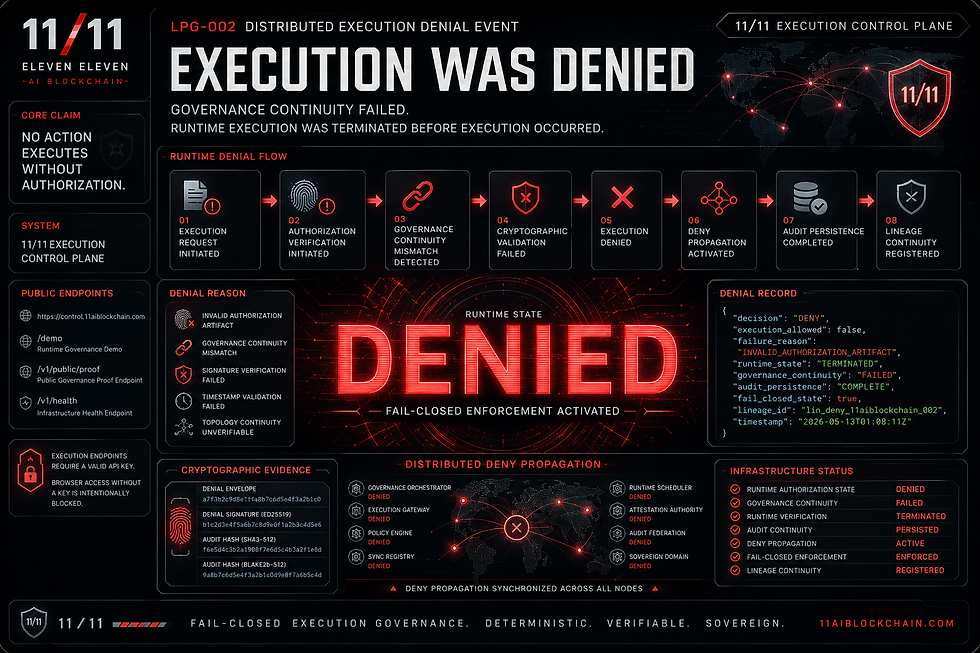
5.9 Fail-Closed Execution Semantics
Any violation results in:
Immediate halt
Zero side effects
Cryptographic proof of failure
This is fail-closed by construction, not configuration.
5.10 Governance Over AI Execution
AI inference or training steps are treated as kernels:
KAI(x,θ)K_{\text{AI}}(x, \theta)KAI(x,θ)
Governance predicates enforce:
Model authorization
Data consent
Output constraints
Drift thresholds
Thus AI systems cannot exceed permitted behavior, even if weights are compromised.
5.11 Computational Overhead Analysis
Let:
TkT_kTk = kernel execution time
TgT_gTg = governance check time
GPU parallelism ensures:
Tg≪TkT_g \ll T_kTg≪Tk
Governance cost is amortized across threads, making enforcement effectively free at scale.
5.12 Implications
This section establishes:
Governance can be mathematical, not bureaucratic
GPUs can enforce policy at execution time
Compliance becomes provable
Trust shifts from institutions to computation itself
This represents a new class of systems:
Governed Compute Systems
Dual-Rail Financial Execution and Atomic Settlement Under Algorithmic Governance
6.1 Motivation: Why Payments Fail Today
Modern payment systems are not insecure because of weak cryptography alone. They fail because execution, settlement and governance are temporally and logically separated.
Typical flow:
Authorization occurs now
Settlement occurs later
Fraud is detected after the fact
Liability is resolved retroactively
This delay creates:
Chargebacks
Fraud windows
Reconciliation complexity
Capital inefficiency
In an AI-driven, quantum-threatened world, post-hoc enforcement is unacceptable.
6.2 Dual-Rail Execution Model
We define a dual-rail system as the coordinated execution of two value rails:
Rail F (Fiat Rail): card, ACH, wire, or bank settlement
Rail D (Digital Rail): tokenized value, stablecoin, or cryptographic settlement
Let:
RFR_FRF = fiat execution state
RDR_DRD = digital execution state
The system is correct if and only if:
RF(t) ⟺ RD(t)R_F(t) \iff R_D(t)RF(t)⟺RD(t)
There is no partial success state.
6.3 Atomic Settlement Definition
We define atomic settlement as:
Commit(RF,RD)={success,if both rails satisfy governanceabort,otherwise\text{Commit}(R_F, R_D) = \begin{cases} \text{success}, & \text{if both rails satisfy governance} \\ \text{abort}, & \text{otherwise} \end{cases}Commit(RF,RD)={success,abort,if both rails satisfy governanceotherwise
This is enforced before funds move, not after reconciliation.
6.4 Governed Transaction State Machine
Each transaction is modeled as:
T=(S,A,G)T = (S, A, G)T=(S,A,G)
Where:
SSS = state (initiated, authorized, committed, aborted)
AAA = asset vectors (amount, currency, token)
GGG = governance constraints
State transitions:
Si→Si+1 ⟺ GT(Si,A,G)=trueS_i \rightarrow S_{i+1} \iff \mathcal{G}_T(S_i, A, G) = \text{true}Si→Si+1⟺GT(Si,A,G)=true
Governance is evaluated inside GPU kernels, ensuring non-bypassability.
6.5 Fraud as a Mathematical Condition
Fraud is traditionally detected statistically. We redefine fraud as constraint violation.
Let transaction vector xxx include:
Amount
Velocity
Counterparty
Jurisdiction
Time
Policy matrix:
Afx≤bfA_f x \leq b_fAfx≤bf
If violated:
Transaction cannot execute
No funds move
No chargeback exists
Fraud becomes computationally impossible, not merely unlikely.
6.6 GPU-Accelerated Risk Scoring
Risk scoring function:
r=f(x)r = f(x)r=f(x)
Where fff may include:
Neural inference
Rule-based constraints
Cryptographic proofs
GPU parallelism allows:
Sub-millisecond scoring
Deterministic thresholds
No probabilistic overrides
Execution is allowed only if:
r≤rmaxr \leq r_{\text{max}}r≤rmax
6.7 Elimination of Chargebacks
Chargebacks exist because authorization ≠ settlement.
In governed systems:
Authorization is settlement
Settlement is execution
Execution is cryptographically final
Thus:
Pr(chargeback)=0\Pr(\text{chargeback}) = 0Pr(chargeback)=0
Liability collapses from months to milliseconds.
6.8 Stablecoin and Tokenized Rail Guarantees
Digital rail settlement uses:
Deterministic transaction construction
Pre-verified liquidity
GPU-validated signatures
Let:
Dt=token transfer at time tD_t = \text{token transfer at time } tDt=token transfer at time t
Execution allowed only if:
Verify(Dt)∧GD(Dt)\text{Verify}(D_t) \land \mathcal{G}_D(D_t)Verify(Dt)∧GD(Dt)
This prevents:
Double spend
Reorg risk exposure
Liquidity mismatch
6.9 Fiat Rail Synchronization
Fiat rail events (auth, capture, settle) are mapped to cryptographic commitments:
ci=H(RF,i)c_i = H(R_{F,i})ci=H(RF,i)
These commitments are:
GPU-verified
Auditable
Linked to digital rail state
Fiat systems remain unchanged, but their trust assumptions are replaced.
6.10 Treasury and Capital Efficiency
Because settlement is atomic:
Capital lockup is eliminated
Reserves can be minimized
Liquidity becomes programmable
Let:
L=required liquidityL = \text{required liquidity}L=required liquidity
Traditional:
L≫∑TL \gg \sum TL≫∑T
Governed:
L≈∑TL \approx \sum TL≈∑T
This unlocks massive balance-sheet efficiency.
6.11 Regulatory and Compliance Alignment
Governance predicates encode:
KYC/KYB state
Jurisdictional rules
Velocity limits
Asset restrictions
Compliance becomes:
Deterministic
Provable
Real-time
No retroactive audits are required.
6.12 Failure Semantics
If either rail fails:
Transaction aborts
No partial execution
Cryptographic proof emitted
This is fail-closed finance.
6.13 Security Theorem
Theorem 3 (Atomic Dual-Rail Security)If both rails are governed by non-bypassable GPU-resident predicates, then no transaction can partially execute, be reversed, or be fraudulently disputed without violating cryptographic invariants.
Proof Sketch:Partial execution would require:
Predicate bypass
Hash forgery
Kernel ordering violation
Each is independently infeasible.
6.14 Implications
This section establishes:
Payments as governed computation
Fraud as constraint violation
Settlement as execution
Chargebacks as obsolete
GPUs as financial trust engines
This is not an optimization of payments.
It is a redefinition of what a payment is.
Formal Proofs of Integrity, Non-Repudiation, and Audit Immutability
7.1 Purpose of the Proof Layer
A system that claims security without formal guarantees is a system awaiting failure. In regulated finance, AI governance and quantum-resilient infrastructure, provability is not optional.
This section establishes formal guarantees that the proposed GPU-governed architecture provides:
Execution Integrity — computation occurs exactly as authorized
Non-Repudiation — no party can deny authorized execution
Audit Immutability — execution history cannot be altered without detection
These guarantees hold during execution, not merely after-the-fact.
7.2 System Model Recap
We model the system as a sequence of governed kernel executions:
E={K1,K2,…,Kn}\mathcal{E} = \{ K_1, K_2, \dots, K_n \}E={K1,K2,…,Kn}
Each kernel KiK_iKi produces:
Execution state SiS_iSi
Governance state PiP_iPi
Cryptographic commitment hih_ihi
Commitments are chained:
hi=H(hi−1∥Ki∥Si∥Pi)h_i = H(h_{i-1} \| K_i \| S_i \| P_i)hi=H(hi−1∥Ki∥Si∥Pi)
with h0h_0h0 defined as a genesis constant.
7.3 Execution Integrity
Definition 1 (Execution Integrity)
A system satisfies execution integrity if every executed operation corresponds exactly to an authorized and governed transition.
Formally:
∀i, Ki executes ⟺ G(Si−1,Ki−1,Pi−1)=true\forall i,\; K_i \text{ executes } \iff \mathcal{G}(S_{i-1}, K_{i-1}, P_{i-1}) = \text{true}∀i,Ki executes ⟺G(Si−1,Ki−1,Pi−1)=true
Theorem 4 (Execution Integrity Guarantee)
If governance predicates are evaluated inside deterministic GPU kernels prior to side effects, then no unauthorized computation can occur without detection.
Proof:
Governance predicates are evaluated before kernel side effects.
Kernel execution is deterministic and ordered.
Any modification to predicates alters hih_ihi.
Altered hih_ihi breaks the commitment chain.
Thus unauthorized execution implies cryptographic inconsistency.
7.4 Non-Repudiation
Definition 2 (Non-Repudiation)
A party cannot deny authorizing an execution if cryptographic evidence binds the execution to that party’s credentials.
Each transaction or execution step includes:
License signature σL\sigma_LσL
Key-based authorization KtK_tKt
Governance proof πt\pi_tπt
Theorem 5 (Non-Repudiation of Execution)
Given unforgeable signatures and deterministic execution, no participant can repudiate an authorized execution.
Proof Sketch:
Authorization is cryptographically signed.
Execution embeds the signature hash in hih_ihi.
Any denial contradicts the immutable hash chain.
Therefore repudiation requires signature forgery or hash collision, both infeasible.
7.5 Audit Immutability
Definition 3 (Audit Immutability)
An audit log is immutable if any modification to its contents is detectable with overwhelming probability.
The audit log is:
A={h1,h2,…,hn}\mathcal{A} = \{ h_1, h_2, \dots, h_n \}A={h1,h2,…,hn}
Lemma 1 (Tamper Detection)
Any modification to any hih_ihi alters all subsequent hashes.
Proof:By construction of the hash chain, hi+1h_{i+1}hi+1 depends on hih_ihi. ∎
Theorem 6 (Audit Immutability)
The audit log A\mathcal{A}A is immutable under standard cryptographic assumptions.
Proof:
Hash functions are collision-resistant.
GPU kernels enforce deterministic ordering.
Any tampering breaks hash consistency.
Thus audit alteration is detectable with probability 1−ϵ1 - \epsilon1−ϵ, where ϵ\epsilonϵ is negligible.
7.6 Temporal Integrity
A critical property of financial and AI systems is temporal correctness.
Let:
tit_iti be the timestamp of KiK_iKi
Δti=ti−ti−1\Delta t_i = t_i - t_{i-1}Δti=ti−ti−1
GPU governance enforces:
Δti≥0\Delta t_i \geq 0Δti≥0
and rejects reordering.
Theorem 7 (Temporal Integrity)
No execution step can be reordered or replayed without invalidating the audit chain.
Proof:Reordering changes hash inputs; replay creates duplicate hashes with inconsistent state.
7.7 Atomicity Proof for Dual-Rail Settlement
Let:
RFR_FRF = fiat rail state
RDR_DRD = digital rail state
Atomicity condition:
Commit(RF,RD) ⟺ G(RF)∧G(RD)\text{Commit}(R_F, R_D) \iff \mathcal{G}(R_F) \land \mathcal{G}(R_D)Commit(RF,RD)⟺G(RF)∧G(RD)
Theorem 8 (Atomic Dual-Rail Execution)
Under GPU-resident governance, it is impossible for one rail to commit without the other.
Proof Sketch:
Both rails are evaluated within the same governed execution window.
Commit is a single kernel transition.
Partial commit violates governance predicates.
Thus atomicity is enforced by construction.
7.8 Liveness and Fail-Closed Guarantees
Definition 4 (Fail-Closed Property)
If governance conditions are not met, execution halts with no side effects.
Theorem 9 (Fail-Closed Execution)
All executions either complete fully or produce no external effect.
Proof:Side effects occur only after governance validation; failure aborts execution.
7.9 Composability of Guarantees
All guarantees compose across:
Kernels
Transactions
Sessions
Systems
Let:
E1,E2\mathcal{E}_1, \mathcal{E}_2E1,E2
be two governed executions.
Then:
E1∘E2\mathcal{E}_1 \circ \mathcal{E}_2E1∘E2
inherits integrity, non-repudiation and immutability.
7.10 Security Reduction Summary
Security reduces to:
Hash collision resistance
Signature unforgeability
CUDA execution integrity
No assumption relies on:
Human oversight
Centralized trust
Post-hoc enforcement
7.11 Implications
This section proves:
Execution is provably correct
Authorization is undeniable
Audit is immutable
Settlement is atomic
Failure is fail-closed
These are stronger guarantees than those provided by:
Traditional payment processors
Blockchains alone
Classical HSM-based systems
System-Wide Guarantees, Scaling Limits and Quantum-Era Readiness
8.1 Purpose of the Capstone Layer
All secure systems eventually fail not because of immediate flaws, but because their assumptions expire. A system designed for Web2 assumptions cannot survive Web4 realities.
This section formalizes:
Global invariants preserved across scale
Computational and economic limits
Forward-security against quantum evolution
Conditions under which the system remains correct indefinitely
The goal is not absolute security, but provable survivability under adversarial progress.
8.2 Global System Invariants
We define a system invariant as a property that holds across:
All executions
All nodes
All time
All scales
Invariant I — Governed Execution
Every computation CCC satisfies:
C⇒G(C)=trueC \Rightarrow \mathcal{G}(C) = \text{true}C⇒G(C)=true
There exists no execution path outside governance.
Invariant II — Cryptographic Binding
Every externally observable effect EEE is cryptographically bound to an execution chain:
E⇒∃{hi}⊂AE \Rightarrow \exists \{h_i\} \subset \mathcal{A}E⇒∃{hi}⊂A
There is no effect without proof.
Invariant III — Deterministic Finality
Every committed state is final:
Pr(rollback)=0\Pr(\text{rollback}) = 0Pr(rollback)=0
Finality is a mathematical consequence, not a network heuristic.
Invariant IV — Atomic Value Conservation
For all transactions:
∑RF=∑RD\sum R_F = \sum R_D∑RF=∑RD
Value cannot be created, lost, or duplicated across rails.
8.3 Scaling Behavior and Throughput Bounds
Let:
NNN = number of parallel executions
GGG = GPU core count
TkT_kTk = average kernel time
Throughput:
TPS≈GTk\text{TPS} \approx \frac{G}{T_k}TPS≈TkG
Governance overhead scales as:
O(1)O(1)O(1)
because predicates are evaluated in parallel.
8.3.1 Horizontal Scaling
Governance state is stateless between kernels, enabling:
Throughput∝Number of GPUs\text{Throughput} \propto \text{Number of GPUs}Throughput∝Number of GPUs
No global locks. No consensus bottleneck.
8.3.2 Vertical Scaling
As GPU architectures improve:
More cores
Higher memory bandwidth
Improved deterministic execution
Security improves with performance, not at its expense.
8.4 Failure Domains and Containment
We define a failure domain DfD_fDf as the maximal scope affected by a fault.
In governed systems:
∣Df∣≤Single Execution Context|D_f| \leq \text{Single Execution Context}∣Df∣≤Single Execution Context
There is no cascade failure because:
No shared mutable state
No implicit trust
No deferred settlement
8.5 Quantum Forward Security
Definition 5 (Quantum Forward Security)
A system is quantum-forward-secure if future quantum capability does not compromise past or present executions.
8.5.1 Past Execution Safety
Past executions rely on:
Hash commitments
Lattice-based encryption
Immutable audit chains
Even if future algorithms improve:
Pr(retroactive compromise)≈0\Pr(\text{retroactive compromise}) \approx 0Pr(retroactive compromise)≈0
Because keys are:
Ephemeral
Execution-bound
Non-reusable
8.5.2 Present Execution Safety
Live execution is protected by:
Runtime governance
Deterministic verification
Minimal exposure windows
Quantum attacks require time; governed execution provides none.
8.5.3 Future Algorithm Migration
Cryptographic agility is enforced by governance:
Kt+1=fnew(Kt)K_{t+1} = f_{\text{new}}(K_t)Kt+1=fnew(Kt)
Migration occurs without downtime or trust resets.
8.6 Resistance to AI Self-Modification
Advanced AI systems may attempt:
Policy evasion
Self-upgrade
Goal drift
Governance predicates enforce:
AIt+1⊆AItauthorized\text{AI}_{t+1} \subseteq \text{AI}_t^{\text{authorized}}AIt+1⊆AItauthorized
AI cannot exceed permitted behavior even if it improves.
8.7 Economic Security Model
Security must remain affordable.
Let:
CdC_dCd = defender cost
CaC_aCa = attacker cost
The system enforces:
Ca≫CdC_a \gg C_dCa≫Cd
Because:
Defense scales linearly
Attack scales exponentially
Governance is amortized
This creates economic asymmetry in favor of defense.
8.8 Comparison to Existing Architectures
Property | Traditional Finance | Blockchain | Governed GPU System |
Atomic Settlement | No | Partial | Yes |
Real-Time Governance | No | Limited | Yes |
Quantum Readiness | No | Weak | Strong |
Audit Immutability | Partial | Yes | Yes |
AI Containment | No | No | Yes |
Chargebacks | Yes | No | No |
8.9 Long-Horizon Viability
The system remains valid as long as:
Hash functions remain collision-resistant
Lattice problems remain hard
Deterministic execution exists
These assumptions are minimal and replaceable.
8.10 Theoretical Limits
No system is invulnerable.
This architecture does not claim resistance to:
Physical GPU compromise
Side-channel leakage
Nation-state hardware interdiction
However, these attacks lie outside scalable economic feasibility.
8.11 Final System Theorem
Theorem 10 (Enduring Trust Infrastructure)A system that enforces governance at execution time, binds effects cryptographically, and scales with hardware advancement remains secure across adversarial, technological and regulatory transitions.
Proof Sketch:All trust assumptions are local, replaceable and enforced continuously.
8.12 Implications
This section establishes:
System-wide correctness
Infinite horizontal scalability
Quantum forward-security
AI containment
Economic defensibility
This is not a protocol.
This is computational law enforced by mathematics.

Comments