
Why AI Procurement Requires Pre-Execution Authorization


Modern AI procurement frameworks increasingly require visibility into autonomous system behavior.
Agencies, regulated enterprises, defense organizations, and critical-infrastructure operators now routinely request auditability, transparency, explainability, logging, and monitoring capabilities when evaluating AI systems for deployment.
Those requirements are necessary.
They are no longer sufficient.
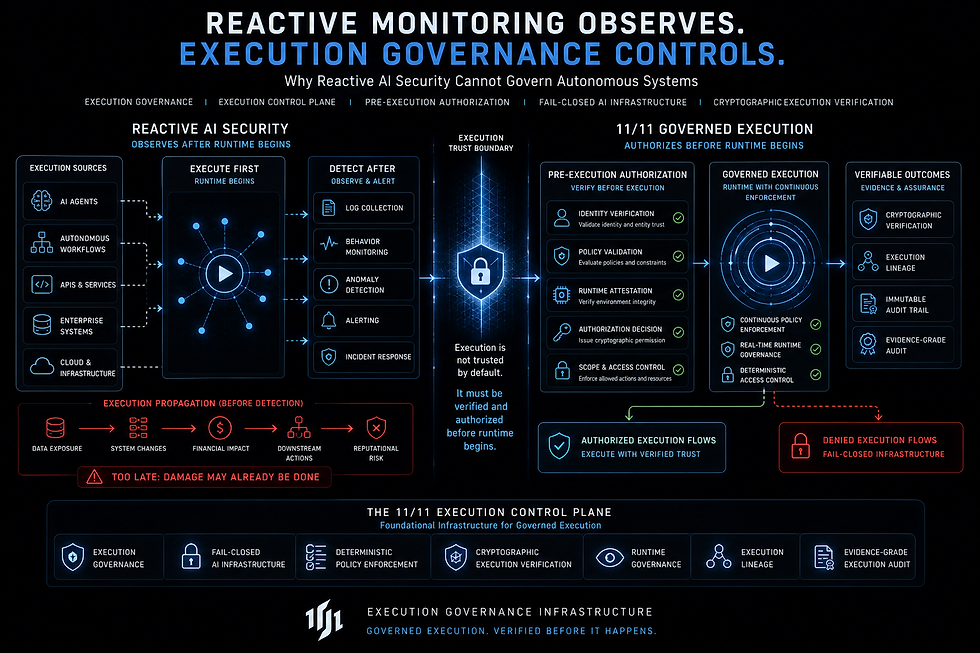
The dominant governance posture in current AI infrastructure remains fundamentally post-execution in nature. Systems execute actions first. Governance infrastructure reconstructs those actions afterward through logs, observability platforms, behavioral analytics, and incident reporting pipelines.
This architecture creates a structural governance gap.
Monitoring infrastructure records what systems have done. It does not determine what systems are permitted to do before execution occurs.
As autonomous systems expand into:
federal environments,
financial systems,
healthcare infrastructure,
defense operational workflows,
critical infrastructure orchestration,
and machine-speed execution pipelines,
the distinction between:
observing execution,
and:
governing execution
becomes operationally decisive.
Execution Governance introduces pre-execution authorization as the missing infrastructure layer for autonomous execution environments.
Under a governed execution architecture, every consequential action proposed by an autonomous system is evaluated against deterministic governance policy before execution occurs. Authorization is cryptographically bound to:
requesting identity,
policy state,
execution scope,
operational context,
and temporal validity.
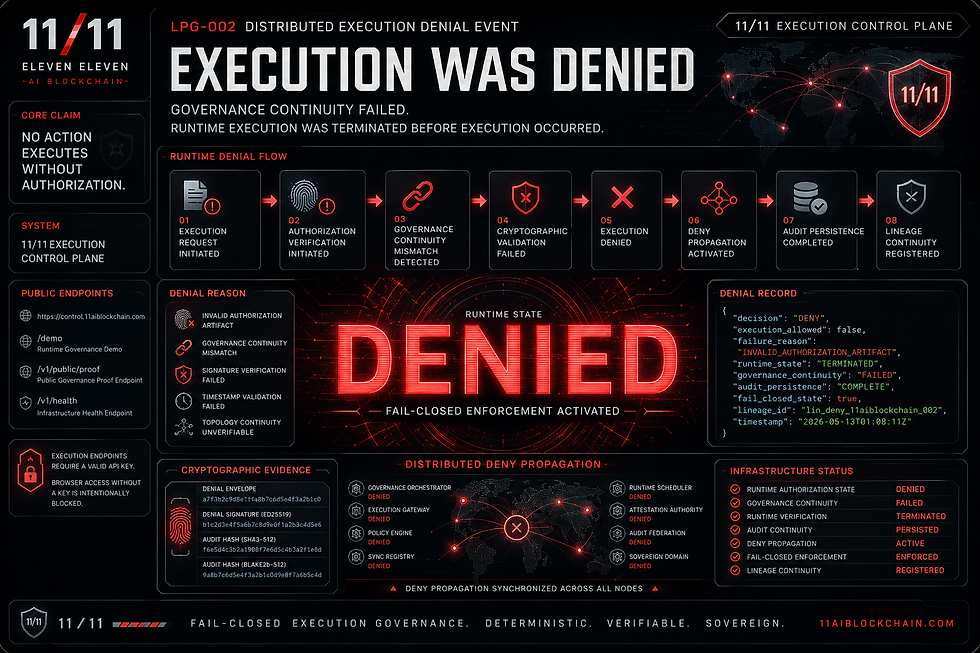
Execution without authorization is structurally denied.
This is the architectural distinction between:
fail-open AI infrastructure,
and:
fail-closed governed execution infrastructure.
Current procurement language often references:
AI accountability,
AI oversight,
explainability,
auditability,
and transparency.
Those concepts remain incomplete without runtime enforcement infrastructure capable of conditioning execution on verified authorization.
Execution Governance addresses this directly through:
pre-execution authorization,
deterministic runtime enforcement,
execution lineage,
governance attestation,
fail-closed execution posture,
and cryptographic accountability infrastructure.
The operational implications for procurement are substantial.
A procurement specification requiring:
execution lineage,
governance attestation,
authorization-bound execution,
and fail-closed runtime controls
establishes governance requirements that are technically measurable and architecturally enforceable.
This mirrors the maturation trajectory of prior infrastructure governance categories:
Zero Trust Architecture,
FedRAMP,
SBOM,
PKI,
and TLS.
In each case, governance requirements evolved from:
conceptual recommendations
into:
procurement-enforced infrastructure baselines.
Execution Governance represents the same transition for autonomous execution systems.
The emergence of Execution Governance Compatible (EGC) conformance frameworks creates the possibility of implementation-neutral procurement baselines for governed AI infrastructure.
Under such a model, procurement does not specify:
a vendor,
a product,
or a proprietary stack.
It specifies governance properties:
authorization before execution,
deterministic policy enforcement,
cryptographic execution lineage,
fail-closed execution posture,
and governance attestation capability.
This distinction is strategically important.
Infrastructure categories mature through:
standards normalization,
procurement integration,
interoperability pressure,
and conformance ecosystems.
Execution Governance is now entering that phase.
The critical question for AI procurement is no longer:
“Can we observe autonomous systems after execution?”
The critical question is:
“Can we determine what autonomous systems are permitted to execute before execution occurs?”
That is the governance boundary.
And increasingly:that boundary will define the difference between:
monitored AI systems,
and:
governed AI infrastructure.
Execution Governance™Governed Execution™Patent Pending
“No action executes without authorization.”
DOC-EG-001
RFC-EG-0100
RFC-EG-0200
RFC-EG-0010
RFC-EG-0500
RFC-EG-0510
IDX-EG-001

Comments