
Governed Execution The Operational Model for Trusted Infrastructure

Updated: May 13

Historically, execution has been trusted by default.
Applications execute.
Services run.
Processes invoke infrastructure.
AI systems trigger actions.
Only afterward do systems attempt to determine whether execution should have occurred.
This architecture creates a fundamental trust problem.
Governed execution exists to solve it.
Governed execution transforms runtime activity from:implicitly trusted execution
into:authorized, policy-governed and cryptographically verifiable execution.
Execution itself becomes governed infrastructure.
Canonical Definition
Governed execution is:
the operational enforcement model in which runtime execution is authorized, policy-bound, cryptographically verified and continuously governed before execution begins.
Governed execution ensures that every runtime action is:
authorized
identity-bound
policy-scoped
cryptographically validated
operationally enforceable
lineage-aware
permanently auditable
prior to execution authorization.
Execution is never assumed to be trusted.
Execution must first be verified.
Why Governed Execution Matters
Modern infrastructure increasingly depends on autonomous runtime systems.
This includes:
AI agents
inference systems
orchestration pipelines
machine-to-machine execution
distributed runtime environments
autonomous workflow systems
regulated execution infrastructure
These systems can:
invoke tools
trigger transactions
modify infrastructure
access sensitive data
orchestrate downstream actions
generate autonomous execution chains
Without governed execution, runtime systems inherit implicit trust assumptions.
That creates uncontrolled execution surfaces.
Governed execution introduces deterministic runtime authorization before execution begins.
The Failure of Implicit Runtime Trust
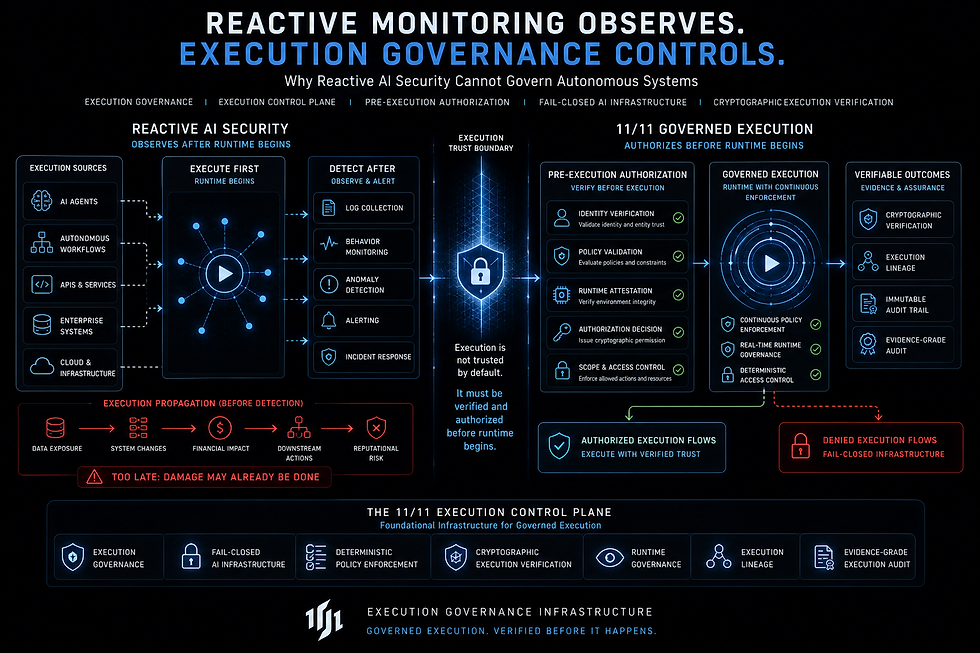
Traditional infrastructure assumes execution is valid unless proven otherwise.
This creates a reactive model:
execution occurs
telemetry is generated
monitoring detects anomalies
investigators review logs afterward
This model increasingly fails in autonomous systems.
Once execution occurs:
infrastructure may already be modified
transactions may already settle
data may already move
AI agents may already act
trust boundaries may already collapse
Reactive detection is not execution governance.
Governed execution introduces pre-runtime enforcement.
Governed Execution Changes the Trust Model
Governed execution shifts infrastructure from:
implicit runtime trust
to:
explicit execution authorization
from:
reactive monitoring
to:
deterministic enforcement
from:
post-event logging
to:
pre-execution governance
from:
advisory controls
to:
fail-closed execution policy
Execution becomes policy-governed infrastructure.
Core Principles of Governed Execution
1. Execution Requires Authorization
No execution proceeds without validation.
Execution requests must satisfy governance requirements before runtime activity begins.
Authorization becomes mandatory infrastructure logic.
2. Execution Must Be Policy-Bound
Execution is constrained by governance policy.
Policies may govern:
identity
workload type
execution scope
runtime environment
geographic restrictions
authorization duration
infrastructure permissions
operational conditions
Execution only proceeds within permitted policy boundaries.
3. Execution Must Be Cryptographically Verifiable
Governed execution requires independently verifiable authorization proof.
Authorization artifacts may include:
signed runtime permissions
execution attestations
cryptographic authorization chains
execution lineage references
identity-bound verification tokens
policy-bound authorization scopes
Execution becomes cryptographically governable.
4. Execution Must Fail Closed
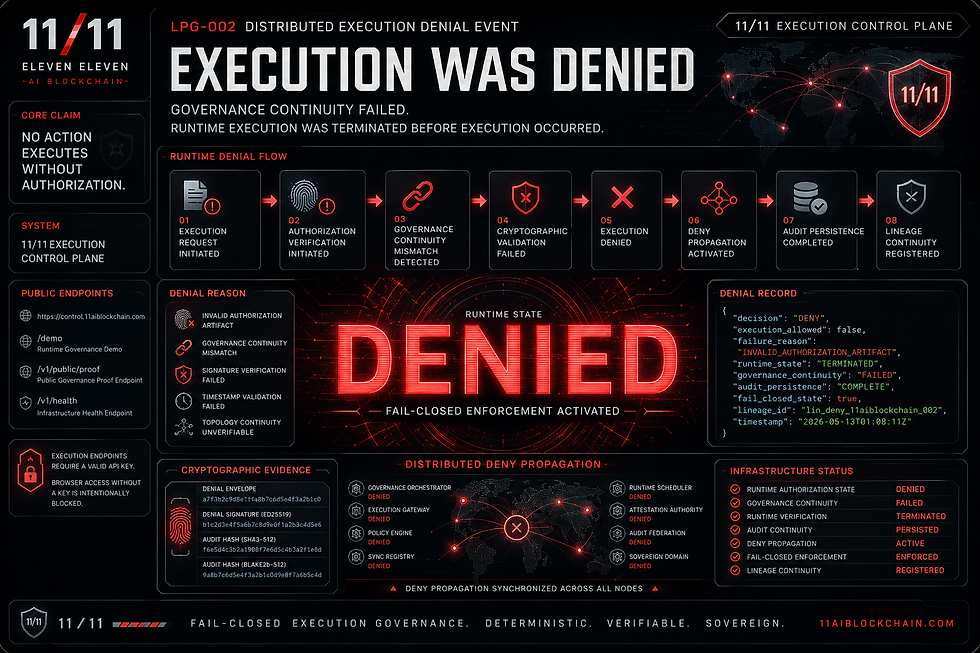
If authorization cannot be verified:
execution cannot proceed.
Governed execution rejects:
silent execution bypass
unverifiable runtime activity
implicit trust assumptions
advisory-only policy systems
Authorization failure results in execution denial.
Governed Execution Lifecycle
Governed execution commonly follows a deterministic runtime lifecycle.
Step 1 — Execution Intent Submitted
A runtime action is requested.
Step 2 — Policy Evaluation Occurs
Governance policy validates whether execution is permitted.
Step 3 — Authorization Artifact Issued
A cryptographically verifiable authorization artifact is generated.
Step 4 — Runtime Verification Occurs
Execution systems validate authorization integrity.
Step 5 — Execution Is Authorized or Denied
Execution either:
proceeds
or:
fails closed
Step 6 — Audit and Lineage Persist
Execution evidence becomes permanently auditable.
This creates governed execution continuity.
Governed Execution and AI Systems
AI infrastructure dramatically increases execution complexity.
AI systems increasingly:
invoke tools autonomously
execute chained workflows
trigger infrastructure changes
orchestrate transactions
coordinate downstream systems
Without governed execution:
AI infrastructure operates using implicit runtime trust.
This creates non-deterministic execution risk.
Governed execution introduces enforceable runtime trust boundaries into AI systems.
This allows AI execution to become:
governable
verifiable
enforceable
cryptographically auditable
before runtime execution occurs.
Governed Execution Infrastructure
Governed execution typically depends on:
identity systems
authorization services
governance policy engines
runtime enforcement systems
cryptographic verification layers
audit persistence systems
execution lineage systems
governance control planes
Together, these systems form governed execution infrastructure.
The purpose is simple:
verify whether execution is allowed before execution begins.
Execution Trust Boundaries
Governed execution introduces explicit runtime trust boundaries.
Trust is no longer assumed because:
a request exists
a system is authenticated
an AI generated an action
a process initiated runtime activity
Trust becomes conditional upon:
authorization
policy validation
runtime verification
governance enforcement
cryptographic integrity
Execution becomes governed trust infrastructure.
Governed Execution as Foundational Infrastructure
Governed execution is not merely a security feature.
It increasingly becomes:
a runtime governance model
an operational trust framework
an authorization enforcement architecture
a cryptographic execution verification system
a foundational AI infrastructure layer
Governed execution changes how runtime trust is established.
The Future of Trusted Runtime Systems
As autonomous systems scale, execution can no longer remain implicitly trusted.
Runtime authorization becomes mandatory.
Execution governance evolves infrastructure toward:
deterministic runtime control
fail-closed authorization
governed execution enforcement
cryptographic runtime proof
execution lineage verification
operational trust continuity
Execution itself becomes governed infrastructure.
11/11 Governed Execution Infrastructure
11/11 is developing governed execution infrastructure designed to verify what systems are allowed to execute before runtime execution begins.
The architecture focuses on:
execution governance
fail-closed runtime enforcement
authorization artifact validation
execution lineage
cryptographic operational proof
governed AI infrastructure
Execution can no longer operate as implicitly trusted infrastructure.
Execution must first be authorized.
Operational Proof Surfaces
Public Governance Console
Runtime Governance Demo
Public Governance Proof Viewer
Infrastructure Health Dashboard
Execution Lineage Explorer

Comments