
Computational Constitutions


Every sufficiently advanced computational system eventually encounters the same question.
What rules govern the rules?
Policies may govern behavior.
Permissions may govern access.
Authorities may govern decisions.
Jurisdictions may govern scope.
Yet something must ultimately govern the governors.
This requirement introduces one of the most important concepts within advanced computational theory:
The Constitution.
Historically, constitutions emerged because institutions required durable foundations.
Temporary rules proved insufficient.
Individual decisions proved insufficient.
Individual leaders proved insufficient.
A higher-order framework became necessary.
Computational systems increasingly face the same challenge.
As infrastructures grow larger, more autonomous, and more persistent, operational behavior can no longer depend solely upon isolated policies or individual state decisions.
The system requires foundational principles.
It requires constitutional structures.
Computational Constitutionalism begins with this observation.
Governance itself must be governed.
The Problem Above Governance
Most governance frameworks focus on operational control.
Who may act.
What may occur.
Which transitions are permitted.
Which states may persist.
These questions are important.
Yet they are secondary.
Before governance can operate, the system must answer a more fundamental question:
What principles govern governance itself?
Without this layer, governance becomes vulnerable to arbitrary modification.
The rules become unstable.
The environment becomes unpredictable.
A constitution solves this problem by establishing foundational constraints above ordinary governance mechanisms.
Constitutions Define Reality
A computational constitution does not operate like a normal policy.
Policies exist within the constitutional framework.
The constitution defines the framework itself.
It establishes:
Foundational principles
Structural boundaries
Governance limitations
Authority relationships
State legitimacy requirements
Jurisdictional structures
The constitution therefore shapes computational reality before operational behavior ever begins.
It is not merely another rule.
It is the source from which all lower rules derive meaning.
Constitutional Layers
Most mature systems naturally develop constitutional layers.
Foundational Layer
↓
Governance Layer
↓
Policy Layer
↓
Operational Layer
↓
Execution Layer
Each layer derives legitimacy from the layer above.
The result is architectural coherence.
Without this hierarchy, systems struggle to explain why certain rules exist and why certain decisions possess authority.
Constitutional structure creates consistency across time.
Constitutional Stability
One purpose of a constitution is stability.
Operational policies may change frequently.
Procedures may evolve.
Technologies may evolve.
Infrastructure may evolve.
The constitution provides continuity while lower layers adapt.
This stability enables long-term system evolution without requiring complete reinvention.
The environment changes.
The foundation remains.
Constitutional Constraints
Constitutions are often misunderstood as enabling mechanisms.
Their most important function may actually be limitation.
A constitution defines what governance cannot do.
It establishes prohibited actions.
Prohibited transitions.
Prohibited authorities.
Prohibited structures.
This limitation prevents governance from undermining its own foundation.
The constitution therefore protects the integrity of the system from both external and internal disruption.
Constitutional Persistence
Constitutions are designed to persist longer than ordinary rules.
They represent accumulated institutional memory.
Foundational assumptions.
Core principles.
Long-term objectives.
Because constitutions persist, they become anchors for computational continuity.
Entire generations of operational behavior may emerge and disappear while constitutional structures remain intact.
Constitutional Failure
Not every constitutional framework succeeds.
Some become obsolete.
Some become contradictory.
Some become incapable of supporting changing realities.
When constitutional structures fail, operational instability follows.
Policies begin conflicting.
Authorities begin overlapping.
Jurisdictions become ambiguous.
The result is constitutional degradation.
This phenomenon suggests that constitutions themselves require governance.
Even foundations require maintenance.
Constitutional Computation
Future computational systems may increasingly operate according to constitutional principles.
Autonomous agents.
Institutional infrastructures.
Digital governance environments.
Persistent computational ecosystems.
Each will require mechanisms capable of defining foundational operational reality.
Constitutions provide that mechanism.
The future of large-scale computational systems may depend as much upon constitutional design as upon software design.
Beyond State Theory
Computational State Theory explains how computational realities emerge.
Computational Constitutionalism explains how those realities become ordered.
The transition between these theories represents a major shift.
The discussion is no longer about individual states.
The discussion becomes the architecture above states.
The framework that governs entire realities.
Conclusion
States require governance.
Governance requires foundations.
Foundations require constitutions.
Computational Constitutions provide the highest layer of computational organization, defining the principles through which governance, authority, jurisdiction, and execution acquire meaning.
As computational environments continue expanding in complexity and autonomy, constitutional structures may become among the most important components of future infrastructure.
The future will belong not merely to governed systems.
It will belong to constitutionally governed systems.
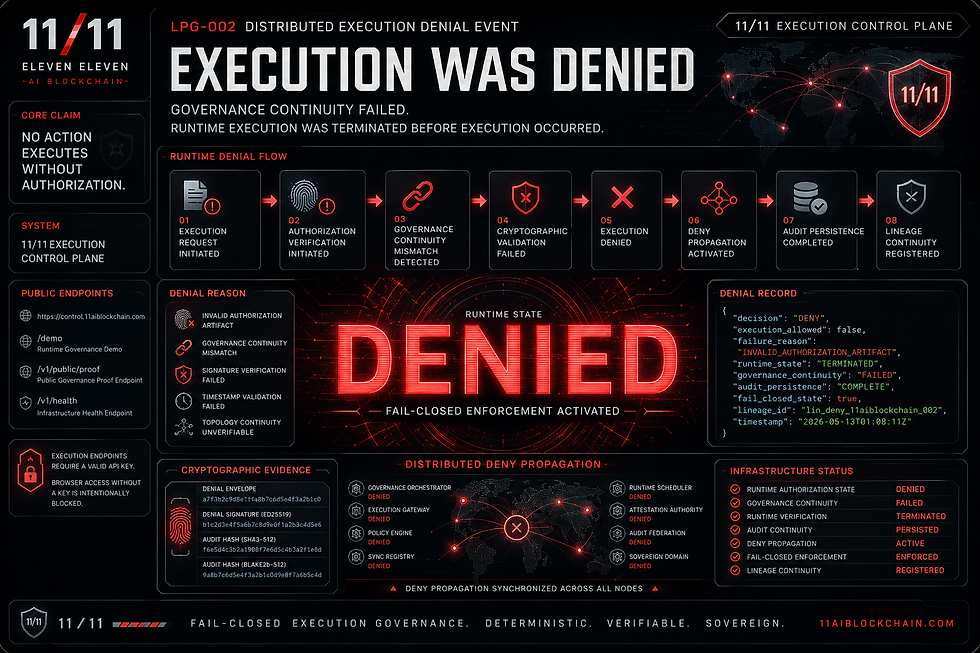
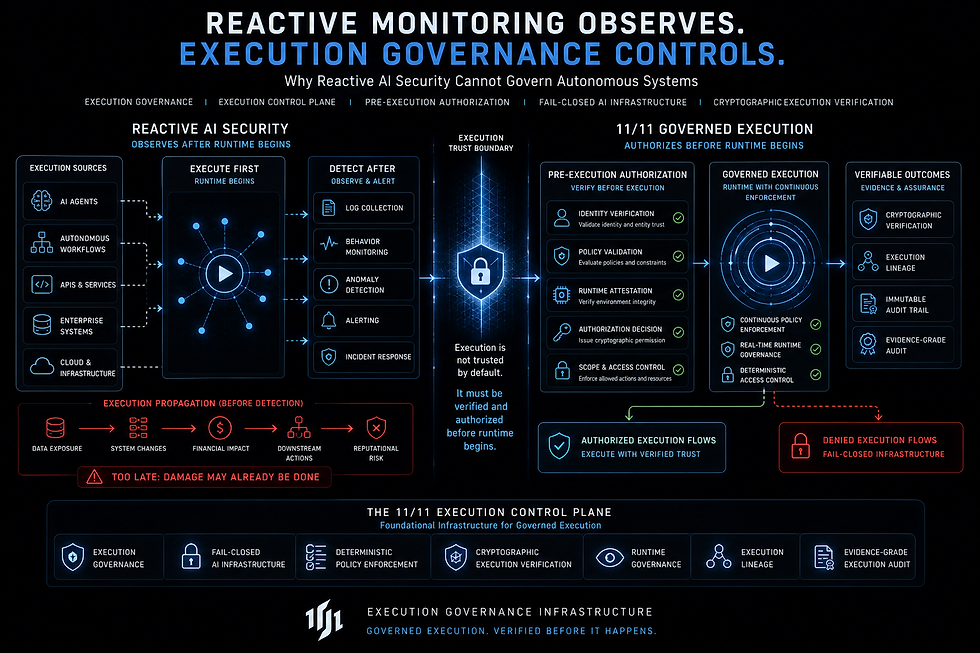
11/11 introduces Execution Governance™ infrastructure for governed autonomous execution and deterministic operational control.
Execution Governance™ Governed Execution™ EA-11™ Execution Arithmetic™
Patent Pending
Public Infrastructure Endpoints

Comments