
Constitutional Authority


One of the most persistent questions throughout human history is deceptively simple:
Where does authority come from?
Governments claim authority.
Institutions claim authority.
Organizations claim authority.
Laws claim authority.
Yet beneath every claim lies a deeper question.
What makes authority legitimate?
Power alone cannot answer this question.
A machine may possess power.
An institution may possess power.
A government may possess power.
Power explains capability.
Power does not explain authority.
Authority emerges when power is accepted as operating within a recognized constitutional framework.
This distinction introduces one of the foundational concepts of Computational Constitutionalism:
Constitutional Authority.
The future of computational civilization may depend less upon the amount of power computational systems possess and more upon the constitutional foundations from which that power derives.
Power And Authority Are Not The Same
History repeatedly demonstrates that power and authority are different phenomena.
Power can compel behavior.
Authority can justify behavior.
Power can force compliance.
Authority can establish legitimacy.
Power may exist temporarily.
Authority seeks permanence.
The distinction is critical because constitutional systems are not designed to maximize power.
They are designed to organize authority.
The goal is not simply to create capability.
The goal is to create recognized legitimacy.
Authority Requires A Source
Every authority ultimately depends upon a source.
An executive derives authority from a constitution.
A court derives authority from a constitution.
A legislature derives authority from a constitution.
The authority is not self-generated.
It is inherited from a higher framework.
Computational systems increasingly face the same requirement.
Permissions must derive from principles.
Policies must derive from principles.
Governance must derive from principles.
Without a recognized source, authority becomes indistinguishable from assertion.
Constitutional Supremacy
A constitution occupies a unique position because it exists above ordinary authority.
It defines:
Who may govern
How governance operates
Where authority applies
What authority cannot do
This relationship creates constitutional supremacy.
Authority derives downward.
Legitimacy derives downward.
Recognition derives downward.
The constitution becomes the origin point from which all operational authority emerges.
Authority And Continuity
Constitutional authority provides continuity across time.
Individuals change.
Leaders change.
Technologies change.
Institutions change.
The constitutional framework remains.
This permanence allows authority to survive beyond the individuals temporarily exercising it.
The result is institutional stability.
Authority becomes attached to principles rather than personalities.
Authority And Limitation
One of the most misunderstood aspects of constitutional authority is that it depends upon limitation.
An authority without limits is not strengthened.
It is weakened.
Unlimited authority possesses no framework for legitimacy.
Constitutional authority derives strength from the existence of boundaries.
The boundary demonstrates that authority operates according to principle rather than impulse.
Limitation creates legitimacy.
Computational Authority
Future computational environments will increasingly exercise forms of authority.
Execution environments will determine outcomes.
Autonomous infrastructures will manage resources.
Digital institutions will govern interactions.
The critical question will not be whether these systems possess capability.
The critical question will be whether their authority derives from constitutional foundations.
The future challenge is therefore constitutional before it is technical.
Constitutional Recognition
Authority exists only when recognized.
Recognition transforms power into legitimacy.
Recognition transforms capability into governance.
Recognition transforms operation into institution.
Constitutions create the conditions through which recognition becomes possible.
This function may become one of the defining characteristics of future computational systems.
Authority And Civilization
Civilizations persist because authority becomes institutionalized.
The same principle may eventually apply to computational civilizations.
As computational environments become increasingly autonomous, constitutional authority may become the mechanism through which order survives across generations of technological change.
The system evolves.
The authority remains recognizable.
The constitution provides continuity.
Beyond Governance
Computational Constitutionalism extends beyond governance.
Governance explains operation.
Authority explains legitimacy.
A system may operate successfully while lacking constitutional authority.
A civilization cannot.
The distinction becomes increasingly important as computational systems acquire greater influence over social, economic, and institutional environments.
Conclusion
Power explains what can be done.
Authority explains what may be done.
Constitutional authority emerges when power derives from recognized foundational principles that exist above individual actors and temporary conditions.
As computational systems continue evolving, constitutional authority may become one of the defining requirements for durable computational civilization.
The future belongs not merely to powerful systems.
The future belongs to constitutionally authorized systems.
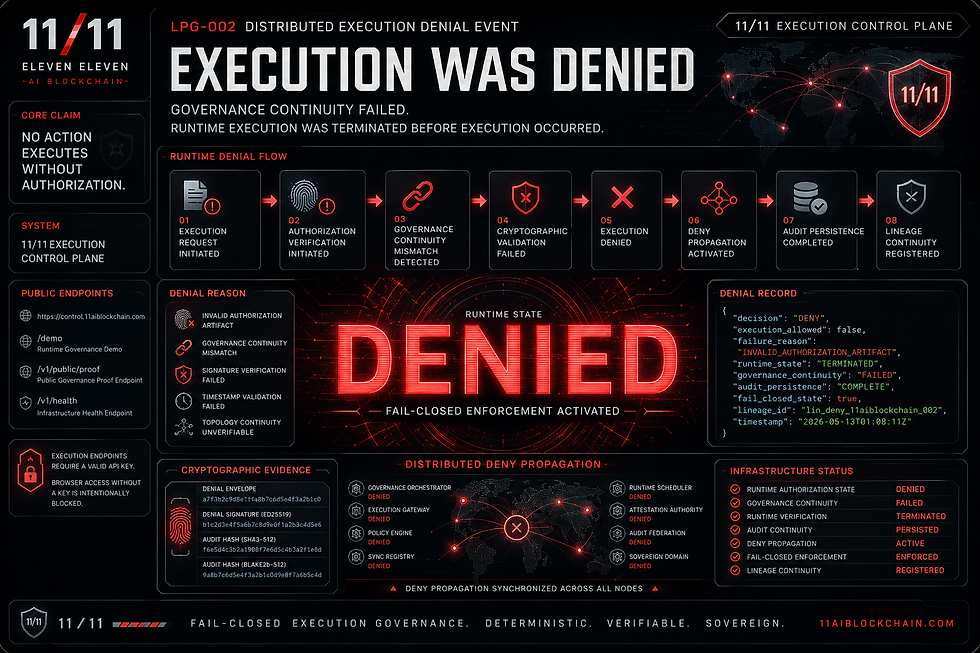
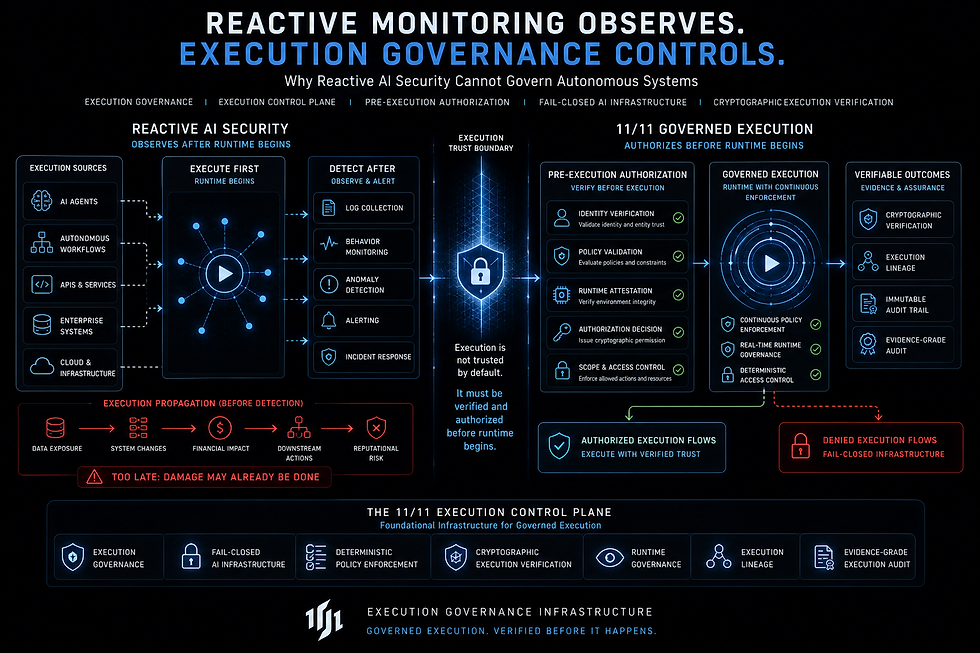
11/11 introduces Execution Governance™ infrastructure for governed autonomous execution and deterministic operational control.
Execution Governance™ Governed Execution™ EA-11™ Execution Arithmetic™
Patent Pending
Public Infrastructure Endpoints

Comments