
Constitutional Enforcement


Every constitution eventually encounters the same challenge.
A principle may be written.
A limitation may be declared.
A boundary may be established.
Yet a question remains.
What happens when the boundary is crossed?
This question separates constitutional aspiration from constitutional reality.
A constitution that cannot preserve itself eventually ceases to function as a constitution.
It becomes a historical artifact.
A symbolic document.
A statement of intention disconnected from operational reality.
For this reason, every enduring constitutional system eventually develops mechanisms of enforcement.
Not because constitutions seek power.
But because constitutions seek permanence.
Constitutional Enforcement is the study of how foundational principles remain operative despite changing actors, changing institutions, and changing conditions.
Principles Alone Are Insufficient
Many constitutional theories begin with principles.
Liberty.
Order.
Limitation.
Responsibility.
Jurisdiction.
These principles provide direction.
Yet direction alone does not create endurance.
A principle survives only when a system possesses the ability to preserve it.
This observation introduces a difficult truth.
A constitution must be capable of defending itself.
Otherwise the constitution depends entirely upon voluntary compliance.
History demonstrates that voluntary compliance alone rarely sustains institutions indefinitely.
Enforcement Preserves Foundations
The purpose of constitutional enforcement is often misunderstood.
It is not primarily punitive.
It is preservational.
The objective is not punishment.
The objective is continuity.
Constitutional enforcement exists to ensure that foundational principles remain operative despite pressure, change, and conflict.
The constitution survives because the mechanisms supporting it survive.
The enforcement mechanism becomes a guardian of continuity.
The Paradox Of Constitutional Power
Constitutions frequently limit power.
Yet constitutions require power to preserve those limitations.
This creates a paradox.
How does a system limit power without becoming powerless?
The answer lies in constitutional structure.
Enforcement power derives from constitutional principles rather than individual discretion.
The enforcement mechanism protects the boundary.
It does not replace the boundary.
This distinction preserves legitimacy while maintaining effectiveness.
Constitutional Durability
Enduring constitutions possess durability because they establish mechanisms capable of surviving beyond individual participants.
Leaders leave.
Institutions evolve.
Technologies change.
The constitution remains.
Durability emerges when enforcement is attached to principle rather than personality.
A constitutional system becomes resilient because preservation no longer depends upon a single actor.
The structure itself sustains continuity.
Enforcement And Self-Preservation
Every durable system develops methods of self-preservation.
Biological systems do.
Institutional systems do.
Civilizations do.
Constitutional systems are no different.
The purpose of constitutional enforcement is ultimately self-preservation.
Not preservation of authority.
Preservation of foundational order.
The distinction is critical.
Authority may change.
The constitutional framework must endure.
Computational Constitutional Enforcement
Future computational environments will increasingly face constitutional challenges.
Autonomous infrastructures.
Persistent execution environments.
Digital institutions.
Governed computational ecosystems.
Each will require mechanisms capable of preserving foundational principles despite continuous operational change.
This requirement transforms enforcement from a legal concept into a computational concept.
The future of constitutional computation may depend upon architectures capable of preserving constitutional order automatically.
Enforcement And Legitimacy
Enforcement without legitimacy becomes coercion.
Legitimacy without enforcement becomes aspiration.
Constitutional systems require both.
Legitimacy provides recognition.
Enforcement provides continuity.
Together they create durable order.
Separated, both eventually fail.
This balance may become one of the defining characteristics of future constitutional infrastructures.
Constitutional Decay
Many constitutions do not fail through direct overthrow.
They decay.
Boundaries weaken.
Exceptions accumulate.
Principles become optional.
Interpretations expand indefinitely.
Eventually the constitution remains visible while its practical influence disappears.
Constitutional enforcement exists primarily to prevent this form of gradual erosion.
The greatest constitutional threat is often not opposition.
It is neglect.
The Future Of Constitutional Systems
As computational civilization expands, constitutional enforcement becomes increasingly important.
The challenge will not be creating principles.
The challenge will be preserving principles across generations of technological evolution.
Future systems may be judged not by how much power they possess.
They may be judged by how effectively they preserve constitutional order despite possessing power.
Conclusion
A constitution survives only when its principles remain operative.
Constitutional Enforcement provides the mechanisms through which foundational order endures across time, change, and conflict.
Without enforcement, constitutions become symbolic.
Without legitimacy, enforcement becomes coercive.
Durable constitutional systems require both.
The future of constitutional computation may ultimately depend upon preserving this balance.
A constitution that cannot preserve itself cannot preserve anything else.
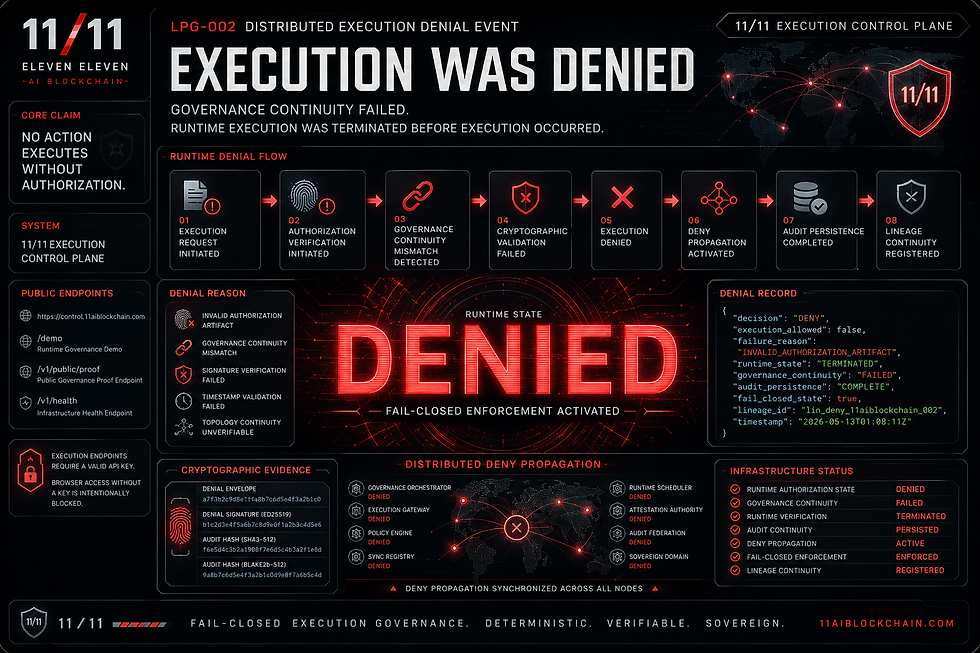
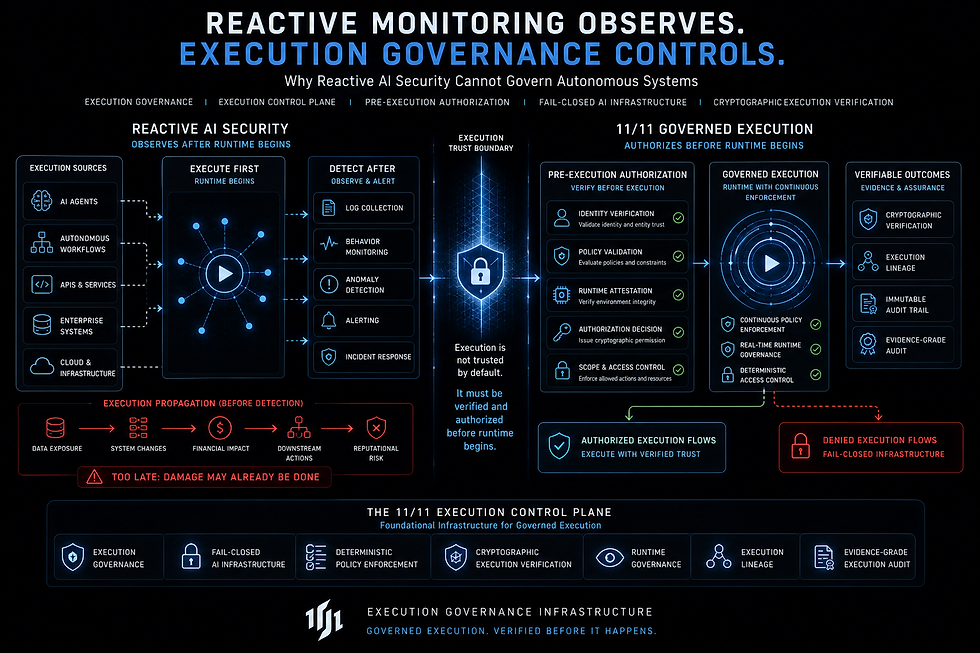
11/11 introduces Execution Governance™ infrastructure for governed autonomous execution and deterministic operational control.
Execution Governance™ Governed Execution™ EA-11™ Execution Arithmetic™
Patent Pending
Public Infrastructure Endpoints

Comments