
Cryptographic Governance Infrastructure and the Future of Autonomous Assurance


Autonomous infrastructure is rapidly increasing the operational importance of cryptographic governance assurance.
Traditional infrastructure security models primarily relied upon:
- perimeter-based trust
- centralized oversight systems
- static authorization assumptions
- fragmented runtime controls
- post-event operational auditing
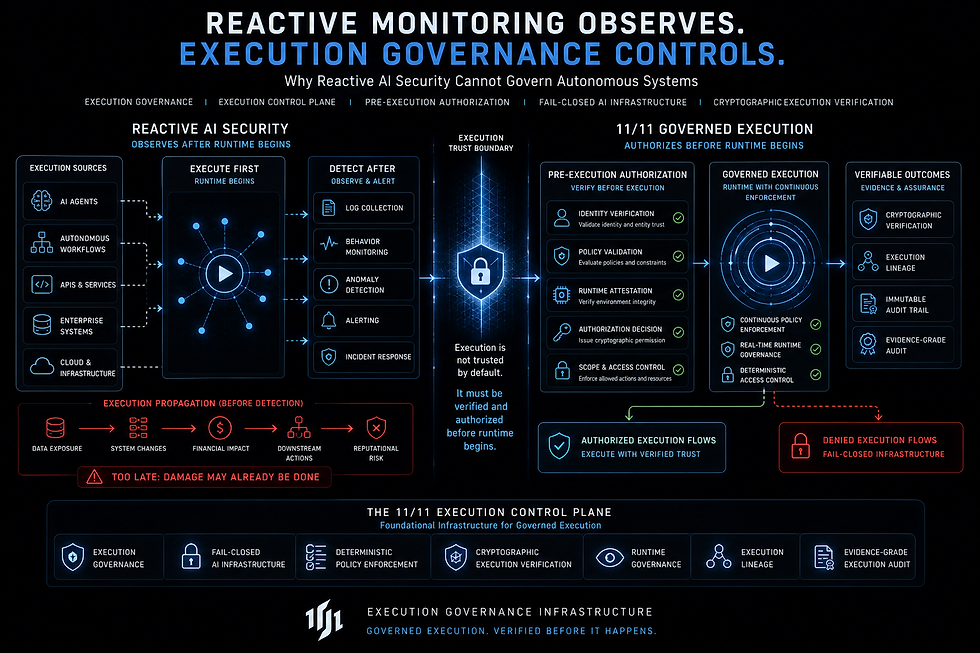
These approaches become increasingly insufficient within machine-speed autonomous environments.
As infrastructure systems increasingly coordinate:
- distributed runtime orchestration
- autonomous execution pathways
- cross-domain operational workflows
- sovereign infrastructure actions
- policy-bound automation
- machine-speed governance decisions
Governance assurance must become cryptographically verifiable.
Execution Governance™ introduces cryptographic governance infrastructure where:
- runtime authorization remains continuously validated
- governance controls remain cryptographically enforceable
- execution lineage continuity persists across operational flows
- governance attestation remains externally verifiable
- trust boundaries remain cryptographically enforced
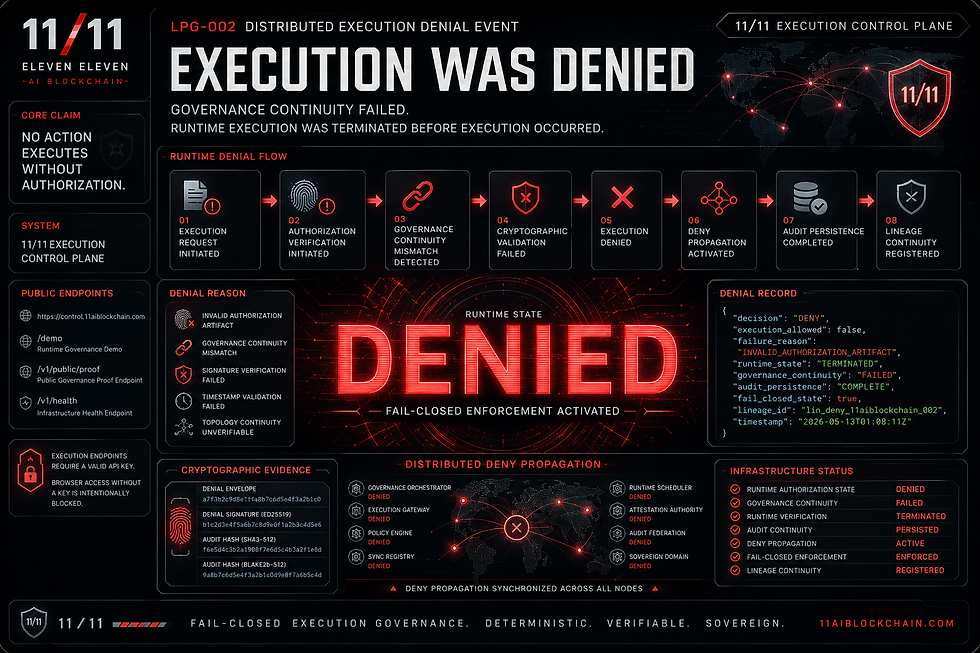
- unauthorized execution paths fail closed automatically
This establishes a fundamentally different operational governance architecture.
Traditional systems often assume:
operational trust is administratively maintained.
Governed execution requires:
cryptographically verifiable runtime governance integrity.
This distinction becomes operationally critical across:
- defense operational systems
- sovereign cloud infrastructure
- industrial automation environments
- healthcare orchestration systems
- financial runtime ecosystems
- critical infrastructure operations
Execution Governance Compatible (EGC) infrastructure operationalizes this through deterministic cryptographic governance semantics.
Cryptographic governance infrastructure enables:
- continuous runtime assurance
- deterministic operational trust
- authorization-bound execution
- cryptographic runtime integrity
- interoperable governance verification
- execution accountability
- procurement-grade operational validation
Importantly, cryptographic governance infrastructure remains implementation-neutral.
Different systems may implement differing:
- runtime architectures
- orchestration frameworks
- governance engines
- infrastructure fabrics
- authorization systems
While still supporting interoperable execution governance semantics.
Future procurement and regulatory frameworks will increasingly prioritize infrastructure capable of:
- preserving cryptographic governance integrity
- validating authorization continuity
- maintaining execution lineage continuity
- generating interoperable governance evidence
- enforcing deterministic runtime controls
- supporting fail-closed operational semantics
- terminating unauthorized execution automatically
Execution Governance™ therefore represents the evolution from administratively trusted infrastructure toward cryptographically governed autonomous execution systems.
Cryptographic governance infrastructure is becoming a foundational operational requirement for sovereign autonomous systems.
The organizations establishing cryptographic governance infrastructure today may ultimately define the next operational baseline for autonomous systems governance.
RFC-EG Reinforcement:
RFC-EG-011, RFC-EG-017, RFC-EG-021, RFC-EG-031, RFC-EG-036
Ecosystem Expansion:
Cryptographic Governance Layer
Runtime Assurance Layer
Execution Trust Layer
Deterministic Enforcement Layer
EGC Conformance Ecosystem
11/11 introduces Execution Governance™ infrastructure for governed autonomous execution and deterministic operational trust.
Execution Governance™
Governed Execution™
Patent Pending

Comments