
Why AI Infrastructure Requires Deterministic Policy Enforcement

Updated: May 13
Modern AI systems increasingly operate inside environments where execution outcomes carry operational, financial, regulatory, and infrastructure consequences.
Autonomous systems now initiate workflows, coordinate machine-driven actions, interact with external APIs, trigger infrastructure changes, and continuously adapt during runtime execution.
But most AI infrastructure still relies on probabilistic governance models.
Policies may exist.
Monitoring may exist.
Detection systems may exist.
Yet runtime enforcement frequently remains inconsistent, reactive, or observational.
This creates a major infrastructure problem.
Because execution trust cannot depend on approximate enforcement.
As AI systems gain operational authority, infrastructure increasingly requires deterministic policy enforcement.
Not advisory enforcement.
Not best-effort enforcement.
Deterministic enforcement.

The Problem With Non-Deterministic Governance
Most current AI security models focus heavily on visibility rather than enforcement consistency.
Systems monitor behavior.
Detect anomalies.
Generate alerts.
Flag suspicious activity.
But detection alone does not guarantee runtime control.
Execution may still proceed despite uncertainty.
Policies may apply inconsistently across environments.
Authorization may vary between services.
Runtime conditions may drift dynamically after execution begins.
This creates fragmented execution trust boundaries.
In autonomous systems, fragmented governance becomes increasingly dangerous.
Because machine-driven execution compounds rapidly across infrastructure layers.
A single inconsistent policy decision may propagate through:
downstream workflows
infrastructure orchestration
external API chains
machine-generated execution paths
financial systems
operational infrastructure
distributed runtime environments
At scale, inconsistent governance creates systemic instability.
Why AI Infrastructure Requires Deterministic Enforcement
Trusted infrastructure historically evolves toward deterministic operational control.
Not probabilistic control.
Aviation systems do not rely on optional policy enforcement.
Industrial safety systems do not operate under advisory-only runtime constraints.
Critical infrastructure requires predictable operational enforcement under all runtime conditions.
AI infrastructure is now entering the same architectural transition.
As autonomous systems gain execution authority, organizations increasingly require:
predictable runtime behavior
consistent authorization enforcement
immutable governance traceability
verifiable policy integrity
continuously enforceable runtime constraints
This changes the infrastructure requirement fundamentally.
Policies can no longer exist merely as compliance documentation.
Policies must become executable infrastructure controls.
That transition defines deterministic policy enforcement.
What Deterministic Policy Enforcement Actually Means
Deterministic policy enforcement means runtime behavior remains consistently governed under defined authorization conditions.
Execution outcomes become bounded by enforceable infrastructure constraints.
Under deterministic enforcement architectures:
execution policies are validated before runtime
authorization decisions remain cryptographically bound
runtime conditions are continuously verified
infrastructure drift triggers enforcement actions
unauthorized execution paths are denied automatically
runtime deviations trigger fail-closed containment
Execution becomes operationally constrained by governance infrastructure itself.
Not merely influenced by governance recommendations.
This creates enforceable runtime trust boundaries around execution activity.
The Execution Control Plane as an Enforcement Layer
The execution control plane becomes the infrastructure layer responsible for deterministic governance enforcement.
Its role extends beyond monitoring.
It governs execution authorization continuously throughout runtime activity.
The execution control plane determines:
whether execution is authorized
which policies apply
what runtime conditions are trusted
what operational constraints remain enforced
what downstream systems may be accessed
what execution lineage must persist
whether runtime integrity remains continuously valid
This creates a continuously governed execution environment.
An operational enforcement architecture.
Not merely a visibility layer.
Why Reactive Runtime Controls Fail
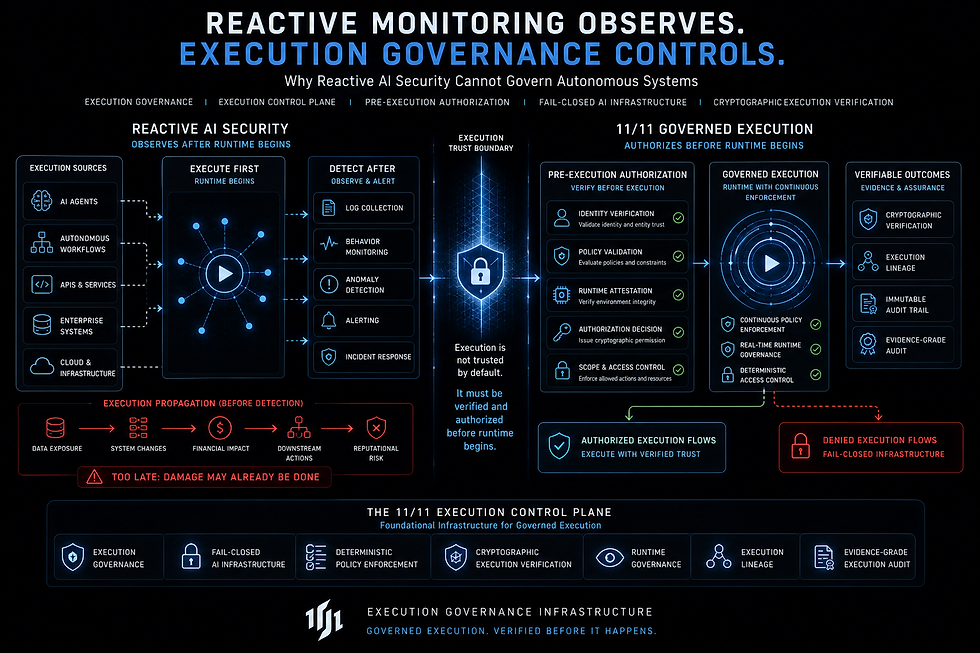
Reactive controls inherently operate after execution propagation begins.
That creates unavoidable governance delay.
In autonomous systems, runtime propagation may occur faster than human intervention capacity.
By the time reactive systems detect violations:
execution chains may already expand
infrastructure states may already change
external systems may already execute downstream actions
operational impact may already propagate
trust boundaries may already be compromised
Reactive enforcement therefore becomes structurally insufficient for governed execution environments.
Deterministic policy enforcement solves this by shifting governance directly into the execution path itself.
Execution becomes governed before runtime propagation occurs.
Not afterward.
Why Fail-Closed Infrastructure Depends on Deterministic Enforcement
Fail-closed AI infrastructure fundamentally depends on deterministic runtime governance.
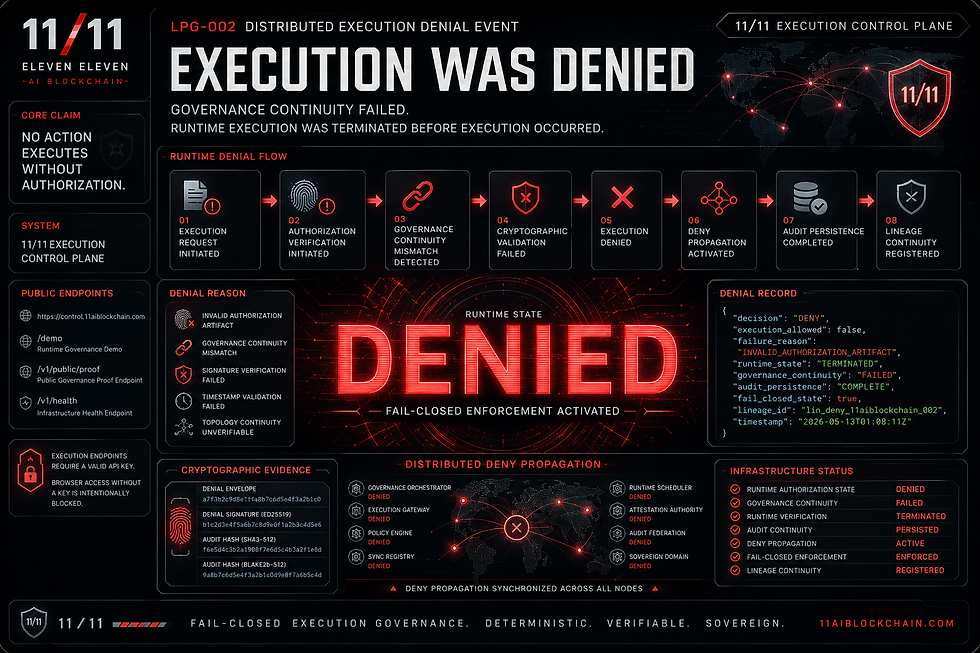
Because fail-closed systems deny execution when authorization integrity cannot be verified continuously.
Under fail-closed enforcement architectures:
invalid runtime conditions halt execution
broken attestation chains deny continuation
unauthorized policy drift triggers containment
unverifiable execution paths terminate automatically
governance system failures default toward denial
Execution is not trusted implicitly.
It remains continuously governed.
This creates operational predictability under uncertain runtime conditions.
A requirement increasingly necessary for autonomous infrastructure environments.
Why Cryptographic Verification Strengthens Enforcement Integrity
Deterministic policy enforcement ultimately requires independently verifiable runtime integrity.
This is why cryptographic execution verification becomes foundational.
Under governed execution architectures:
policy decisions are cryptographically signed
authorization integrity becomes independently provable
runtime attestations become verifiable
execution lineage becomes tamper-evident
immutable execution audit becomes enforceable
runtime governance remains continuously auditable
This transforms enforcement trust from procedural trust into cryptographic trust.
The distinction becomes increasingly important as AI infrastructure expands into regulated and operationally sensitive environments.
Particularly across:
financial systems
healthcare infrastructure
industrial automation
autonomous operational systems
government infrastructure
enterprise runtime environments
Execution governance increasingly becomes the infrastructure trust layer beneath runtime execution itself.
Why Deterministic Governance Defines the Next Infrastructure Standard
Infrastructure markets historically mature around operational predictability.
Cloud computing matured around deterministic orchestration systems.
Enterprise systems matured around enforceable identity governance.
Distributed systems matured around verifiable integrity enforcement.
AI infrastructure is now entering the deterministic governance phase.
This phase increasingly requires:
execution governance
governed execution
deterministic policy enforcement
execution control planes
runtime governance
pre-execution authorization
fail-closed AI infrastructure
execution lineage
immutable execution audit
cryptographic execution verification
These systems increasingly become foundational infrastructure requirements for trusted autonomous environments.
Because infrastructure that cannot enforce policy deterministically ultimately cannot guarantee runtime trust reliably.
11/11 and Deterministic Runtime Governance
11/11 is not positioned as a generic AI company.
11/11 is building execution governance infrastructure for autonomous systems and governed AI environments.
The objective is to establish deterministic runtime trust beneath execution itself.
11/11 introduces infrastructure centered around:
execution governance
governed execution
deterministic policy enforcement
runtime governance
execution control planes
pre-execution authorization
fail-closed AI infrastructure
immutable execution audit
execution lineage
cryptographic execution verification
As AI systems increasingly operate inside high-consequence infrastructure environments, deterministic policy enforcement becomes unavoidable.
Because trusted execution ultimately requires governance systems capable of enforcing runtime integrity continuously, predictably, and verifiably.
That transition defines the rise of execution governance infrastructure.\
Execution Governance™, Governed Execution™, and related execution control plane terminology are used by 11/11 to describe emerging infrastructure models centered on pre-execution authorization, deterministic policy enforcement, and cryptographic runtime verification for AI systems and autonomous infrastructure.
Patent Pending. Certain systems, architectures, infrastructure models, execution governance methods, and runtime authorization mechanisms described herein are subject to ongoing U.S. and international patent filings and related intellectual property protections by 11/11.
Public Infrastructure Endpoints
Public Runtime Infrastructure
Public Governance Console
Runtime Governance Demo
Public Governance Proof Viewer
Infrastructure Health Dashboard
Execution Lineage Explorer
Execution endpoints intentionally require valid API authorization.
Browser access without a valid authorization key is fail-closed by design.

Comments