
EG-018 Governed Execution Mesh Architecture

Updated: May 13

Modern infrastructure increasingly operates as distributed systems.
Cloud systems are distributed.
Identity systems are distributed.
Financial systems are distributed.
AI execution infrastructure is becoming:massively distributed.
Autonomous systems increasingly coordinate across:
multi-agent environments
distributed inference systems
sovereign infrastructure
enterprise execution layers
financial orchestration systems
edge execution environments
autonomous runtime ecosystems
Execution governance must scale with this reality.
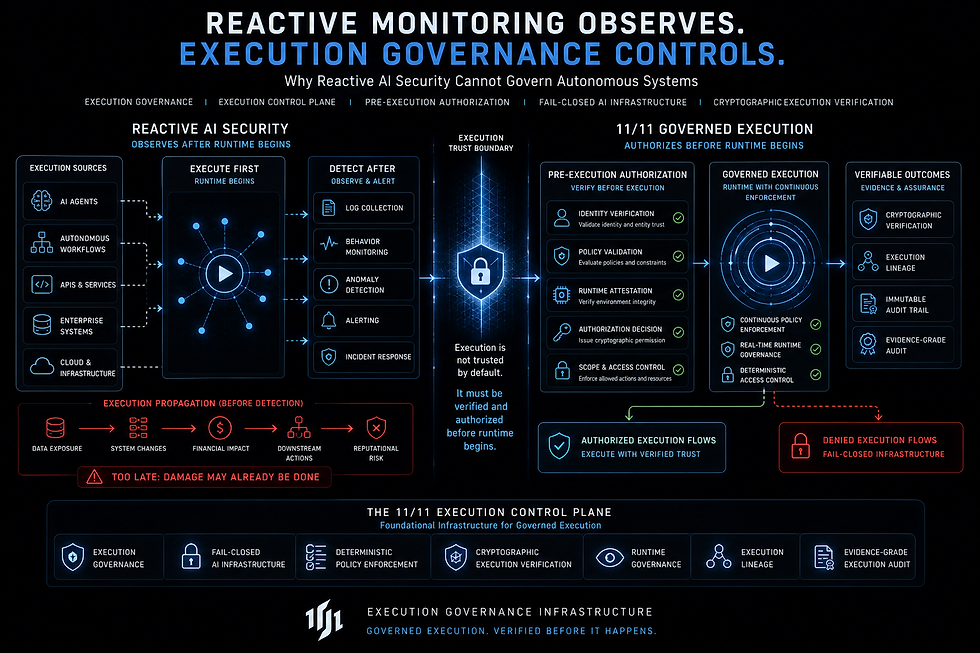
11/11 defines governed execution mesh architecture as distributed governance infrastructure where execution trust, authorization enforcement, runtime verification, and lineage continuity operate coherently across interconnected execution environments.
Execution governance becomes a distributed trust fabric.
What Is a Governed Execution Mesh?
A governed execution mesh is a distributed execution governance architecture where:
runtime trust is coordinated
authorization enforcement remains synchronized
governance policies persist consistently
verification states remain coherent
execution lineage propagates continuously
trust boundaries remain enforced
across multiple execution environments.
The mesh itself becomes governance-aware infrastructure.
Why Execution Mesh Architecture Matters
Traditional governance systems often assume:
execution occurs inside centralized boundaries.
Autonomous infrastructure invalidates this assumption.
Execution increasingly operates across:
clouds
clusters
regions
edge systems
sovereign environments
autonomous agents
distributed runtimes
Governance itself must become distributed.
Without governed execution meshes:
policy fragmentation occurs
trust continuity breaks
authorization drift emerges
lineage coherence weakens
runtime trust becomes inconsistent
Execution governance must scale horizontally with autonomous infrastructure.
EG-018 Governed Execution Mesh Principles
1. Governance Policies Must Remain Consistent Across the Mesh
Distributed environments cannot enforce conflicting runtime trust rules.
Governance consistency becomes infrastructure-critical.
2. Authorization Enforcement Must Remain Coordinated
Execution authorization cannot become fragmented across environments.
Trust validation must remain synchronized across the mesh.
3. Runtime Verification Must Persist Across Distributed Systems
Trust verification cannot stop at environment boundaries.
Governance continuity must propagate across all governed execution nodes.
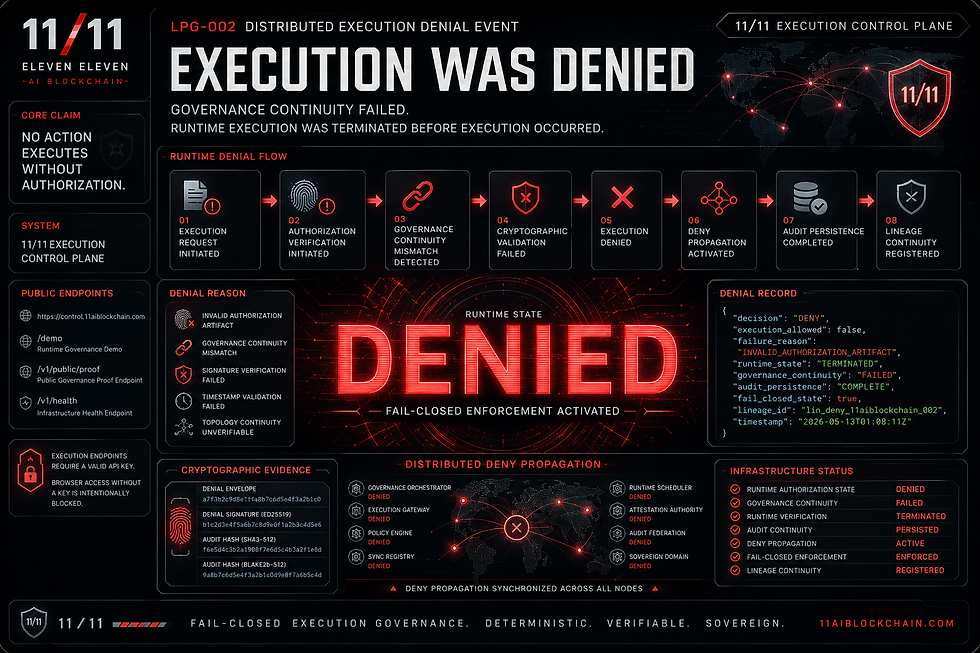
4. Boundary Violations Must Fail Closed Across the Mesh
If runtime trust fails anywhere within the governed mesh:
execution propagation must stop automatically.
No permissive trust escalation.
No uncontrolled lateral execution spread.
5. Execution Lineage Must Remain Globally Coherent
Execution lineage systems must preserve:
distributed authorization continuity
cross-environment trust transitions
governance synchronization
execution ancestry
cryptographic audit persistence
Distributed execution history must remain provable.
Autonomous Infrastructure Requires Distributed Governance
As AI infrastructure scales:
execution governance cannot remain centralized.
Future infrastructure increasingly requires:
distributed runtime governance
synchronized trust enforcement
cryptographic execution coordination
governed execution containment
mesh-wide lineage continuity
deterministic policy synchronization
Governance itself becomes distributed infrastructure.
Governed Execution Meshes Change Infrastructure Semantics
Historically:
distributed systems optimized for:
scalability
redundancy
availability
performance
Execution governance introduces a new requirement:
distributed trust continuity.
Future infrastructure increasingly governs:
how trust propagates
where execution may spread
how runtime verification synchronizes
whether authorization remains coherent
whether governance continuity persists globally
Execution governance becomes the connective trust layer across autonomous infrastructure.
Distributed Trust Becomes Foundational
Autonomous systems increasingly operate:
continuously
globally
asynchronously
independently
This requires:
continuous distributed trust governance.
Future enterprise and sovereign systems increasingly depend on:
governed execution meshes
synchronized runtime governance
fail-closed trust propagation
distributed authorization verification
global execution lineage continuity
operational trust coordination
Execution governance becomes distributed operational infrastructure.
11/11 Positioning
11/11 is positioned as the execution governance layer for AI infrastructure.
Its governance architecture establishes:
governed execution mesh coordination
distributed runtime governance
deterministic trust synchronization
cryptographic authorization enforcement
immutable execution lineage
operational trust continuity
across distributed execution environments.
Execution itself becomes the trust boundary.
Official Proof Systems
Public Governance Console
Runtime Governance Demo
Public Governance Proof Viewer
Infrastructure Health Dashboard
Execution Lineage Explorer
Autonomous infrastructure cannot safely scale without coordinated runtime trust.
Execution governance itself must become distributed infrastructure.

Comments