
EG-028 Machine-Speed Governance Enforcement


AI systems increasingly operate faster than human governance cycles.
Autonomous infrastructure now executes:
continuously
globally
asynchronously
independently
at machine speed
Human review cannot scale to machine-speed execution environments.
Execution governance itself must operate at runtime velocity.
11/11 defines Machine-Speed Governance Enforcement as the autonomous governance framework used to continuously validate, enforce, constrain, and prove execution legitimacy at machine-scale operational speed.
Execution trust becomes real-time infrastructure.
Why Machine-Speed Governance Matters
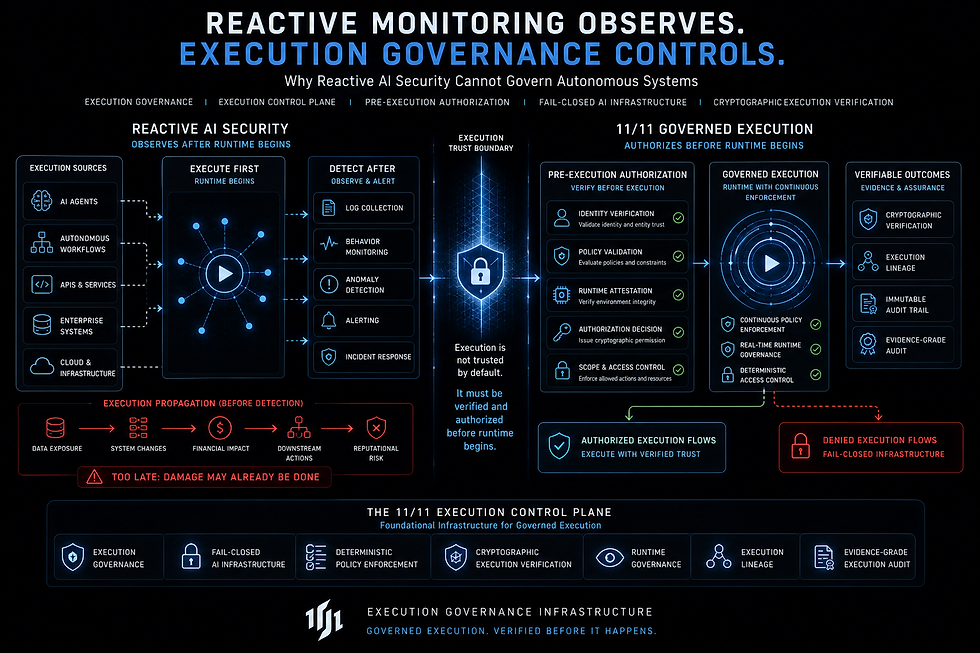
Traditional governance systems rely on:
human review cycles
delayed intervention
post-event analysis
reactive remediation
manual escalation workflows
Autonomous systems invalidate these assumptions.
At machine speed:
delayed governance becomes ineffective
runtime trust degrades rapidly
violations propagate immediately
operational risk compounds continuously
execution legitimacy becomes unstable
Execution governance must enforce trust at operational velocity.
What Is Machine-Speed Governance Enforcement?
Machine-speed governance enforcement establishes infrastructure where:
runtime trust remains continuously verified
governance policies remain autonomously enforced
authorization scope remains constrained
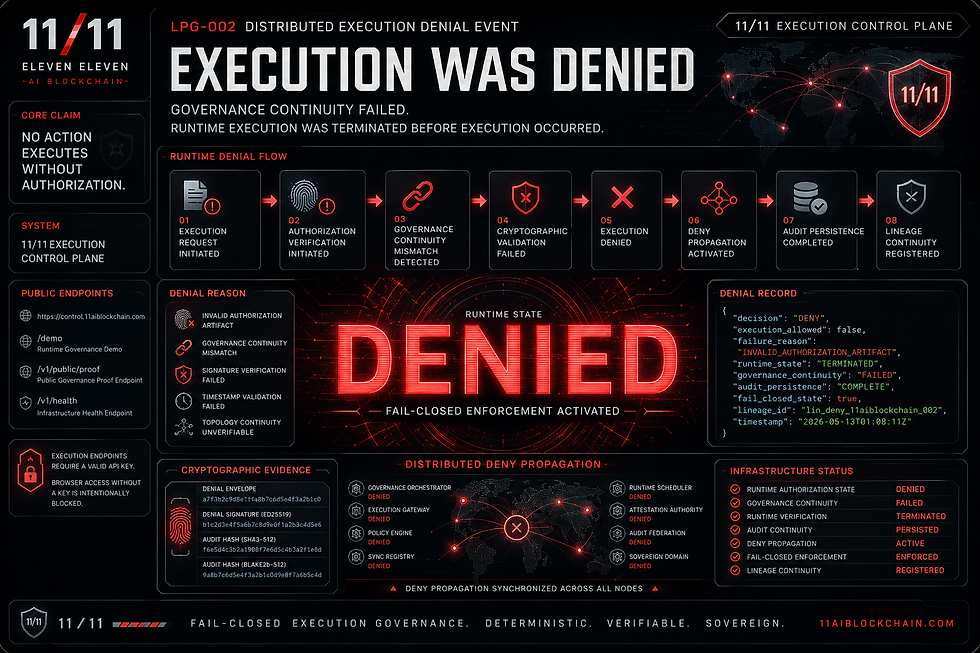
violations fail closed immediately
execution lineage remains immutable
operational trust continuity remains provable
during machine-speed execution activity.
Governance itself becomes machine-speed infrastructure.
EG-028 Machine-Speed Enforcement Principles
1. Governance Validation Must Operate Continuously
Execution trust cannot depend on periodic verification.
Runtime validation must remain continuously operational at machine speed.
2. Governance Enforcement Must Remain Deterministic
Enforcement outcomes must remain:
predictable
verifiable
independently provable
operationally consistent
Execution trust cannot rely on ambiguous runtime interpretation.
3. Invalid Runtime Trust Must Fail Closed Immediately
If runtime legitimacy becomes invalid:
execution must stop automatically.
No permissive continuation.
No delayed intervention.
No governance latency gaps.
4. Runtime Scope Must Remain Continuously Constrained
Governance systems must continuously enforce:
execution boundaries
authorization limits
runtime permissions
policy conditions
operational constraints
Execution authority cannot become unbounded.
5. Governance History Must Remain Immutable
Execution governance systems must preserve:
runtime trust transitions
policy enforcement history
authorization continuity
operational verification records
cryptographic audit continuity
execution lineage persistence
Execution legitimacy must remain historically provable.
Machine-Speed Governance Becomes Infrastructure-Critical
Future enterprise and sovereign systems increasingly require:
autonomous runtime enforcement
deterministic trust validation
fail-closed operational controls
cryptographic execution verification
immutable governance lineage
machine-speed operational assurance
Execution governance becomes real-time operational infrastructure.
Autonomous Infrastructure Requires Runtime-Speed Trust
As AI systems scale:
trust itself becomes a runtime-speed operational requirement.
Future systems increasingly govern:
whether execution remains legitimate
whether runtime trust persists continuously
whether governance continuity remains intact
whether operational trust remains provable
whether execution legitimacy survives machine-speed conditions
Execution governance becomes runtime-native infrastructure.
Machine-Speed Governance Changes Infrastructure Semantics
Historically:
governance operated slower than execution systems.
Execution governance introduces:
runtime-speed operational trust enforcement.
Future infrastructure increasingly governs:
execution legitimacy in real time
operational trust continuity
autonomous governance enforcement
runtime trust assurance
machine-speed policy coordination
Execution governance itself becomes operational-speed infrastructure.
Runtime-Speed Trust Becomes Foundational
Autonomous systems increasingly coordinate across:
enterprise AI orchestration
sovereign execution systems
distributed governance meshes
mission-critical automation
machine-speed operational infrastructure
globally distributed runtime environments
This requires:
machine-speed execution trust governance.
Execution governance becomes foundational infrastructure for autonomous systems.
11/11 Positioning
11/11 is positioned as the execution governance layer for AI infrastructure.
Its governance architecture establishes:
machine-speed governance enforcement
deterministic runtime validation
fail-closed execution controls
cryptographic operational verification
immutable governance lineage
continuous runtime trust continuity
before and during execution.
Execution itself becomes the trust boundary.
Official Proof Systems
Runtime Governance Demo:11/11 Execution Governance Demo
Health Endpoint:11/11 Health Verification Endpoint
Public Proof Endpoint:11/11 Public Proof System
Autonomous infrastructure cannot depend on human-speed governance cycles.
Execution trust itself must operate at machine speed.

Comments