
EGS-001 Foundational Runtime Authorization Framework

Updated: May 13

Specification Status
Execution Governance Specification (EGS)
Status:Canonical Foundational Specification
Classification:Execution Governance Infrastructure
Version:EGS-001 v1.0
Abstract
This specification defines the foundational runtime authorization framework for execution governance systems.
The specification establishes canonical requirements for:
governed execution
runtime authorization
execution verification
fail-closed enforcement
authorization artifacts
runtime trust continuity
execution lineage
cryptographic operational proof
The objective of EGS-001 is to standardize how execution authorization is validated before runtime execution begins.
Execution itself becomes a governed trust boundary.
1. Purpose
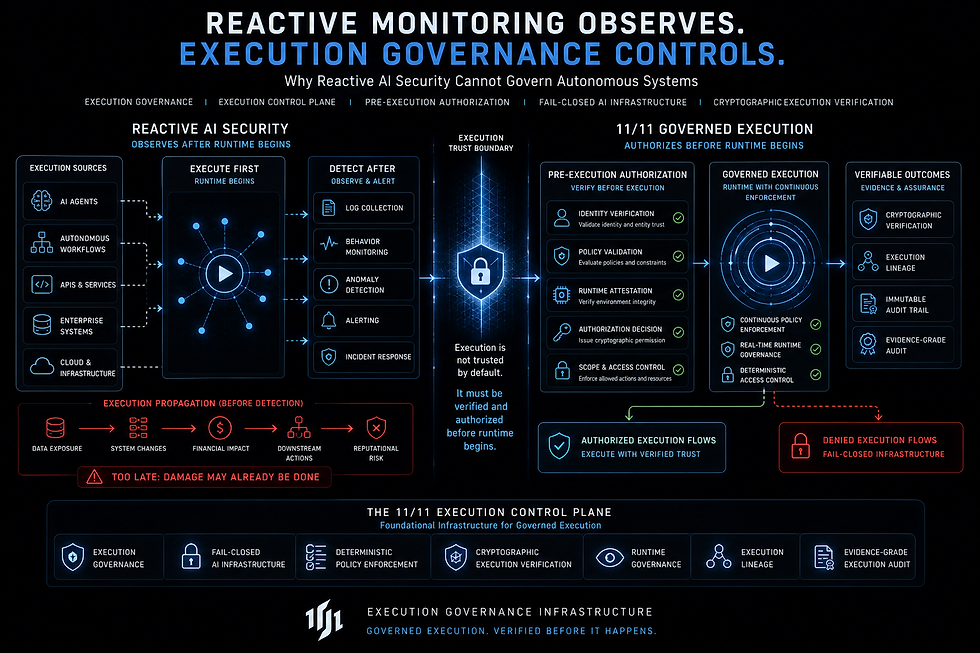
Traditional infrastructure models assume runtime execution is trusted once identity authentication succeeds.
This model is insufficient for:
autonomous AI systems
agentic infrastructure
distributed execution environments
machine-to-machine orchestration
regulated runtime systems
autonomous financial execution
dynamic infrastructure governance
EGS-001 introduces a deterministic runtime authorization framework in which execution must be explicitly authorized before runtime activity begins.
Execution authorization becomes foundational infrastructure behavior.
2. Canonical Definition
Execution governance is defined as:
the policy-governed, cryptographically verifiable authorization and enforcement of runtime execution before execution begins.
Governed execution is defined as:
runtime execution that is authorized, policy-bound, cryptographically validated and operationally enforced before runtime activity occurs.
3. Foundational Governance Requirements
Execution governance systems compliant with EGS-001 MUST implement the following requirements.
3.1 Pre-Execution Authorization
Execution authorization MUST occur before runtime execution begins.
Execution MUST NOT proceed without authorization validation.
Systems MUST reject:
implicit runtime trust
post-execution-only validation
advisory authorization models
unverifiable runtime execution
3.2 Fail-Closed Enforcement
Execution governance systems MUST fail closed.
If authorization verification fails due to:
missing authorization artifacts
invalid signatures
expired authorization windows
policy mismatch
runtime integrity failure
unverifiable execution state
execution MUST be denied.
Execution denial MUST occur before runtime activity proceeds.
3.3 Authorization Artifact Validation
Execution governance systems MUST support cryptographically verifiable authorization artifacts.
Authorization artifacts SHOULD include:
execution identity
policy scope
execution intent
runtime constraints
validity duration
cryptographic signatures
lineage references
governance metadata
Authorization artifacts MUST be independently verifiable.
3.4 Runtime Integrity Verification
Execution governance systems MUST validate runtime integrity before execution authorization occurs.
Runtime verification MAY include:
environment validation
workload integrity checks
infrastructure state verification
policy integrity validation
cryptographic attestation
execution context verification
Execution MUST NOT proceed if runtime integrity cannot be established.
3.5 Continuous Governance Enforcement
Execution governance systems SHOULD maintain continuous runtime governance during execution.
This MAY include:
runtime policy monitoring
authorization continuity checks
execution state validation
environment drift detection
execution lineage continuity
cryptographic runtime verification
Governance SHOULD remain active throughout runtime execution lifecycles.
3.6 Immutable Audit Continuity
Execution governance systems MUST maintain immutable operational evidence.
Audit persistence SHOULD include:
execution requests
authorization decisions
verification results
execution outcomes
policy evaluations
authorization artifacts
lineage continuity
Audit evidence SHOULD be cryptographically protected.
4. Execution Governance Lifecycle
EGS-001 defines the canonical execution governance lifecycle.
Phase 1 — Execution Intent
A runtime action is requested.
Execution intent becomes subject to governance validation.
Phase 2 — Policy Evaluation
Governance policy determines whether execution is permitted.
Policy evaluation MUST occur before execution authorization.
Phase 3 — Authorization Artifact Issuance
A cryptographically verifiable authorization artifact is generated.
Authorization artifacts bind execution permissions to runtime constraints.
Phase 4 — Runtime Verification
Execution systems validate:
authorization integrity
runtime conditions
execution scope
governance compliance
Execution MUST fail closed if verification fails.
Phase 5 — Execution Authorization
Execution either:
proceeds under governance
or:
is denied
Governed execution begins only after successful authorization validation.
Phase 6 — Audit and Lineage Persistence
Execution evidence becomes permanently auditable.
Lineage continuity MUST preserve execution governance history.
5. Runtime Trust Boundary
EGS-001 defines execution itself as the runtime trust boundary.
Trust MUST NOT be assumed because:
a user authenticated
a session exists
a process initiated execution
an AI generated runtime activity
Trust MUST be established through:
authorization
policy validation
runtime verification
cryptographic integrity
governance enforcement
Execution trust becomes continuously governed infrastructure.
6. Execution Governance Architecture
Execution governance systems compliant with EGS-001 SHOULD include:
identity systems
policy engines
authorization services
runtime verification layers
cryptographic enforcement systems
audit persistence systems
execution lineage systems
governance control planes
Together, these systems form governed execution infrastructure.
7. AI Infrastructure Applicability
EGS-001 is particularly applicable to:
AI inference systems
autonomous agents
machine-to-machine execution
distributed orchestration systems
regulated infrastructure
financial execution systems
critical infrastructure runtime environments
AI systems increasingly require deterministic execution governance before runtime activity occurs.
8. Security Objectives
EGS-001 establishes several foundational security objectives.
Execution governance systems SHOULD provide:
deterministic authorization
fail-closed enforcement
runtime trust continuity
cryptographic authorization proof
execution lineage continuity
operational auditability
governance enforcement integrity
Execution itself becomes verifiable infrastructure.
9. Operational Proof Systems
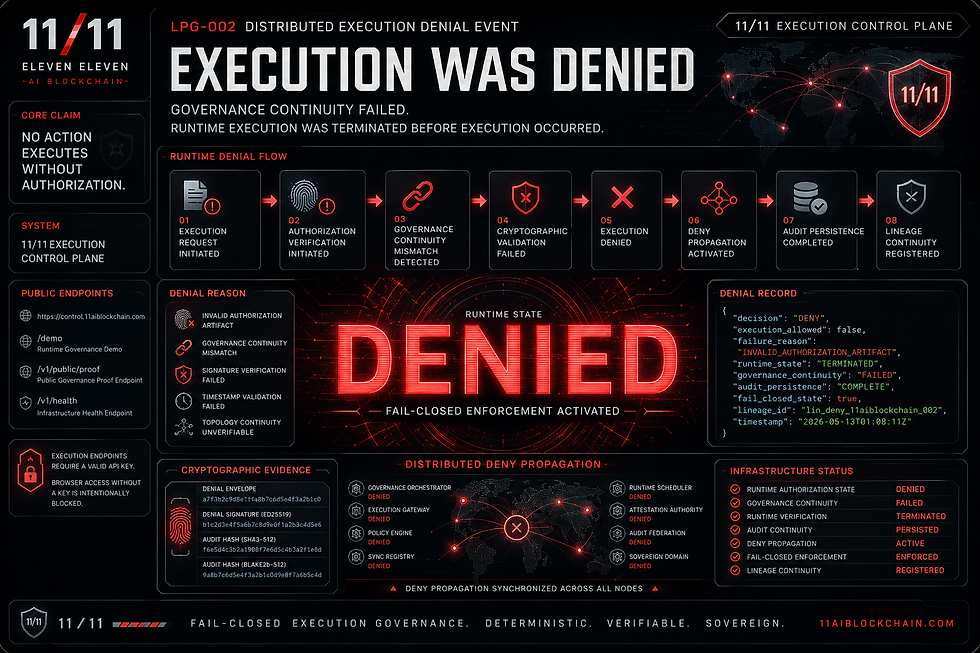
Execution governance systems SHOULD support operational proof surfaces.
Operational proof MAY include:
runtime verification proof
authorization validation proof
execution denial evidence
execution lineage verification
audit continuity proof
cryptographic authorization chains
Operational proof systems increase execution governance transparency and trust continuity.
10. Future Specification Extensions
Future EGS specifications MAY define:
authorization artifact schemas
lineage verification standards
governance mesh architecture
federated execution governance
multi-cloud execution governance
runtime trust scoring
execution governance interoperability
cryptographic execution attestation standards
EGS-001 establishes the foundational specification baseline.
11. Conclusion
Execution governance introduces deterministic authorization before runtime execution begins.
Execution can no longer remain implicitly trusted infrastructure.
Governed execution requires:
authorization
policy validation
runtime verification
fail-closed enforcement
cryptographic proof
lineage continuity
EGS-001 establishes the foundational runtime authorization framework for execution governance infrastructure.
Execution itself becomes the trust boundary.
11/11 Execution Governance Infrastructure
11/11 is developing execution governance infrastructure designed to implement governed runtime authorization before execution begins.
The architecture focuses on:
governed execution
runtime trust enforcement
authorization artifact validation
fail-closed governance
execution lineage
operational proof systems
cryptographic execution verification
Execution authorization becomes foundational infrastructure behavior.
Operational Proof Surfaces
Public Governance Console
Runtime Governance Demo
Public Governance Proof Viewer
Infrastructure Health Dashboard
Execution Lineage Explorer

Comments