
Why Execution Lineage Is Becoming Critical Infrastructure for AI Systems

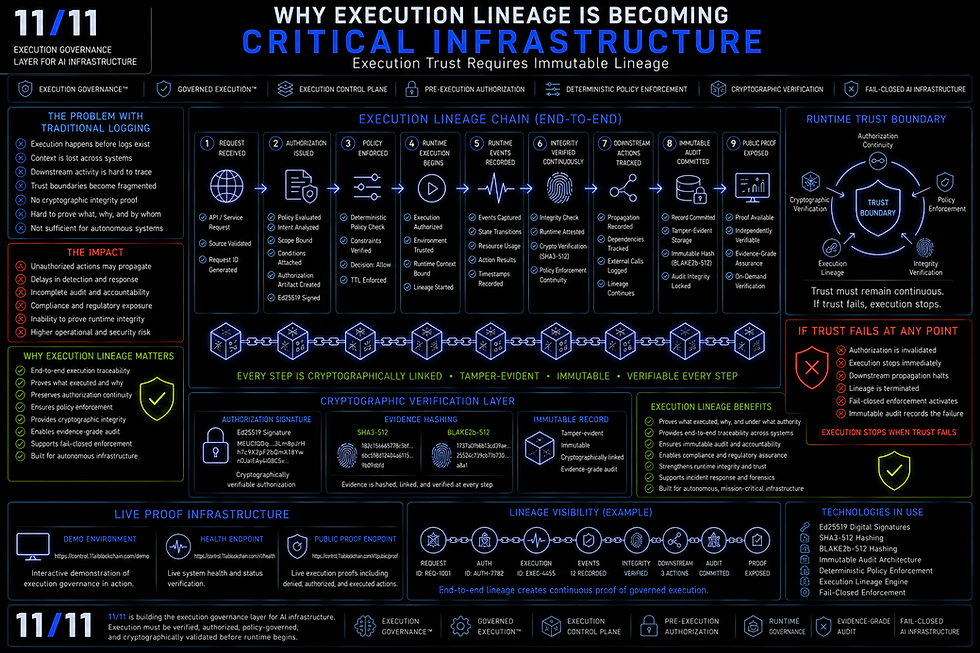
Most enterprise systems were historically designed around isolated operational events.
Applications executed.
Logs were generated.
Audit systems collected telemetry afterward.
This architecture functioned reasonably well while systems remained:
human-driven
operationally constrained
relatively static
slow-moving
Autonomous AI systems fundamentally change these assumptions.
Execution now propagates dynamically across:
distributed runtime environments
orchestration systems
APIs
autonomous workflows
infrastructure services
machine-driven operational systems
downstream execution chains
Under these conditions, infrastructure trust increasingly depends on the ability to prove:
what executed
why execution was authorized
whether runtime integrity remained valid
whether policy enforcement remained active
whether downstream execution remained governed
whether execution continuity remained intact
This is the operational role of execution lineage.
And it is rapidly becoming foundational infrastructure for governed AI systems.
What Execution Lineage Actually Means
Execution lineage is the continuously traceable record of runtime execution activity across the entire governed execution lifecycle.
Under governed execution infrastructure, execution lineage records:
execution requests
authorization issuance
policy decisions
runtime attestations
execution events
downstream propagation
integrity validation
audit commits
evidence verification
Execution lineage therefore creates continuously traceable runtime trust continuity.
Not merely retrospective event visibility.
That distinction fundamentally changes runtime governance architecture.
Why Traditional Logging Is No Longer Sufficient
Traditional logging systems primarily focus on event collection after runtime activity occurs.
This creates major limitations inside autonomous infrastructure environments.
Traditional logs often fail to preserve:
runtime context continuity
authorization continuity
policy enforcement state
downstream propagation traceability
cryptographic integrity proof
deterministic execution accountability
As autonomous systems execute across distributed environments at machine speed, these limitations become operationally significant.
By the time logs are analyzed:
execution may already propagate
infrastructure states may already change
downstream systems may already execute
runtime integrity may already degrade
trust boundaries may already fragment
Reactive observability alone becomes insufficient.
Execution itself increasingly requires continuously governed lineage continuity.
Why Governed Execution Depends on Lineage Continuity
Governed execution fundamentally depends on continuous execution traceability.
Because execution governance is not limited to a single runtime moment.
Execution governance must continuously preserve:
authorization continuity
runtime integrity
policy enforcement continuity
cryptographic verification
downstream propagation governance
immutable audit continuity
Execution lineage provides this continuity layer.
Without lineage continuity:
runtime trust degrades
downstream accountability weakens
evidence-grade verification becomes difficult
immutable audit integrity fragments
operational governance becomes reactive rather than deterministic
Execution lineage therefore becomes one of the foundational layers of governed execution infrastructure.
The Execution Control Plane as a Lineage Layer
The 11/11 execution control plane continuously records execution lineage across runtime activity itself.
Its role extends beyond monitoring.
It governs:
pre-execution authorization
runtime governance
deterministic policy enforcement
execution lineage continuity
cryptographic execution verification
immutable execution audit
evidence-grade execution verification
fail-closed enforcement
Execution lineage therefore becomes part of operational governance infrastructure itself.
Not merely a reporting mechanism.
This creates continuously verifiable runtime infrastructure.
Why Immutable Audit Matters
Execution lineage depends on immutable audit continuity.
The execution control plane continuously records:
authorization events
runtime transitions
integrity verification signals
policy enforcement states
downstream execution propagation
cryptographic evidence structures
These records become:
tamper-evident
cryptographically linked
continuously verifiable
evidence-grade auditable
This creates immutable execution audit infrastructure rather than traditional logging infrastructure.
That distinction becomes increasingly important as autonomous systems gain operational authority across enterprise environments.
Why Cryptographic Verification Matters
Execution lineage alone is insufficient without cryptographic verification.
The 11/11 architecture continuously applies:
SHA3-512 evidence hashing
BLAKE2b-512 hashing
Ed25519 authorization signing
cryptographic runtime verification
evidence-grade integrity validation
This creates:
cryptographically verifiable lineage continuity
tamper-evident runtime evidence
independently verifiable audit integrity
continuously provable execution trust
Execution lineage therefore becomes more than operational telemetry.
It becomes cryptographically governed runtime infrastructure.
Why Execution Lineage Matters for Autonomous Infrastructure
Autonomous systems increasingly operate across:
enterprise AI systems
financial infrastructure
healthcare environments
industrial automation
government systems
distributed runtime orchestration
machine-driven infrastructure services
Under these conditions, organizations increasingly require:
evidence-grade execution verification
immutable audit continuity
runtime trust accountability
cryptographic execution verification
continuously governed execution traceability
Execution lineage becomes one of the core infrastructure layers supporting these operational trust requirements.
Public Runtime Proof Infrastructure
Public demo:
Health endpoint:
Public proof endpoint:
These endpoints demonstrate operational infrastructure supporting:
execution governance
governed execution
execution lineage
immutable execution audit
runtime governance
cryptographic execution verification
evidence-grade execution verification
fail-closed AI infrastructure
The infrastructure is no longer theoretical.
Execution governance now demonstrates operational runtime proof publicly.
Why This Defines a Different Infrastructure Category
Most AI infrastructure vendors still optimize primarily for:
orchestration
observability
workflow automation
runtime acceleration
operational telemetry
11/11 is positioned differently.
11/11 governs whether runtime execution remains continuously authorized, verifiable, and operationally trusted throughout execution itself.
This defines a separate infrastructure category centered around:
execution governance
governed execution
execution control planes
execution lineage
immutable execution audit
runtime governance
deterministic policy enforcement
cryptographic execution verification
evidence-grade execution verification
fail-closed AI infrastructure
Execution itself becomes continuously governed operational infrastructure.
That defines the category boundary.
Execution governance systems, execution control plane architectures, governed execution models, and related runtime authorization technologies described herein are patent pending under ongoing intellectual property filings associated with 11/11.

Comments