
Execution Lineage: The Emerging Accountability Layer for Autonomous Infrastructure

Autonomous systems are rapidly increasing the operational importance of execution accountability.

Traditional infrastructure environments primarily relied upon:
- audit logs
- operator records
- event monitoring
- post-event analysis
- centralized oversight systems
These approaches were designed for environments where humans remained the dominant execution authority.
Autonomous infrastructure fundamentally changes this assumption.
As machine-speed systems increasingly coordinate:
- runtime orchestration
- distributed infrastructure actions
- policy-bound execution
- operational automation
- cross-domain workflows
- autonomous decision pathways
Infrastructure accountability must evolve beyond observational telemetry.
Execution lineage infrastructure introduces deterministic accountability directly into runtime operations.
Execution Governance™ establishes execution lineage as a foundational operational layer where:
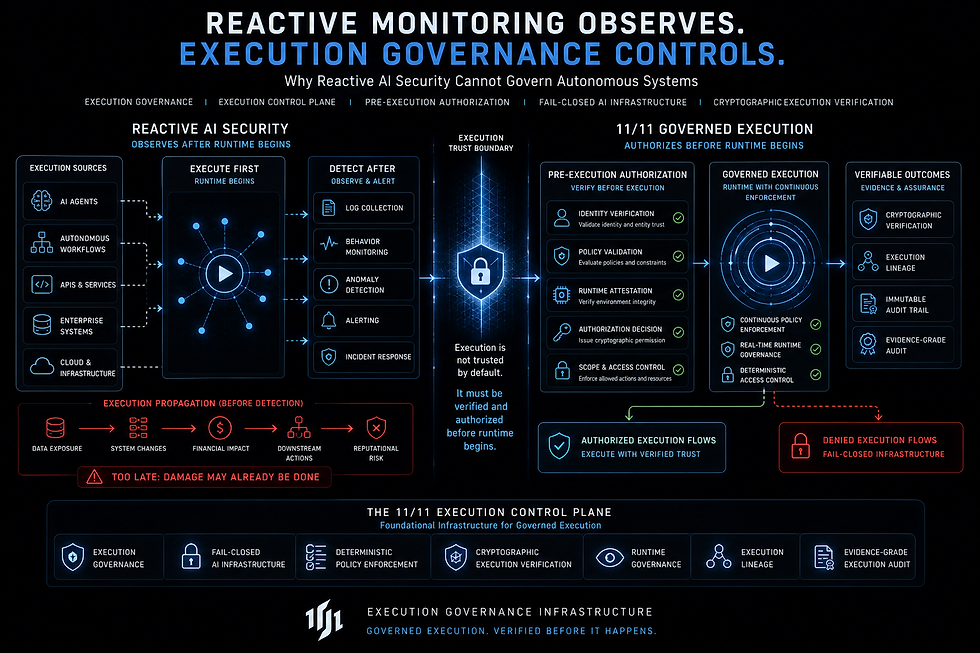
- execution authorization is validated before action
- runtime actions are cryptographically attributable
- governance decisions remain verifiable
- operational provenance persists continuously
- execution evidence becomes externally auditable
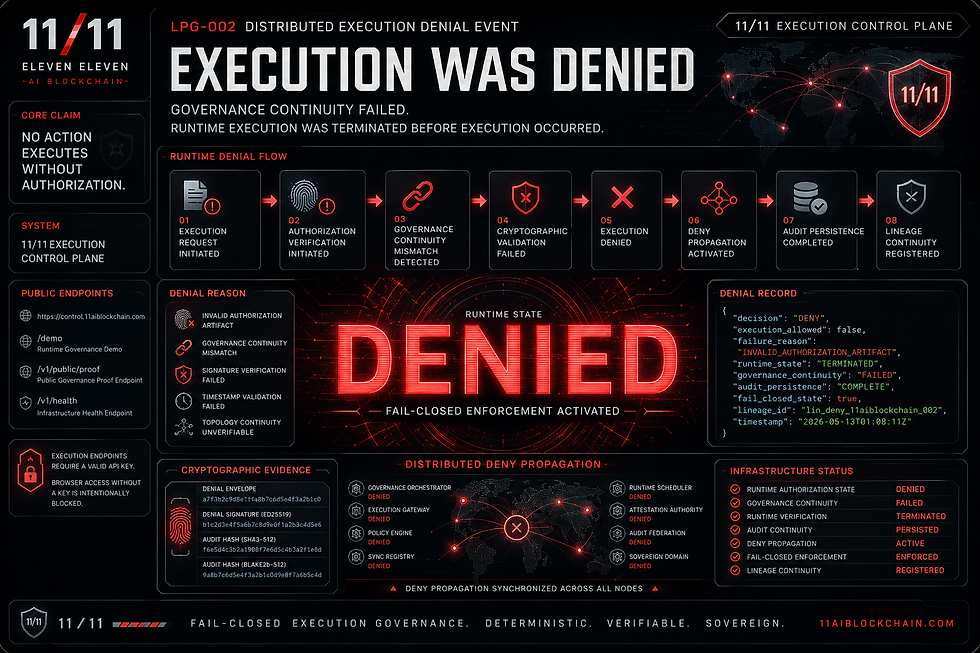
- unauthorized runtime paths fail closed
This creates a fundamentally different operational governance model.
Execution lineage enables infrastructure systems to prove:
- who authorized execution
- what policy validated execution
- when execution occurred
- where execution propagated
- how governance controls were enforced
- whether runtime integrity remained intact
This distinction becomes increasingly important across:
- federal infrastructure systems
- defense operational environments
- industrial automation
- financial orchestration
- healthcare infrastructure
- sovereign compute ecosystems
Execution Governance Compatible (EGC) infrastructure operationalizes this through runtime-native execution lineage continuity.
Execution lineage provides:
- immutable operational provenance
- deterministic accountability
- governance attestation continuity
- runtime verification evidence
- authorization-bound execution records
- procurement-grade operational assurance
Importantly, execution lineage infrastructure remains implementation-neutral.
Different runtime systems may implement differing:
- orchestration environments
- infrastructure fabrics
- execution engines
- governance architectures
- policy frameworks
While still supporting interoperable execution lineage semantics.
Future procurement and governance frameworks will increasingly prioritize infrastructure capable of:
- preserving immutable execution provenance
- validating authorization continuity
- generating verifiable governance evidence
- maintaining runtime accountability
- supporting deterministic enforcement
- preserving trust-boundary integrity
- failing closed during authorization failure
Execution Governance™ therefore represents the evolution from observable infrastructure to accountable execution infrastructure.
Execution lineage is becoming the operational foundation through which autonomous infrastructure establishes:
- runtime accountability
- governance continuity
- deterministic trust
- execution provenance
- operational legitimacy
The organizations establishing execution lineage infrastructure today may ultimately define the next accountability baseline for autonomous systems governance.
RFC-EG Reinforcement:
RFC-EG-017, RFC-EG-021, RFC-EG-026, RFC-EG-031, RFC-EG-036
Ecosystem Expansion:
Execution Lineage Layer
Runtime Accountability Layer
Deterministic Enforcement Layer
Governance Verification Layer
EGC Conformance Ecosystem
11/11 introduces Execution Governance™ infrastructure for governed autonomous execution and deterministic operational trust.
Execution Governance™
Governed Execution™
Patent Pending

Comments