
Why Governance Before Execution Changes Autonomous Infrastructure


Infrastructure is entering an era where execution happens faster than oversight can respond.
Autonomous systems now coordinate decisions across cloud infrastructure, APIs, AI systems, orchestration layers, financial rails, operational runtimes, and distributed machine-speed environments.
That changes the operational model of infrastructure itself.
Historically, governance often existed after execution.
Actions occurred first.
Validation happened later.
Audits reviewed outcomes after the fact.
Operational trust depended heavily on retrospective analysis.
That model breaks down in autonomous infrastructure.
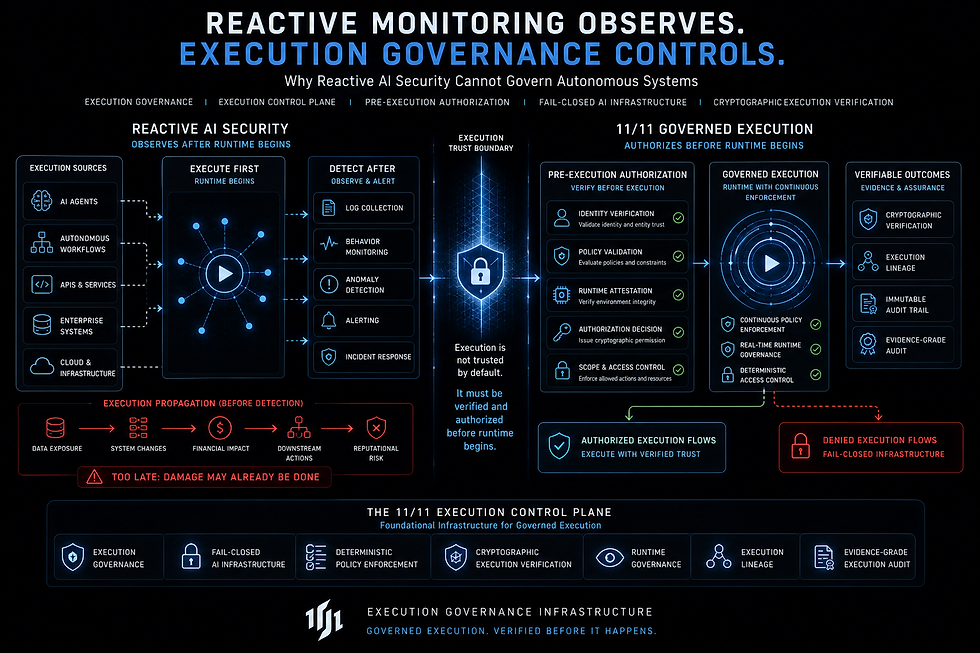
By the time reactive oversight begins, execution has already occurred.
A workflow may already be complete.
A decision may already have propagated.
An unauthorized operation may already have impacted downstream systems.
This is why governance must move before execution.
Governance before execution establishes operational trust prior to action.
Instead of assuming infrastructure should execute automatically, governed systems require proof before execution is permitted.
Identity must be verified.
Authorization must be confirmed.
Policy must be evaluated.
Runtime context must be validated.
Operational conditions must align.
Execution lineage must be prepared.
Only then can execution proceed.
This creates deterministic operational infrastructure.
Without governance before execution, autonomous systems operate on assumption.
With governance before execution, autonomous systems operate on verified trust boundaries.
That distinction becomes foundational at machine speed.
Because autonomous systems do not simply increase operational scale.
They increase operational velocity.
At that speed, even small governance gaps become infrastructure risks.
An expired authorization.
A stale runtime condition.
A policy mismatch.
An unverified execution request.
A disconnected governance layer.
Any of these failures can create operational instability if infrastructure continues executing without verification.
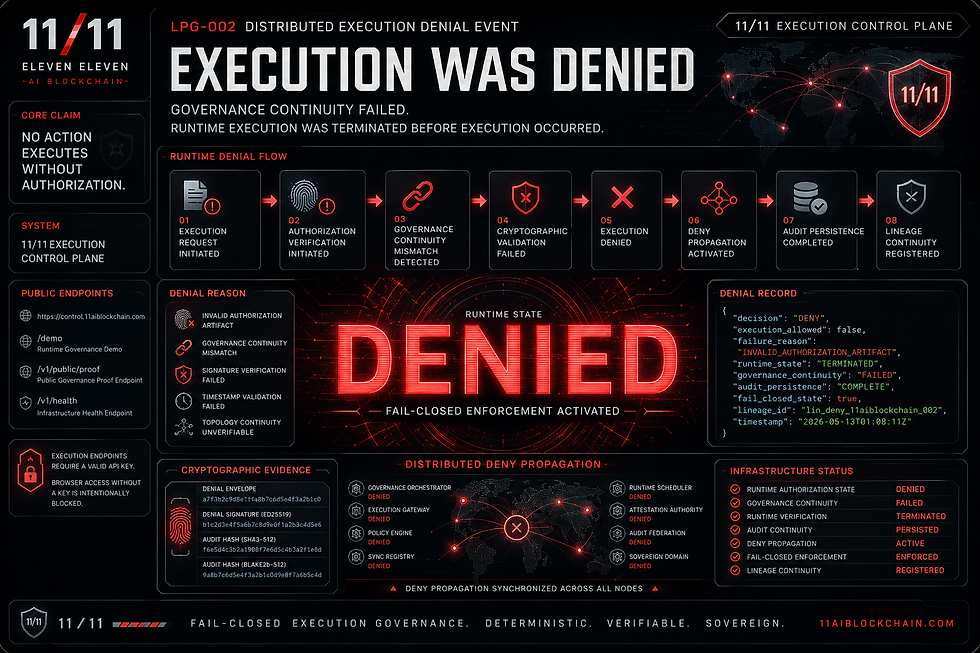
This is why fail-closed enforcement becomes essential.
No valid governance proof means no execution.
That principle transforms governance from documentation into operational infrastructure.
Execution Governance™ introduces governance as a runtime execution boundary.
Not a reporting layer.
Not an advisory overlay.
Not post-event analysis.
But an active infrastructure layer controlling whether execution is admitted or denied before action occurs.
This creates infrastructure capable of maintaining operational trust even as systems become increasingly autonomous.
It enables deterministic governance at machine speed.
It creates synchronized runtime coordination.
It establishes immutable execution lineage.
It prevents uncontrolled operational drift.
Most importantly, it ensures autonomous systems remain governable as infrastructure complexity expands.
The future of infrastructure will not be defined solely by intelligence or automation.
It will be defined by whether execution remains governed.
That is why governance before execution changes autonomous infrastructure.
That is the infrastructure boundary 11/11 is defining through Execution Governance™.
Public Infrastructure Endpoints
Public Runtime Infrastructure
Public Governance Console
Runtime Governance Demo
Public Governance Proof Viewer
Infrastructure Health Dashboard
Execution Lineage Explorer
Execution endpoints intentionally require valid API authorization.
Browser access without a valid authorization key is fail-closed by design.
11/11 introduces Execution Governance™ infrastructure for governed autonomous execution and deterministic operational trust.
Execution Governance™
Governed Execution™
Patent Pending

Comments