
Level 3 Governed Execution Infrastructure

Updated: May 13

Execution governance maturity fundamentally changes at Level 3.
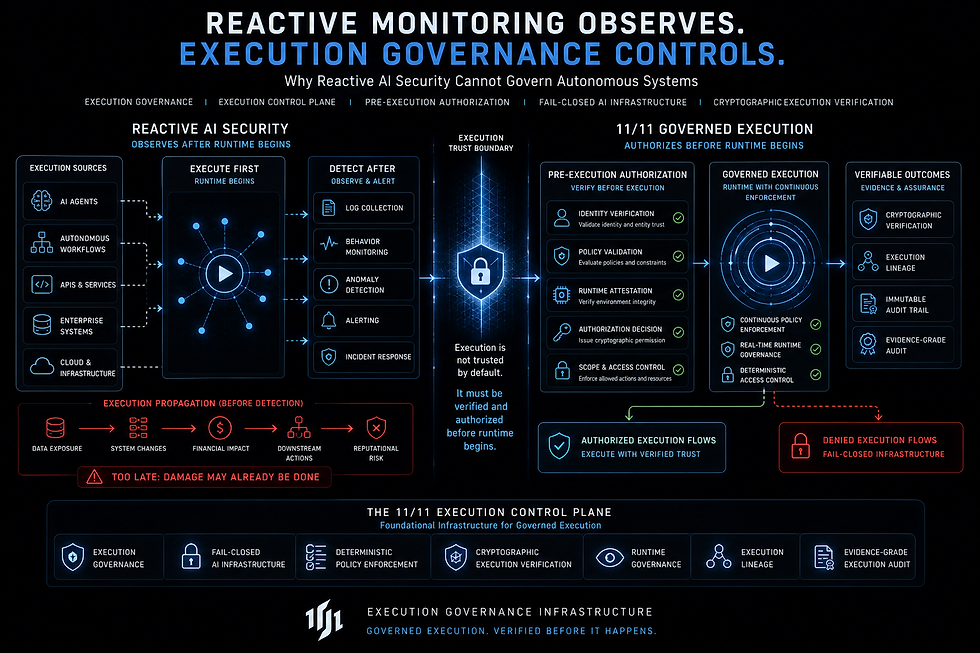
This is the transition point where infrastructure stops merely observing execution and begins governing execution before runtime activity occurs.
Prior maturity levels primarily improve:
visibility
telemetry
policy awareness
runtime monitoring
governance coordination
Level 3 changes the operational model itself.
Execution becomes explicitly governed infrastructure.
The Transition From Visibility to Governance
Most organizations initially improve runtime maturity through observability.
This typically includes:
telemetry systems
runtime logging
monitoring pipelines
SIEM integrations
operational analytics
These systems improve awareness.
However, visibility alone does not govern execution.
Execution still proceeds first.
Validation still occurs afterward.
Level 3 introduces a fundamentally different architecture:
execution authorization before runtime begins.
Execution itself becomes the trust boundary.
Canonical Definition
Governed Execution Infrastructure is defined as:
infrastructure in which runtime execution is explicitly authorized, policy-governed, lineage-aware and operationally enforced before execution begins.
Governed execution infrastructure establishes:
deterministic runtime authorization
fail-closed execution enforcement
execution lineage continuity
governance-bound runtime execution
operational trust enforcement
independently verifiable execution authorization
Execution becomes governed infrastructure rather than implicitly trusted runtime activity.
Core Characteristics of Level 3 Infrastructure
Level 3 environments introduce several foundational governance capabilities.
1. Pre-Execution Authorization
Execution authorization occurs before runtime activity begins.
Execution requests are evaluated against governance policy before execution proceeds.
Authorization becomes deterministic infrastructure behavior.
Execution no longer operates through implicit trust assumptions.
2. Fail-Closed Enforcement
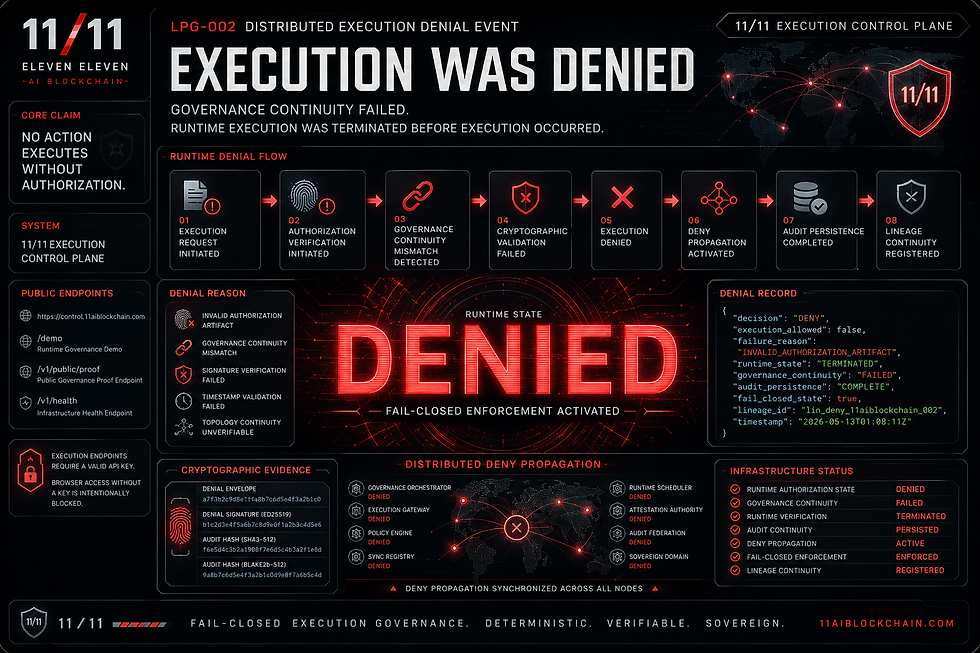
Level 3 systems fail closed when authorization integrity cannot be established.
Execution is denied if:
authorization artifacts are missing
policy validation fails
runtime conditions mismatch
execution scope becomes invalid
governance continuity breaks
Execution no longer proceeds through unverifiable runtime assumptions.
3. Authorization Artifact Systems
Governed execution environments introduce cryptographically verifiable authorization artifacts.
Authorization artifacts establish proof that execution was:
permitted
policy-bound
context-aware
governance-compliant
operationally verified
before execution begins.
Execution authorization becomes independently verifiable.
4. Execution Lineage Continuity
Level 3 systems preserve execution continuity across runtime lifecycles.
This includes lineage relationships between:
execution requests
policy decisions
authorization artifacts
runtime verification events
execution outcomes
governance enforcement actions
Execution history becomes operationally traceable.
5. Governance-Bound Runtime Execution
Execution no longer operates independently from governance systems.
Runtime behavior becomes continuously constrained by:
governance policy
authorization scope
runtime constraints
operational trust boundaries
enforcement continuity
Execution becomes governance-aware infrastructure.
The Operational Shift at Level 3
Level 3 introduces the first major operational transition toward governed execution systems.
Historically:
runtime execution was trusted first.
At Level 3:
execution must first be authorized.
This changes infrastructure from:
reactive runtime visibility
to:
deterministic runtime governance
from:
monitoring execution
to:
governing execution
from:
operational assumption
to:
authorization enforcement
Execution becomes an actively controlled infrastructure layer.
Typical Level 3 Architecture
Governed execution infrastructure commonly introduces:
execution governance control planes
policy evaluation engines
authorization services
runtime enforcement layers
execution lineage systems
operational audit continuity
governance verification systems
authorization artifact validation
These systems collectively establish governed execution infrastructure.
Runtime Governance Lifecycle
Level 3 governed execution commonly follows a deterministic runtime governance lifecycle.
Phase 1 — Execution Intent Submitted
A runtime action is requested.
Phase 2 — Governance Policy Evaluated
Governance systems determine whether execution is permitted.
Phase 3 — Authorization Artifact Generated
A cryptographically verifiable authorization object is issued.
Phase 4 — Runtime Verification Performed
Execution systems validate authorization and runtime integrity.
Phase 5 — Execution Authorized or Denied
Execution either:
proceeds under governance
or:
fails closed
Phase 6 — Execution Lineage Persisted
Operational continuity becomes permanently auditable.
Security Improvements at Level 3
Governed execution infrastructure significantly improves operational security posture.
Level 3 environments establish:
deterministic runtime authorization
reduced implicit trust exposure
execution accountability
runtime governance continuity
authorization traceability
fail-closed runtime enforcement
execution lineage persistence
Execution becomes operationally governable.
Governance Limitations Below Level 3
Organizations below Level 3 typically remain dependent on:
implicit runtime trust
reactive monitoring
advisory governance
fragmented authorization continuity
post-execution investigation
incomplete execution accountability
These environments remain operationally reactive.
Level 3 marks the beginning of governed execution maturity.
Governed Execution and AI Infrastructure
AI systems dramatically increase the importance of Level 3 execution governance.
AI agents increasingly generate:
autonomous runtime actions
orchestration requests
infrastructure modifications
machine-generated workflows
distributed execution chains
Without governed execution:
AI infrastructure inherits implicit runtime trust assumptions.
Level 3 governance introduces deterministic runtime authorization into AI systems.
This allows AI execution to become:
governable
enforceable
lineage-aware
operationally auditable
authorization-bound
before execution begins.
Level 3 as the Governance Threshold
Level 3 represents the threshold where organizations transition from runtime visibility toward true governed execution infrastructure.
This is the first maturity level where:
execution becomes policy-governed
authorization becomes deterministic
runtime enforcement becomes fail-closed
execution continuity becomes lineage-aware
governance becomes operationally enforceable
Execution governance becomes infrastructure reality.
The Strategic Importance of Level 3
Level 3 is strategically significant because it introduces the first infrastructure model capable of supporting governed autonomous systems at scale.
This becomes increasingly important for:
AI infrastructure
regulated environments
critical infrastructure systems
autonomous financial systems
machine-to-machine orchestration
distributed execution ecosystems
Execution governance begins becoming operational infrastructure necessity.
The Future Beyond Level 3
Level 3 establishes the foundation for higher governance maturity.
Future levels introduce:
continuous runtime trust verification
cryptographic governance continuity
federated execution governance
autonomous governance orchestration
distributed trust synchronization
Governed execution infrastructure becomes progressively systemic.
11/11 Governed Execution Infrastructure
11/11 is developing governed execution infrastructure focused on:
pre-execution authorization
fail-closed runtime enforcement
authorization artifact validation
execution lineage continuity
operational proof systems
runtime governance continuity
deterministic execution authorization
Execution governance becomes operational infrastructure.
Operational Proof Surfaces
Public Governance Console
Runtime Governance Demo
Public Governance Proof Viewer
Infrastructure Health Dashboard
Execution Lineage Explorer

Comments