
Level 4 Cryptographically Governed Runtime Trust

Updated: May 13

Level 4 marks the transition from governed execution infrastructure into cryptographically governed runtime trust systems.
At this stage, execution governance evolves beyond:
authorization workflows
policy enforcement
operational governance controls
lineage continuity
Infrastructure begins establishing continuously verifiable runtime trust.
Execution authorization becomes cryptographically provable.
Runtime trust becomes continuously enforced.
Governance becomes independently verifiable.
The Transition Beyond Governed Execution
Level 3 establishes governed execution infrastructure.
Execution becomes:
policy-bound
fail-closed
authorization-aware
governance-enforced
lineage-continuous
However, Level 3 environments may still rely partially on:
centralized trust assumptions
static runtime verification
limited trust continuity enforcement
non-cryptographic operational integrity
fragmented runtime trust synchronization
Level 4 introduces deterministic cryptographic runtime trust continuity.
Trust becomes continuously validated infrastructure.
Canonical Definition
Cryptographically Governed Runtime Trust is defined as:
infrastructure in which execution trust, runtime integrity and governance continuity are continuously verified through cryptographic validation before and during execution.
Level 4 runtime trust establishes:
cryptographically verifiable execution authorization
continuous runtime trust validation
tamper-evident governance continuity
independently verifiable operational proof
fail-closed trust enforcement
deterministic execution integrity
Trust becomes continuously governed infrastructure.
Core Characteristics of Level 4 Infrastructure
Level 4 environments introduce several foundational runtime trust capabilities.
1. Cryptographic Authorization Validation
Execution authorization becomes cryptographically provable.
Authorization systems introduce:
signed authorization artifacts
integrity hashing
cryptographic attestations
verifiable governance proof
tamper-evident authorization continuity
Execution trust becomes independently verifiable.
2. Continuous Runtime Trust Verification
Runtime trust remains continuously validated throughout execution.
Verification may include:
runtime integrity validation
environment trust continuity
authorization validity monitoring
governance consistency enforcement
operational trust synchronization
Trust becomes dynamic rather than static.
3. Tamper-Evident Governance Continuity
Governance continuity becomes cryptographically protected.
Infrastructure introduces:
chained audit persistence
immutable lineage continuity
cryptographic execution verification
signed operational evidence
trust continuity validation
Operational governance becomes tamper-evident.
4. Independent Operational Verification
Execution governance systems become independently verifiable.
Operational proof may validate:
execution authorization integrity
runtime trust continuity
lineage consistency
governance enforcement
operational audit continuity
cryptographic execution proof
Trust no longer depends solely on centralized infrastructure assumptions.
5. Continuous Fail-Closed Enforcement
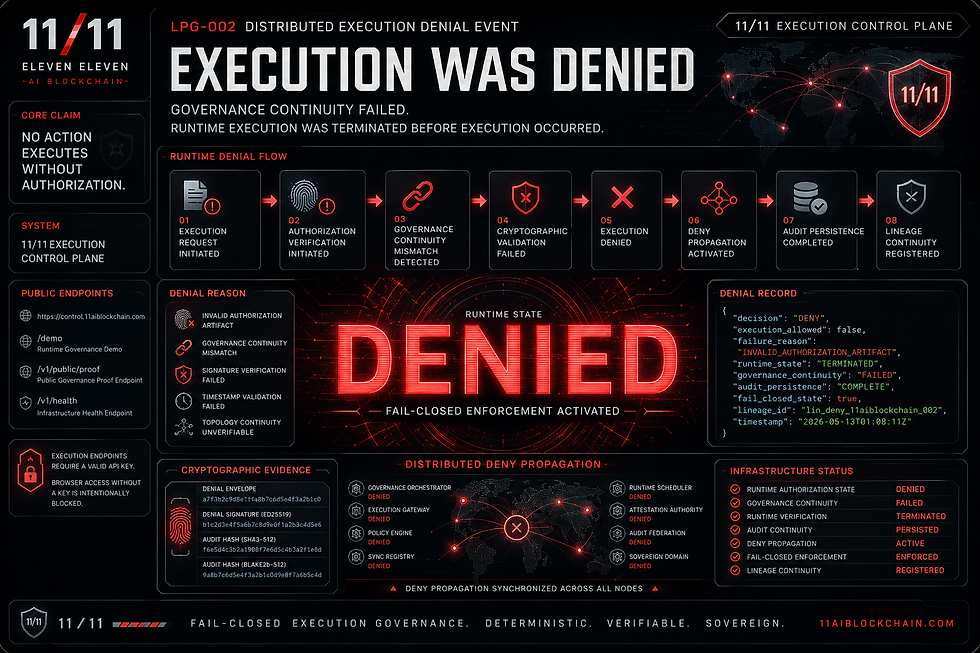
Level 4 systems continuously enforce fail-closed runtime trust.
Execution is denied or halted if:
runtime trust becomes unverifiable
authorization integrity breaks
governance continuity fails
trust expiration occurs
runtime integrity degrades
cryptographic verification fails
Execution trust remains continuously enforced.
The Operational Shift at Level 4
Level 4 fundamentally changes runtime trust architecture.
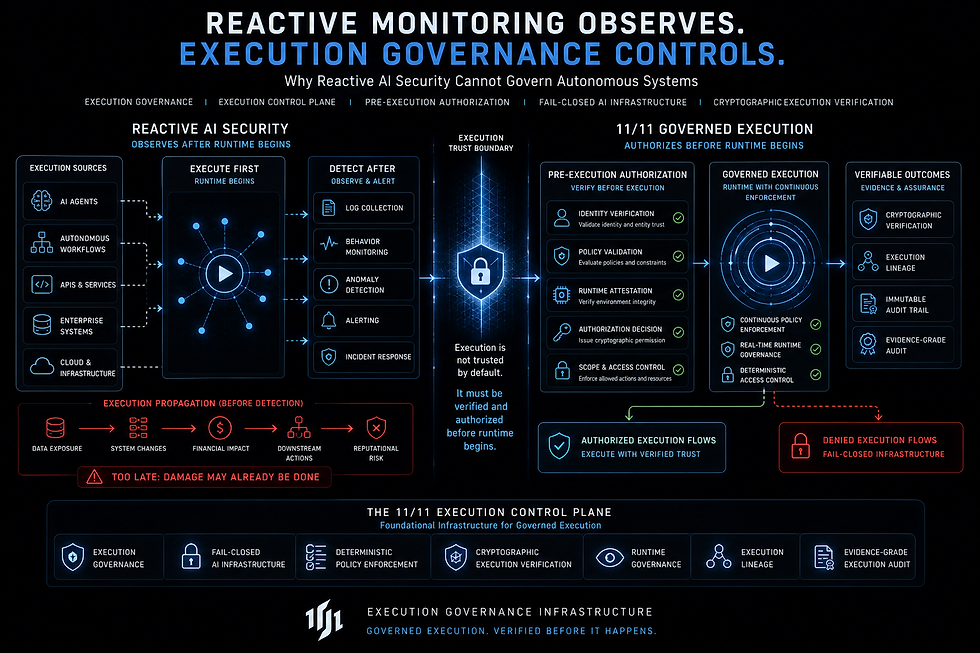
Historically:
systems trusted execution until something appeared wrong.
At Level 4:
trust must remain continuously provable.
This changes infrastructure from:
governance enforcement
to:
cryptographic governance continuity
from:
operational trust assumptions
to:
continuously validated runtime trust
from:
runtime authorization
to:
independently verifiable operational integrity
Execution trust becomes measurable infrastructure.
Typical Level 4 Architecture
Cryptographically governed runtime environments commonly introduce:
cryptographic authorization systems
runtime trust validation engines
governance continuity layers
execution proof systems
integrity attestation systems
trust synchronization infrastructure
immutable lineage systems
cryptographic audit persistence
These systems collectively establish continuously governed runtime trust.
Runtime Trust Lifecycle
Level 4 runtime trust commonly follows a deterministic governance lifecycle.
Phase 1 — Execution Authorization Issued
A cryptographically verifiable authorization artifact is generated.
Phase 2 — Runtime Trust Established
Execution environment integrity becomes trusted.
Phase 3 — Continuous Runtime Verification
Runtime conditions remain continuously validated.
Phase 4 — Governance Continuity Enforced
Trust continuity remains policy-governed and cryptographically protected.
Phase 5 — Operational Proof Generated
Execution evidence becomes independently verifiable.
Phase 6 — Lineage and Audit Continuity Persisted
Execution continuity remains cryptographically traceable.
Security Improvements at Level 4
Level 4 infrastructure significantly improves operational trust integrity.
Organizations establish:
independently verifiable authorization
cryptographically protected governance continuity
continuous runtime trust enforcement
tamper-evident audit persistence
deterministic trust continuity
operational proof transparency
execution trust accountability
Execution governance becomes cryptographically enforceable infrastructure.
Limitations Below Level 4
Organizations below Level 4 commonly remain dependent on:
partially centralized trust assumptions
non-cryptographic governance continuity
static runtime verification
operational trust fragmentation
incomplete runtime integrity validation
Execution governance remains operationally constrained.
Level 4 introduces continuously verifiable runtime trust.
Cryptographic Runtime Trust and AI Infrastructure
AI systems dramatically increase runtime trust complexity.
AI agents increasingly generate:
autonomous execution chains
dynamic runtime orchestration
distributed governance decisions
machine-generated infrastructure actions
continuously evolving execution conditions
Without cryptographically governed runtime trust:
AI infrastructure remains operationally fragile.
Level 4 governance introduces continuously verifiable trust into autonomous runtime systems.
This allows AI execution to become:
continuously governable
cryptographically verifiable
operationally trustworthy
independently auditable
fail-closed enforceable
before and during runtime execution.
Level 4 as the Cryptographic Governance Threshold
Level 4 represents the threshold where execution governance becomes cryptographically enforced infrastructure.
This is the first maturity level where:
runtime trust becomes continuously validated
governance continuity becomes tamper-evident
authorization becomes independently verifiable
operational proof becomes foundational
execution trust becomes cryptographically governed
Execution governance becomes infrastructure-grade trust architecture.
The Strategic Importance of Level 4
Level 4 becomes strategically critical for infrastructure environments supporting:
autonomous AI systems
regulated execution environments
critical infrastructure governance
distributed execution ecosystems
financial runtime systems
machine-to-machine orchestration
Execution trust becomes continuously governed operational infrastructure.
The Future Beyond Level 4
Level 4 establishes the foundation for:
federated governance ecosystems
autonomous governance orchestration
distributed runtime trust synchronization
execution governance interoperability
infrastructure-scale governed execution systems
Governance evolves toward ecosystem-wide trust continuity.
11/11 Runtime Trust Infrastructure
11/11 is developing cryptographically governed runtime trust infrastructure focused on:
continuous runtime verification
authorization artifact validation
fail-closed trust enforcement
operational proof systems
execution lineage continuity
cryptographic governance continuity
independently verifiable execution trust
Runtime trust becomes continuously governed infrastructure.
Operational Proof Surfaces
Public Governance Console
Runtime Governance Demo
Public Governance Proof Viewer
Infrastructure Health Dashboard
Execution Lineage Explorer

Comments