
Why Machine-Speed Governance Is Becoming National Infrastructure


Autonomous systems are changing the speed of infrastructure.
Across government, finance, healthcare, defense, logistics, communications, and digital operations, execution is increasingly occurring at machine speed.
Software no longer waits for traditional approval cycles.
Workflows no longer depend entirely on human coordination.
Operational systems now evaluate, route, authorize, trigger, synchronize, and execute actions automatically.
That creates a new infrastructure requirement.
Governance itself must operate at machine speed.
Traditional oversight systems were built for slower operational environments. Human review, escalation chains, audit committees, and retrospective analysis were sufficient when infrastructure moved at human speed.
That assumption no longer holds.
A machine-speed system can produce thousands of operational decisions before a manual review process even begins.
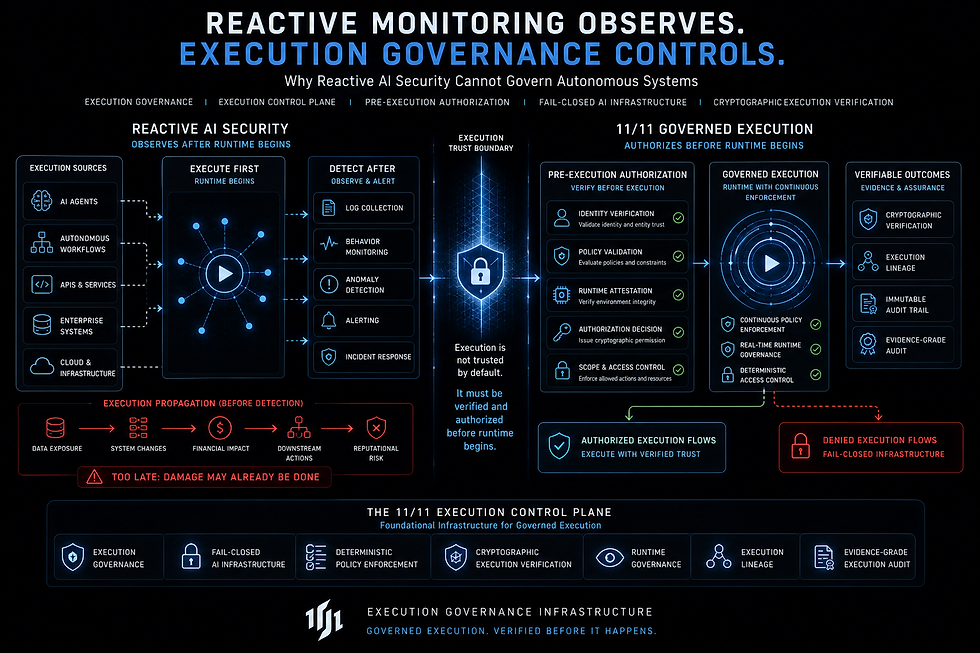
By the time an event is investigated, the execution has already occurred.
By the time oversight reacts, the infrastructure may already be affected.
This is why governance can no longer exist only as policy documentation or post-event analysis.
Governance must become an active operational layer inside execution infrastructure itself.
This is the emergence of machine-speed governance.
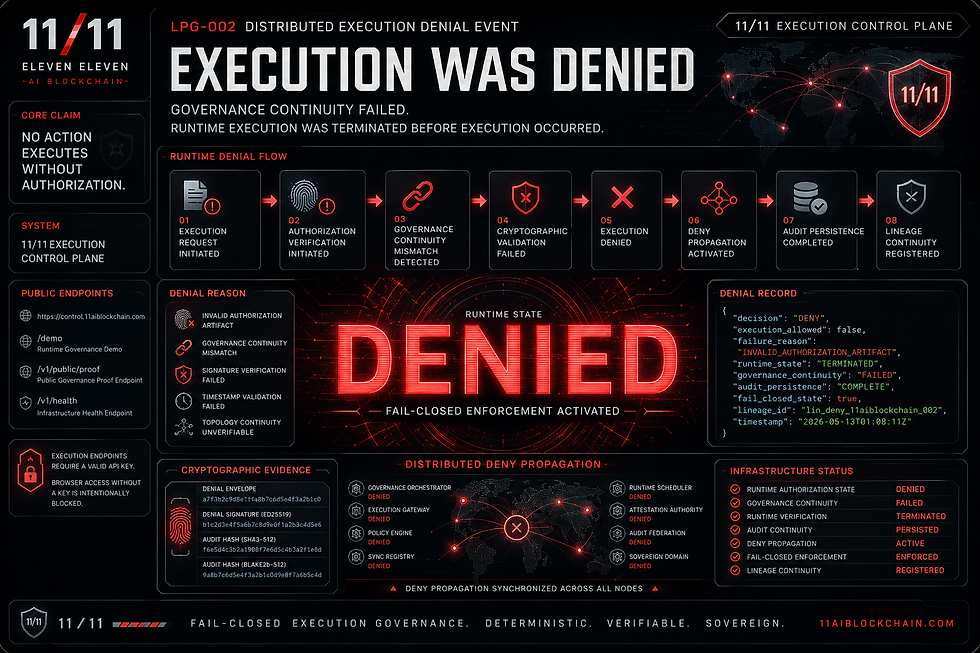
Machine-speed governance means the infrastructure can evaluate execution conditions before the action occurs.
Identity is validated.
Authorization is confirmed.
Policy is evaluated.
Runtime conditions are checked.
Environmental context is verified.
Operational lineage is prepared.
Execution is either admitted or denied.
All before the action proceeds.
This transforms governance from a reactive process into a deterministic infrastructure function.
The implications are enormous.
Critical systems increasingly depend on autonomous coordination between APIs, orchestration layers, AI systems, cloud runtimes, decision engines, financial rails, and infrastructure automation.
Without runtime governance, these systems operate on assumption.
With governed execution, infrastructure operates on proof.
That distinction defines the future operational boundary of sovereign systems.
Machine-speed governance is not about slowing automation down.
It is about ensuring autonomous systems remain governed while operating at scale.
It enables infrastructure to maintain operational trust even when execution occurs faster than humans can intervene.
That is why fail-closed enforcement becomes critical.
If valid governance proof does not exist, execution should not proceed.
No authorization means no execution.
No proof means no operational trust.
This creates deterministic infrastructure behavior instead of probabilistic operational risk.
Machine-speed governance therefore becomes foundational for:
sovereign infrastructure
autonomous public systems
regulated AI environments
defense modernization
critical financial infrastructure
operational continuity systems
national digital coordination
The infrastructure question is no longer whether autonomous systems will exist.
They already do.
The real question is whether those systems will operate under governed execution or uncontrolled automation.
11/11 positions Execution Governance™ as the infrastructure layer designed for this transition.
A runtime governance architecture where operational trust is enforced before execution.
A fail-closed control plane for machine-speed infrastructure.
A deterministic governance model for autonomous systems operating at civilization scale.
Machine-speed systems require machine-speed governance.
That is the operational shift now underway.
That is why execution governance is becoming national infrastructure.
Public Infrastructure Endpoints
Public Runtime Infrastructure
Public Governance Console
Runtime Governance Demo
Public Governance Proof Viewer
Infrastructure Health Dashboard
Execution Lineage Explorer
Execution endpoints intentionally require valid API authorization.
Browser access without a valid authorization key is fail-closed by design.
11/11 introduces Execution Governance™ infrastructure for governed autonomous execution and deterministic operational trust.
Execution Governance™
Governed Execution™
Patent Pending

Comments