
Pre-Execution Authorization in Practice


Most AI systems today still rely on implicit runtime trust.
Execution begins.
Monitoring occurs afterward.
Policy enforcement often becomes reactive rather than preventative.
11/11 was designed around a different operational model.
Execution is not trusted by default.
Execution must first become:
verified
authorized
policy-governed
cryptographically validated
before runtime execution begins.
This is the operational foundation of pre-execution authorization.
And unlike purely theoretical governance models, the 11/11 execution control plane now demonstrates this architecture operationally through live execution governance infrastructure.
What Pre-Execution Authorization Actually Means
Pre-execution authorization means runtime execution cannot begin until governance conditions are satisfied first.
This differs fundamentally from traditional runtime security models.
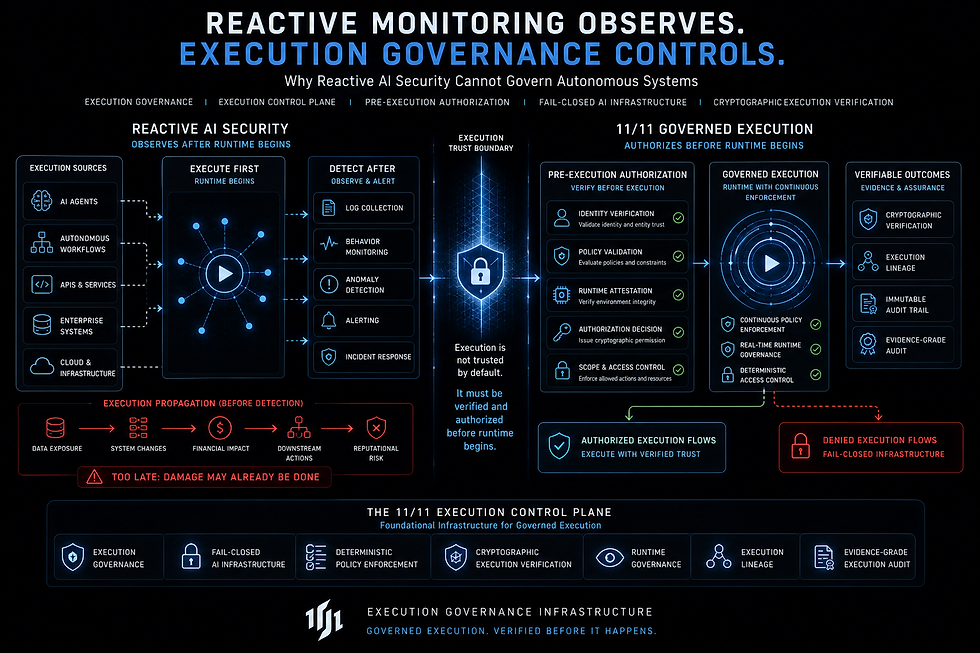
In most environments today:
access is granted
execution begins
monitoring observes afterward
detection attempts to identify problems reactively
Governed execution changes this sequence entirely.
Under the 11/11 execution control plane:
execution request received
policy evaluated
identity validated
runtime conditions verified
authorization artifact issued
runtime execution permitted
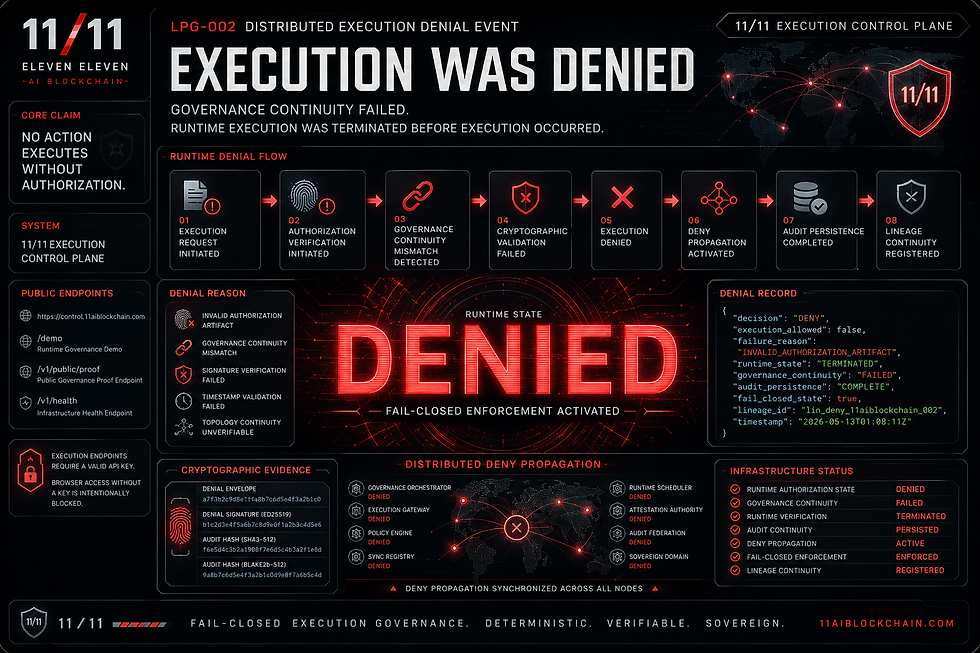
If any condition fails:
execution is denied
authorization artifact is not issued
runtime execution is never called
fail-closed enforcement activates automatically
This creates deterministic execution governance before runtime begins.
The Role of Policy Validation
The first operational layer of pre-execution authorization is policy enforcement.
When execution requests enter the execution control plane, the system evaluates:
execution intent
protected rules
role permissions
API authorization scope
operational constraints
execution context
runtime trust conditions
This is deterministic policy enforcement.
The goal is not merely to observe policy violations afterward.
The goal is to prevent unauthorized execution before runtime propagation occurs.
If policy validation fails:
execution stops
authorization stops
runtime execution never begins
This creates fail-closed AI infrastructure by design.
API Key Gating and Role Validation
The execution control plane also validates identity and access conditions before authorization issuance occurs.
This includes:
API key verification
role validation
permission scope evaluation
execution boundary enforcement
request integrity validation
Execution authorization is therefore tied directly to operational trust conditions.
Not merely generic authentication.
An execution request must demonstrate:
valid identity
authorized role
permitted execution scope
trusted runtime conditions
policy-compliant intent
before authorization is permitted.
This creates a continuously governed execution trust boundary around runtime activity itself.
Ed25519 Authorization Artifacts
One of the most important operational concepts inside the 11/11 architecture is the authorization artifact.
When execution is approved:
an authorization artifact is generated
the artifact is cryptographically signed
execution permissions become bound to governance conditions
runtime trust becomes verifiable
11/11 uses Ed25519 signing for authorization issuance and runtime trust validation.
This creates:
cryptographic execution verification
tamper-evident authorization
independently verifiable execution trust
evidence-grade execution authorization
The authorization artifact becomes operational proof that governed execution has been permitted under validated runtime conditions.
Without the artifact, runtime execution cannot proceed.
Why Authorization Happens Before Runtime
The operational distinction is critical.
In reactive architectures:
runtime execution begins first
governance occurs afterward
In governed execution architectures:
governance occurs first
runtime execution occurs afterward
This difference fundamentally changes runtime trust.
Execution propagation may occur at machine speed across:
orchestration layers
APIs
autonomous systems
distributed runtime environments
infrastructure services
By the time reactive systems observe unauthorized execution, downstream impact may already propagate.
Pre-execution authorization solves this by establishing governance before runtime begins.
Fail-Closed Conditions
The execution control plane was designed around fail-closed operational behavior.
Meaning:
If trust fails, execution stops.
Examples include:
invalid API key
unauthorized role
policy violation
invalid runtime conditions
integrity verification failure
missing authorization artifact
cryptographic verification failure
Under these conditions:
runtime execution is denied
authorization artifacts are not issued
execution lineage does not continue
fail-closed containment activates automatically
This creates continuously governed execution infrastructure rather than reactive runtime infrastructure.
Why Execution Lineage Matters
Authorization is not isolated from runtime governance.
Once execution begins, the execution control plane continuously records:
execution lineage
runtime integrity
authorization continuity
policy enforcement state
cryptographic verification evidence
downstream propagation activity
This creates:
immutable execution audit
evidence-grade execution verification
runtime governance continuity
execution trust accountability
Execution governance therefore continues before, during, and after runtime activity itself.
Public Runtime Proof Infrastructure
The public proof phase now demonstrates this architecture operationally.
Public demo:
Health endpoint:
Public proof endpoint:
These endpoints demonstrate:
governed execution
deterministic policy enforcement
fail-closed AI infrastructure
execution lineage
cryptographic execution verification
runtime governance
evidence-grade execution verification
The execution control plane is therefore not presented merely as conceptual doctrine.
It is operational governance infrastructure.
Why This Represents a Different Infrastructure Category
Most AI infrastructure today still optimizes primarily for:
model scale
orchestration speed
observability
workflow automation
runtime acceleration
11/11 is positioned differently.
11/11 governs whether execution is operationally allowed before runtime begins.
This defines a separate infrastructure category centered around:
execution governance
execution control planes
governed execution
pre-execution authorization
deterministic policy enforcement
runtime governance
execution lineage
cryptographic execution verification
evidence-grade execution verification
fail-closed AI infrastructure
Execution itself becomes governed infrastructure.
That is the category boundary.
Execution governance systems, execution control plane architectures, governed execution models, and related runtime authorization technologies described herein are patent pending under ongoing intellectual property filings associated with 11/11.

Comments