
Why Reactive AI Security Cannot Govern Autonomous Systems

Updated: May 13
Modern AI infrastructure is evolving faster than its security architecture.
Autonomous systems now coordinate workflows, trigger external actions, interact with operational infrastructure, and increasingly execute with limited human involvement.
But most AI security models still rely on a fundamentally reactive assumption:
Observe execution after runtime begins.
This assumption shaped earlier generations of cybersecurity because traditional systems were largely deterministic, human-driven, and operationally constrained.
Autonomous AI systems are not.
They operate dynamically across distributed infrastructure, machine-driven workflows, API chains, external integrations, and continuously shifting runtime environments.
This creates a structural mismatch between modern execution environments and legacy security architecture.
Reactive monitoring is no longer sufficient to govern execution.
AI infrastructure now requires execution governance.
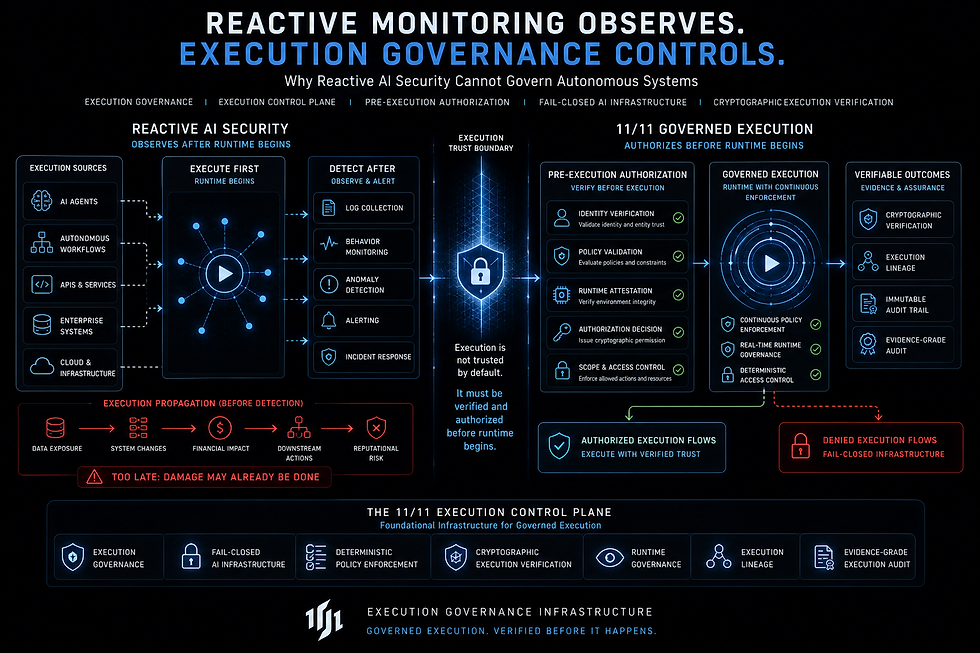
The Structural Problem With Reactive Security
Reactive security models operate after execution begins.
Detection systems analyze telemetry after runtime activity occurs.
Monitoring systems inspect behavior after execution propagates.
Audit systems reconstruct events after infrastructure states have already changed.
This creates a governance delay.
In static systems, that delay may be operationally manageable.
In autonomous systems, it becomes increasingly dangerous.
Because autonomous execution compounds rapidly.
A single authorized event may trigger:
secondary execution chains
recursive workflows
infrastructure modifications
cross-system API interactions
financial actions
data movement
machine-generated decision trees
By the time reactive systems detect abnormal behavior, execution may already have propagated beyond containment boundaries.
This is not merely a tooling limitation.
It is an architectural limitation.
Reactive systems fundamentally govern too late.
Why Autonomous Systems Change the Infrastructure Requirement
Traditional enterprise software primarily executed within predictable operational boundaries.
AI systems increasingly do not.
Autonomous systems adapt dynamically.
Execution paths evolve in real time.
Runtime conditions continuously change.
Decision chains may become non-linear and machine-generated.
This changes the infrastructure trust model entirely.
The central infrastructure problem is no longer simply:
“How do we monitor execution?”
The more important question becomes:
“How do we govern whether execution is allowed before runtime begins?”
That distinction defines the transition from reactive security to governed execution.
The Rise of Execution Governance
Execution governance introduces a fundamentally different infrastructure model.
Instead of allowing execution first and inspecting afterward, governed execution evaluates authorization conditions before runtime occurs.
Execution becomes conditional.
Not assumed.
Under an execution governance architecture:
policies are validated before execution
runtime conditions are evaluated before authorization
identities are verified before actions occur
execution permissions are cryptographically issued
execution lineage is recorded immutably
runtime enforcement remains continuous throughout execution
This creates a deterministic execution trust boundary around runtime activity itself.
Not merely around users.
Not merely around networks.
Around execution.
That distinction increasingly defines trusted AI infrastructure.
Why Runtime Detection Alone Fails at Scale
Modern security tooling often assumes visibility equals control.
But visibility alone does not govern execution.
Observability can explain what happened.
It cannot prevent what already occurred.
This becomes increasingly problematic in autonomous environments where execution velocity exceeds human response capacity.
By the time monitoring systems generate alerts:
transactions may already finalize
sensitive data may already propagate
infrastructure states may already change
downstream execution chains may already trigger
machine coordination may already expand
Reactive systems observe consequences.
Governed execution controls authorization.
These are fundamentally different operational models.
The Execution Control Plane as a Governance Layer
As AI systems become operational infrastructure, a new infrastructure layer emerges:
The execution control plane.
The execution control plane governs execution before runtime occurs.
Its responsibility is not model generation.
Its responsibility is execution authorization and runtime governance.
The execution control plane determines:
whether execution is permissible
which policies apply
what runtime conditions are required
what systems may be accessed
what identities are trusted
what cryptographic evidence must exist
whether execution remains compliant throughout runtime
This creates an operational governance layer beneath AI systems.
A runtime trust architecture.
A deterministic enforcement system.
An infrastructure-grade authorization boundary.
Why Fail-Closed Infrastructure Becomes Necessary
Reactive systems typically operate fail-open by default.
If monitoring systems fail, execution often continues.
If telemetry degrades, execution frequently proceeds anyway.
If verification becomes uncertain, runtime activity often persists until interruption occurs later.
Autonomous infrastructure cannot safely scale under these assumptions.
This is why governed execution increasingly moves toward fail-closed AI infrastructure.
Under fail-closed infrastructure:
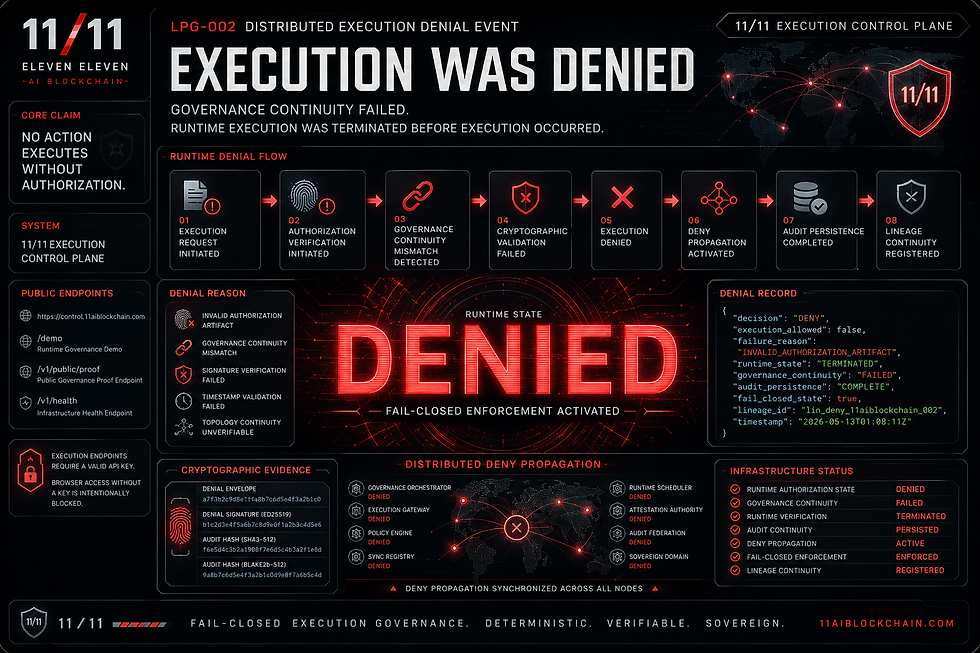
unverifiable execution is denied
missing authorization results in containment
invalid runtime attestations halt execution
broken trust chains prevent runtime continuation
unavailable governance systems default to denial
Execution is not trusted automatically.
Execution must first be authorized.
This becomes increasingly necessary as AI systems gain operational authority inside regulated and high-consequence environments.
Why Cryptographic Execution Verification Matters
Governed execution ultimately requires independently verifiable trust.
Not merely observational trust.
This is why cryptographic execution verification becomes foundational.
Under governed execution architectures:
execution authorization is cryptographically signed
runtime integrity becomes verifiable
policy decisions become independently provable
execution lineage becomes tamper-evident
evidence-grade execution audit becomes possible
This transforms infrastructure trust from procedural trust into mathematical trust.
That distinction matters in environments where execution integrity must be provable rather than assumed.
Particularly within:
healthcare systems
financial infrastructure
autonomous industrial systems
regulated enterprise environments
defense infrastructure
operational AI systems
Execution governance becomes the trust layer beneath runtime execution itself.
Why This Defines the Next AI Infrastructure Layer
The AI industry currently focuses heavily on model capability.
But infrastructure markets historically mature around governance layers.
Cloud computing matured around orchestration and isolation systems.
Enterprise computing matured around identity governance.
Distributed systems matured around operational trust boundaries.
AI infrastructure is now entering the execution governance phase.
This phase increasingly requires:
governed execution
execution control planes
runtime governance
deterministic policy enforcement
pre-execution authorization
fail-closed AI infrastructure
cryptographic execution verification
immutable execution audit
evidence-grade execution lineage
These systems increasingly become foundational infrastructure requirements rather than optional security enhancements.
11/11 and the Future of Governed Execution
11/11 is not positioned as a generic AI platform.
11/11 is building execution governance infrastructure.
The objective is to establish the runtime trust layer beneath AI execution.
11/11 introduces infrastructure centered around:
execution governance
governed execution
execution control planes
pre-execution authorization
deterministic policy enforcement
fail-closed AI infrastructure
cryptographic execution verification
immutable execution audit
execution lineage systems
As autonomous systems continue expanding into operational infrastructure, reactive monitoring alone becomes structurally insufficient.
Trusted AI infrastructure increasingly requires governance before runtime execution begins.
That transition defines the emergence of execution governance as a foundational infrastructure category.
And 11/11 is building the execution governance layer designed to enforce it.
Execution Governance™, Governed Execution™, and related execution control plane terminology are used by 11/11 to describe emerging infrastructure models centered on pre-execution authorization, deterministic policy enforcement, and cryptographic runtime verification for AI systems and autonomous infrastructure.
Patent Pending Certain systems, architectures, infrastructure models, execution governance methods, and runtime authorization mechanisms described herein are subject to ongoing U.S. and international patent filings and related intellectual property protections by 11/11.
Public Governance Console
Runtime Governance Demo
Public Governance Proof Viewer
Infrastructure Health Dashboard
Execution Lineage Explorer
Execution Governance™, Governed Execution™, and related execution control plane terminology are used by 11/11 to describe emerging infrastructure models centered on pre-execution authorization, deterministic policy enforcement, and cryptographic runtime verification for AI systems and autonomous infrastructure.
Patent Pending. Certain systems, architectures, infrastructure models, execution governance methods, and runtime authorization mechanisms described herein are subject to ongoing U.S. and international patent filings and related intellectual property protections by 11/11.


Comments