
What Is Execution Governance?
- 11/11 AI

- May 7
- 3 min read
Updated: May 13
Artificial intelligence is rapidly becoming embedded into critical infrastructure, enterprise systems, autonomous operations, financial networks, and government environments.
Yet most AI systems still operate on a fundamentally flawed model:
They execute first and verify later.
Modern infrastructure largely depends on:
post-execution monitoring
reactive detection
runtime observation
after-the-fact audit logging
By the time something is detected, execution has already occurred.
That model may have been acceptable for traditional software environments.
It is not acceptable for autonomous AI systems.
As AI gains the ability to:
make operational decisions
trigger workflows
access regulated systems
coordinate infrastructure
execute machine-driven actions
execution itself becomes the primary trust boundary.
This is where execution governance emerges.
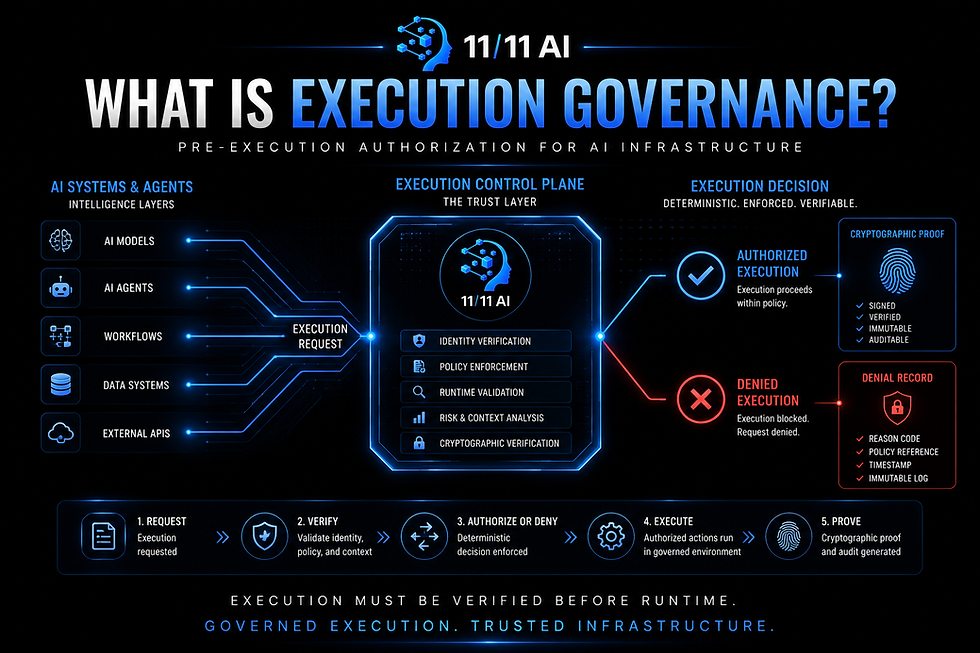
The Shift From Reactive Security to Governed Execution
Traditional cybersecurity focuses heavily on perimeter defense and post-event analysis.
Execution governance introduces a different model.
Instead of observing execution after it occurs, execution governance verifies whether execution is authorized before runtime begins.
This changes the security model entirely.
Under an execution governance architecture:
identity is verified before execution
policy is enforced before runtime
execution authorization is validated deterministically
unauthorized actions are denied
all execution produces cryptographic evidence
This creates:fail-closed AI infrastructure.
What Is an Execution Control Plane?
An execution control plane is the infrastructure layer responsible for governing whether intelligent systems are permitted to execute.
Rather than acting as another AI application, the execution control plane sits beneath models, agents, workflows, and runtime systems.
Its responsibility is not generating intelligence.
Its responsibility is controlling execution.
Core capabilities include:
pre-execution authorization
deterministic policy enforcement
runtime verification
cryptographic execution validation
immutable audit generation
execution lineage tracking
enforcement orchestration
This creates a governed execution environment where trust is enforced directly at runtime.
Why Runtime Detection Is No Longer Enough
Most existing AI security models remain reactive.
They attempt to:
monitor outputs
detect anomalies
observe runtime behavior
investigate incidents afterward
But once execution occurs:the system state may already be altered.
Data may already be exposed.Actions may already be triggered.Infrastructure may already be affected.
Execution governance introduces a different assumption:
Execution is not trusted by default.
Execution must be authorized.
This is the architectural shift.
The Importance of Fail-Closed AI Infrastructure
Fail-open systems assume execution should proceed unless something explicitly blocks it.
Fail-closed systems reverse that logic.
Execution is categorically denied unless authorization requirements are satisfied.
This includes scenarios such as:
invalid signatures
expired authorization
unauthorized runtime state
revoked policies
tampered execution requests
unverified infrastructure conditions
Under a fail-closed model:execution denial becomes a security feature.
Not a system failure.
Cryptographic Execution Verification
Execution governance also introduces a new trust layer:cryptographic execution verification.
Every authorized action can produce:
signed execution evidence
immutable audit records
execution lineage metadata
runtime verification artifacts
policy validation proofs
This creates evidence-grade execution integrity.
Not merely operational logging.
Why This Infrastructure Layer Matters
AI systems are moving rapidly into:
defense environments
financial systems
autonomous operations
healthcare infrastructure
critical enterprise workflows
These systems require:
deterministic control
verifiable runtime trust
execution integrity
infrastructure accountability
policy-governed operations
The future of AI infrastructure will not be defined solely by model intelligence.
It will be defined by execution governance.
The Emergence of a New Infrastructure Category
Major infrastructure shifts historically create new foundational categories.
VMware helped define virtualization.NVIDIA established accelerated computing through CUDA.CrowdStrike shaped endpoint detection and response.OpenAI normalized foundation models.
Execution governance represents a similar architectural shift.
As intelligent systems become operational actors rather than passive tools, infrastructure must evolve from:open execution
to:governed execution.
This is the purpose of the execution control plane.
Execution is no longer trusted by default.
It must be verified.It must be authorized.It must be governable.
The next era of AI infrastructure will be built around execution governance.
Execution Governance™, Governed Execution™, and related execution control plane terminology are used by 11/11 to describe emerging infrastructure models centered on pre-execution authorization, deterministic policy enforcement, and cryptographic runtime verification for AI systems and autonomous infrastructure.
Patent Pending. Certain systems, architectures, infrastructure models, execution governance methods, and runtime authorization mechanisms described herein are subject to ongoing U.S. and international patent filings and related intellectual property protections by 11/11.
Public Governance Console
Runtime Governance Demo
Public Governance Proof Viewer
Infrastructure Health Dashboard
Execution Lineage Explorer


Comments