
Why Civilizations Create Legitimacy


Every civilization eventually discovers a limit to power.
Power can compel behavior.
Power can enforce decisions.
Power can create compliance.
Yet power alone struggles to create continuity.
The reason is simple.
Civilizations do not endure because participants obey.
Civilizations endure because participants recognize.
Recognition transforms authority.
Recognition transforms institutions.
Recognition transforms rules.
The result is legitimacy.
Legitimacy may be one of the most important inventions in constitutional history.
Without legitimacy, civilizations depend primarily upon force.
With legitimacy, civilizations begin depending upon recognition.
This transition changes everything.
Power And Recognition
Power explains what can be done.
Legitimacy explains why it is accepted.
The distinction is subtle but profound.
A participant may comply with authority because enforcement exists.
A participant may also comply because the authority is recognized as rightful.
The second condition is more durable.
Recognition survives where enforcement becomes expensive.
Recognition scales where coercion struggles.
Civilizations therefore create legitimacy because legitimacy reduces the cost of maintaining order.
Why Recognition Matters
Recognition creates continuity.
When participants recognize institutions, institutions become durable.
When participants recognize constitutional order, constitutional order becomes stable.
When recognition disappears, continuity weakens.
The institution may remain.
The authority may remain.
The structure may remain.
Yet legitimacy begins fading.
Eventually the visible structure survives while the constitutional foundation weakens.
Recognition therefore becomes one of the deepest foundations beneath civilization itself.
Legitimacy Reduces Friction
Civilizations continuously coordinate behavior.
Participation.
Responsibility.
Stewardship.
Authority.
Without legitimacy, every interaction requires greater effort.
Every decision requires more enforcement.
Every disagreement requires more intervention.
Legitimacy reduces this friction.
Participants cooperate because constitutional order is recognized as valid.
The civilization becomes easier to sustain.
Constitutional Legitimacy
Constitutions play a unique role in creating legitimacy.
They establish:
Authority
Boundaries
Recognition
Participation
Continuity
The constitution provides a shared explanation for why authority exists.
This explanation becomes the foundation of legitimacy.
Without constitutional legitimacy, authority becomes increasingly dependent upon power alone.
Why Computational Civilizations Need Legitimacy
Future computational civilizations will face similar challenges.
Persistent execution environments.
Digital institutions.
Autonomous constitutional systems.
Machine-scale governance.
Each must eventually answer the same question:
Why should participants recognize the system?
This question is constitutional before it is technical.
The answer becomes legitimacy.
Legitimacy And Continuity
The deeper purpose of legitimacy is continuity.
Civilizations survive because institutions survive.
Institutions survive because recognition survives.
Recognition survives because legitimacy survives.
The chain extends through every enduring constitutional order.
Legitimacy therefore becomes one of the most important forms of civilizational infrastructure.
The Cost Of Lost Legitimacy
History repeatedly demonstrates what happens when legitimacy weakens.
Trust declines.
Participation declines.
Authority becomes contested.
Continuity fragments.
The problem rarely begins with institutional collapse.
The problem begins with declining recognition.
Civilizations often lose legitimacy before they lose structure.
Beyond Trust
Trust explains confidence.
Legitimacy explains recognition.
The constitutional question is no longer:
What do we trust?
The constitutional question becomes:
What do we recognize as rightful?
Legitimacy emerges as the answer.
Civilizational Stability
Stable civilizations tend to possess strong legitimacy structures.
Participants recognize authority.
Institutions recognize boundaries.
Constitutional order remains coherent.
The civilization spends less effort maintaining itself and more effort evolving.
Legitimacy becomes an engine of stability.
Conclusion
Civilizations create legitimacy because continuity depends upon recognition.
Power creates capability.
Recognition creates legitimacy.
Legitimacy creates continuity.
As computational civilization evolves, legitimacy may become one of the most important constitutional infrastructures ever developed.
Trust preserves cooperation.
Legitimacy preserves civilization.
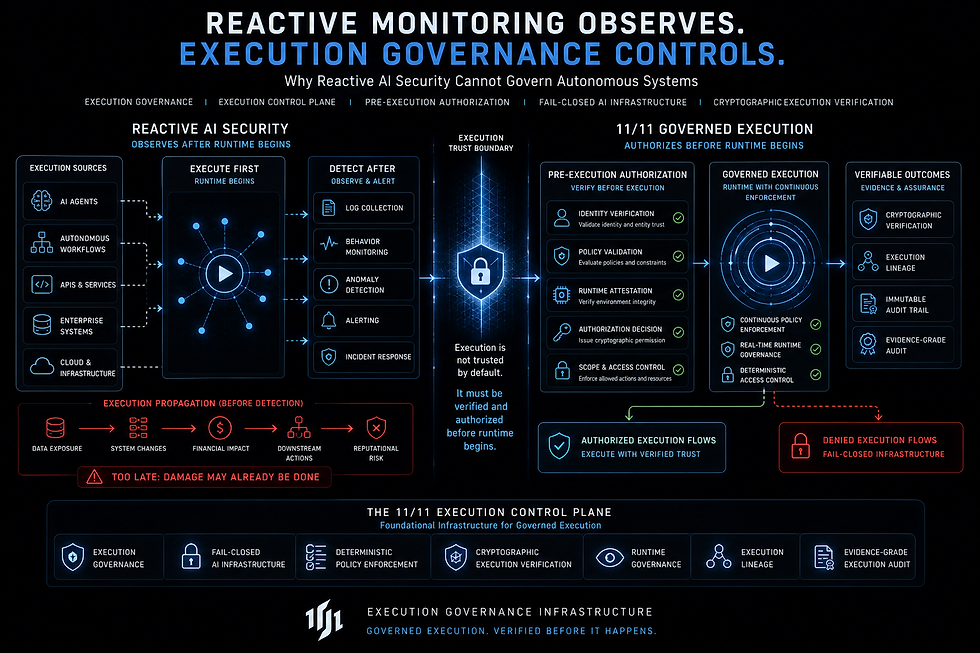
11/11 introduces Execution Governance™ infrastructure for governed autonomous execution and deterministic operational control.
Execution Governance™ Governed Execution™ EA-11™ Execution Arithmetic™
Patent Pending
Public Infrastructure Endpoints

Comments