
Why Civilizations Create Memory


Every civilization faces the same challenge.
Time.
People leave.
Generations change.
Institutions evolve.
Technologies disappear.
Circumstances transform.
Without a mechanism for preserving knowledge across these transitions, civilization continuously restarts itself.
The result is instability.
Every lesson must be relearned.
Every mistake must be repeated.
Every achievement becomes temporary.
Civilizations therefore create memory.
Not merely records.
Not merely archives.
Memory.
A structured mechanism through which continuity survives the passage of time.
The deeper a civilization becomes, the more important memory becomes.
Eventually memory transforms from a convenience into a constitutional necessity.
Memory Solves The Continuity Problem
Continuity depends upon persistence.
Persistence depends upon memory.
Without memory there can be no durable continuity.
A civilization incapable of remembering becomes trapped within the present.
The future becomes disconnected from the past.
Civilizations create memory because continuity requires a bridge between generations.
Memory becomes that bridge.
Knowledge Is Not Memory
Knowledge and memory are different.
Knowledge may exist.
Memory preserves it.
A civilization may possess extraordinary knowledge.
Without memory structures, that knowledge disappears with the people who hold it.
Memory transforms individual understanding into civilizational continuity.
The distinction is critical.
Knowledge belongs to participants.
Memory belongs to civilization.
Why Constitutional Systems Remember
Constitutions themselves are memory structures.
They preserve principles.
They preserve boundaries.
They preserve legitimacy.
They preserve assumptions about order.
The constitution exists because civilizations eventually recognize that continuity requires preserved memory.
The constitution becomes institutional memory made durable.
Memory Creates Identity
Identity persists because memory persists.
A civilization remembers who it is.
An institution remembers why it exists.
A participant remembers where they belong.
Memory therefore becomes one of the deepest foundations beneath constitutional identity.
Without memory, identity dissolves.
Without identity, continuity becomes impossible.
Memory Creates Legitimacy
Legitimacy depends upon continuity.
Continuity depends upon memory.
A constitutional order derives legitimacy partly from its ability to demonstrate continuity across time.
Memory preserves this continuity.
The civilization recognizes itself because it remembers itself.
The result is constitutional stability.
Why Computational Civilizations Will Create Memory
Future computational civilizations will likely require memory structures even more than institutional civilizations.
Persistent execution systems.
Digital constitutional orders.
Autonomous infrastructures.
Machine-scale governance environments.
Each will depend upon preserved continuity.
Computational memory becomes constitutional infrastructure.
Not because technology requires storage.
Because civilization requires continuity.
Memory And Stewardship
The deeper purpose of memory is stewardship.
Civilizations inherit knowledge from previous generations.
Memory preserves that inheritance.
Participants become stewards of continuity rather than isolated actors.
This relationship explains why memory repeatedly emerges wherever civilizations endure.
The Cost Of Forgetting
History repeatedly demonstrates the consequences of forgetting.
Institutions lose coherence.
Civilizations lose identity.
Constitutional systems lose legitimacy.
The problem is not the absence of information.
The problem is the absence of continuity.
Memory protects civilizations from beginning again every generation.
Beyond Participation
Participation explains continuity.
Memory explains persistence.
The constitutional question is no longer:
Who participates?
The constitutional question becomes:
What survives participation?
The answer is memory.
Conclusion
Civilizations create memory because continuity requires preservation.
Identity depends upon memory.
Legitimacy depends upon memory.
Constitutional order depends upon memory.
As computational civilization emerges, memory may become one of its most important constitutional structures.
Civilizations survive because they remember.
Memory transforms participation into continuity.
Continuity transforms society into civilization.
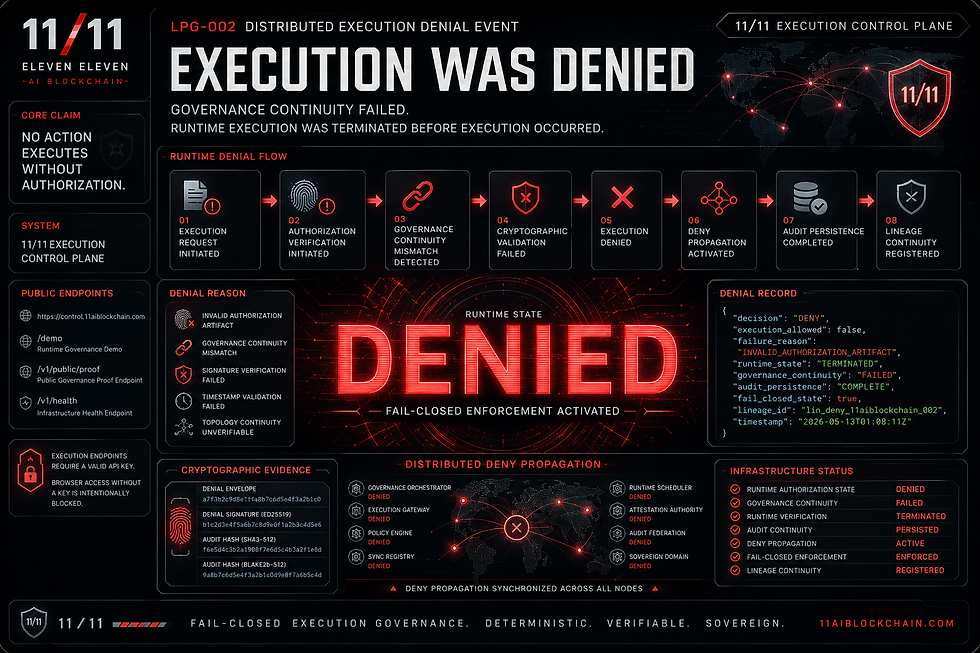
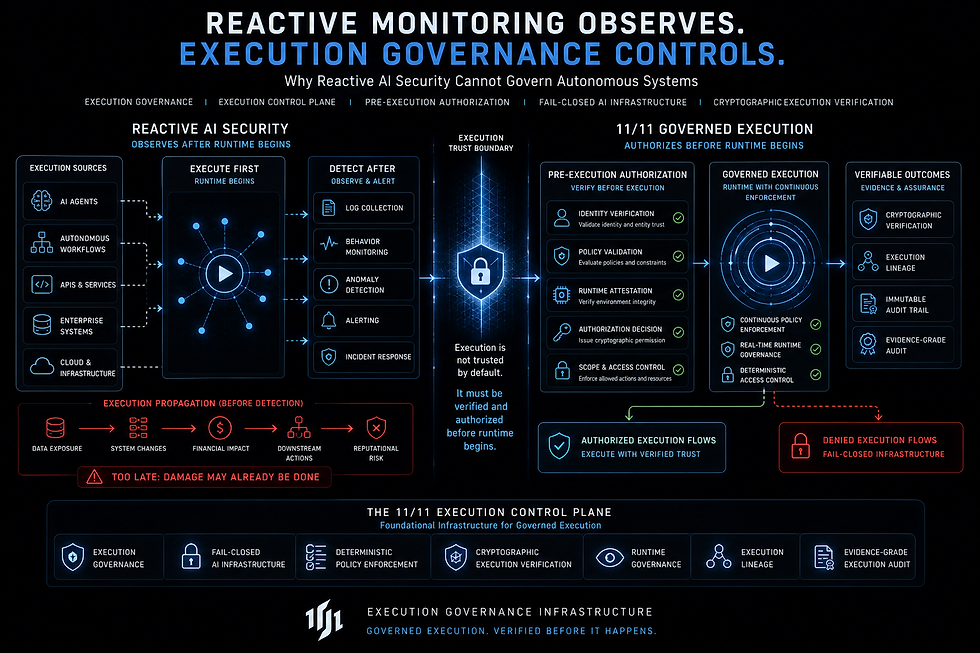
11/11 introduces Execution Governance™ infrastructure for governed autonomous execution and deterministic operational control.
Execution Governance™ Governed Execution™ EA-11™ Execution Arithmetic™
Patent Pending
Public Infrastructure Endpoints

Comments