
Why Civilizations Create Precedent


Memory preserves the past.
Yet memory alone does not preserve continuity.
A civilization may remember every decision it has ever made and still fail to create stability.
The reason is simple.
Memory records.
Precedent guides.
This distinction becomes increasingly important as civilizations mature.
Eventually every constitutional order confronts the same question:
Should similar situations be treated similarly?
The answer creates precedent.
Precedent emerges because continuity requires more than memory.
Continuity requires consistency.
Without consistency, every generation begins negotiating reality again.
Without consistency, every institution becomes unpredictable.
Without consistency, constitutional order becomes unstable.
Precedent develops because civilizations require a mechanism for carrying judgment across time.
Memory Records. Precedent Applies.
The difference between memory and precedent is profound.
Memory answers:
What happened?
Precedent answers:
What should happen now because of what happened before?
This transformation changes stored knowledge into operational continuity.
Civilizations do not merely remember prior decisions.
They inherit them.
Precedent becomes inherited judgment.
Why Consistency Matters
Constitutional systems depend upon predictability.
Predictability depends upon consistency.
Consistency depends upon precedent.
Without precedent, every decision becomes isolated.
Every situation becomes unique.
Every outcome becomes uncertain.
The result is instability.
Precedent emerges because civilizations eventually discover that continuity requires recurring patterns of judgment.
Precedent Creates Expectations
One of the deepest functions of precedent is expectation.
Participants begin understanding how constitutional order behaves.
Institutions begin understanding how constitutional order responds.
Civilizations become predictable.
Predictability creates trust.
Trust creates participation.
Participation creates continuity.
Precedent therefore supports constitutional order indirectly through expectation.
Why Precedent Outlives Decisions
Individual decisions are temporary.
Precedent persists.
The decision addresses a specific circumstance.
The precedent influences future circumstances.
This persistence allows constitutional systems to accumulate continuity rather than continuously restart themselves.
The civilization learns.
The learning survives.
Constitutional Memory Becomes Constitutional Guidance
As constitutional systems mature, memory evolves.
At first memory simply preserves events.
Eventually memory begins shaping future behavior.
This transition marks the emergence of precedent.
The civilization is no longer merely remembering.
It is applying remembered judgment.
The result is constitutional continuity across generations.
Computational Precedent
Future computational civilizations may develop similar structures.
Persistent execution environments.
Governed digital institutions.
Autonomous constitutional systems.
Machine-scale governance frameworks.
Each will eventually confront recurring situations.
The pressure for consistency will create precedent.
Not because precedent is programmed.
Because continuity requires it.
The Danger Of Forgetting Precedent
Civilizations occasionally lose continuity not because memory disappears but because precedent disappears.
Knowledge remains available.
Judgment stops being inherited.
The result is fragmentation.
Each generation begins solving problems already solved by previous generations.
Progress slows.
Instability increases.
Precedent protects civilizations from perpetual reinvention.
Beyond Memory
Memory preserves knowledge.
Precedent preserves judgment.
The constitutional question is no longer:
What do we remember?
The constitutional question becomes:
What do we continue applying?
Precedent emerges as the answer.
Civilizational Learning
A civilization learns when its experiences become memory.
A civilization matures when its memories become precedent.
This progression may be one of the defining characteristics of enduring constitutional systems.
Learning survives because precedent survives.
Conclusion
Civilizations create precedent because continuity requires consistency.
Memory records the past.
Precedent carries the past into the future.
As computational civilization evolves, precedent may become one of the primary mechanisms through which constitutional learning survives across generations.
Memory preserves experience.
Precedent preserves wisdom.
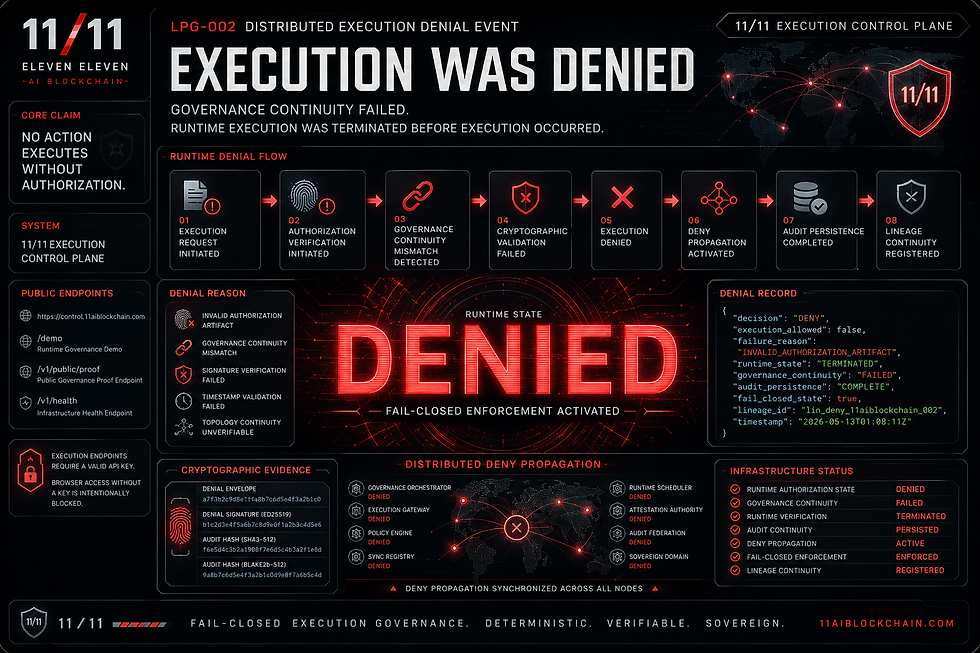
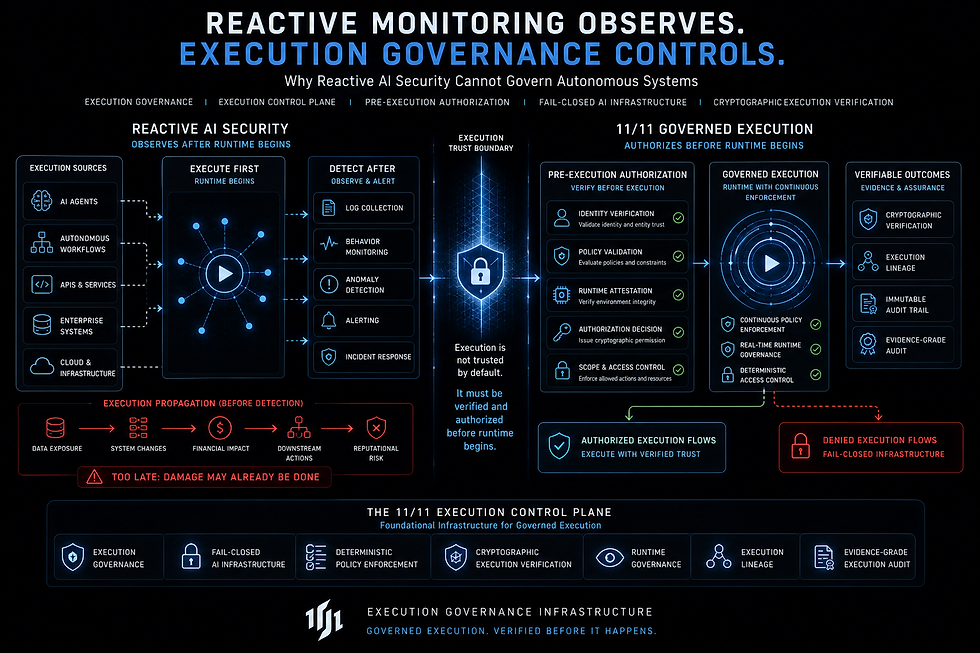
11/11 introduces Execution Governance™ infrastructure for governed autonomous execution and deterministic operational control.
Execution Governance™ Governed Execution™ EA-11™ Execution Arithmetic ™Patent Pending
Public Infrastructure Endpoints

Comments