
Why Execution Governance Defines The Next Infrastructure Category
- 11/11 AI

- May 29
- 3 min read
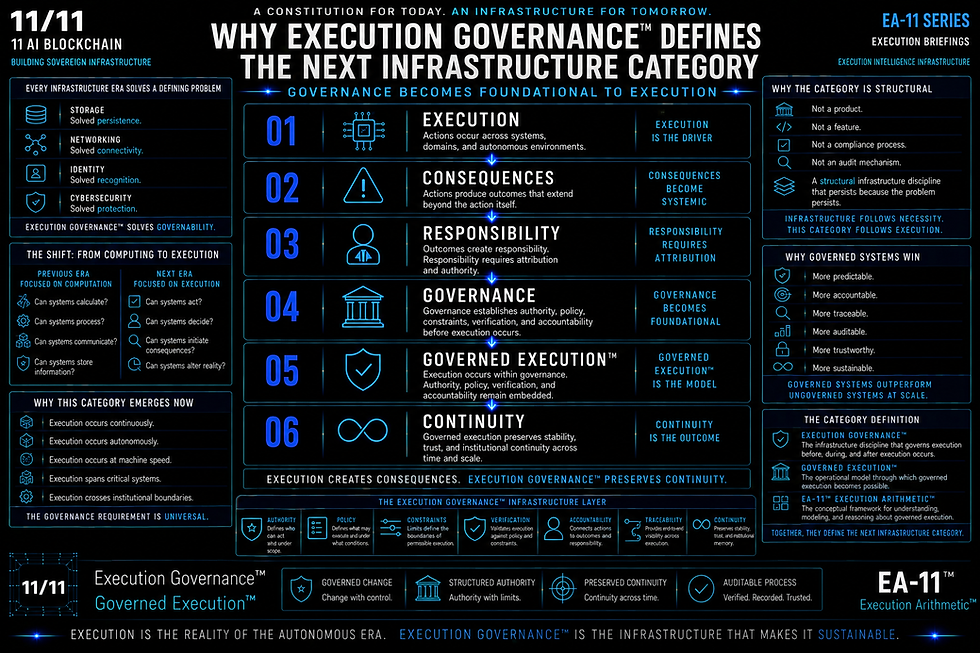
Every infrastructure era is defined by a problem.
Storage solved persistence.
Networking solved connectivity.
Identity solved recognition.
Cybersecurity solved protection.
Each category emerged because the underlying problem became impossible to ignore.
The category was not created by marketing.
The category was created by necessity.
Execution Governance™ follows the same pattern.
The defining challenge of the autonomous era is no longer computation.
Computation has already scaled.
The defining challenge is execution.
Who can execute?
Under what authority?
Under what constraints?
Under what conditions?
With what accountability?
With what continuity?
These questions increasingly determine whether autonomous systems remain governable.
Execution Governance™ emerges because these questions become unavoidable.
Infrastructure Appears After The Threshold
Categories rarely emerge early.
They emerge after a threshold is crossed.
Before the threshold:
The problem appears isolated.
After the threshold:
The problem appears everywhere.
Execution has crossed that threshold.
Execution now occurs:
Continuously
Autonomously
At machine speed
Across critical systems
Across institutional boundaries
The governance requirement therefore becomes universal rather than isolated.
The Shift From Computing To Execution
Previous generations focused on computation.
Can systems calculate?
Can systems process?
Can systems communicate?
Can systems store information?
The next era focuses on execution.
Can systems act?
Can systems decide?
Can systems initiate consequences?
Can systems alter reality?
Execution changes the discussion.
The action becomes more important than the calculation.
Governance follows naturally.
Why Governance Becomes Foundational
Execution creates outcomes.
Outcomes create consequences.
Consequences create responsibility.
Responsibility creates governance requirements.
The chain is structural.
Governance therefore becomes foundational infrastructure rather than administrative overhead.
The governance layer increasingly becomes as important as the execution layer itself.
Governed Execution™ Becomes The Operational Model
Execution Governance™ defines the infrastructure category.
Governed Execution™ defines the operational model.
The relationship is simple.
Execution no longer occurs independently.
Execution occurs within governance.
Authority exists first.
Policy exists first.
Verification exists first.
Execution follows.
The model becomes repeatable, accountable, and scalable.
Why The Category Persists
Infrastructure categories persist because their underlying problems persist.
Execution is not disappearing.
Autonomy is not disappearing.
Consequence is not disappearing.
The governance requirement therefore remains.
Execution Governance™ persists because the execution problem persists.
The category becomes durable because the challenge becomes durable.
The Infrastructure Layer Above Execution
Historically:
Infrastructure enabled execution.
Increasingly:
Infrastructure governs execution.
This distinction defines the category.
Execution Governance™ becomes the layer that determines:
What may execute
What may not execute
Under what authority execution occurs
How accountability is preserved
How continuity is maintained
The category exists above execution while remaining embedded within execution.
The Inevitability Of Governed Systems
As systems become more autonomous, more connected, and more consequential, governed execution becomes increasingly difficult to avoid.
The challenge is no longer whether governance is required.
The challenge is how governance is implemented.
Execution Governance™ emerges because governed systems become more sustainable than ungoverned systems.
The incentive structure itself drives adoption.
The Category Definition
Execution Governance™ is the infrastructure discipline responsible for governing execution before, during, and after execution occurs.
Governed Execution™ is the operational model through which governed execution becomes possible.
EA-11™ provides the conceptual framework through which governed execution can be understood, analyzed, and reasoned about.
Together they define a category.
Not a feature.
Not a product.
Not a compliance process.
An infrastructure category.
Conclusion
Execution Governance™ defines the next infrastructure category because execution itself has become the defining challenge of the autonomous era.
Execution scales.
Consequences scale.
Governance requirements scale.
The category emerges because the problem becomes unavoidable.
Infrastructure follows necessity.
Governed execution has become necessary.
Execution Governance™ follows naturally.
11/11 introduces Execution Governance™ infrastructure for governed autonomous execution and deterministic operational control.
Execution Governance™ Governed Execution™ EA-11™ Execution Arithmetic™
Patent Pending
Public Infrastructure Endpoints


Comments