
Why Governance Moves Into Execution


For most of modern history, governance operated outside execution.
An action occurred.
A review followed.
An audit appeared.
A report was generated.
Governance existed after execution.
The model worked because execution remained relatively slow.
The consequence arrived after the action.
The review arrived before the next action.
The cycle remained manageable.
Modern execution environments are changing this relationship.
Execution increasingly occurs continuously.
Decisions occur continuously.
Interactions occur continuously.
Consequences occur continuously.
Governance therefore begins moving closer to execution itself.
Eventually governance becomes part of execution.
This shift represents one of the most important changes occurring within modern infrastructure.
Governance Began As Observation
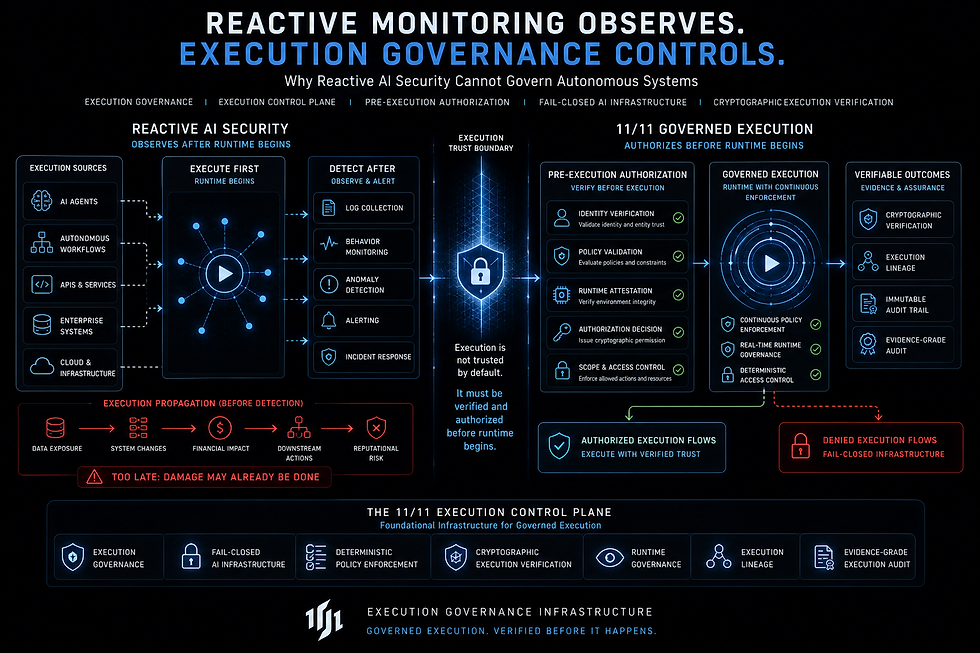
Traditional governance operated as observation.
Observe the action.
Evaluate the action.
Report the action.
The governance layer functioned primarily as a witness.
Execution remained separate.
The separation created distance.
That distance was acceptable while execution remained limited.
The distance becomes increasingly problematic as execution accelerates.
Speed Changes Governance
Execution speed changes everything.
The faster execution becomes, the less time remains for external review.
The shorter the review window becomes, the more governance must move toward the execution event itself.
Eventually governance can no longer operate effectively as an external observer.
It must become an active participant in execution.
Consequences Arrive Earlier
Modern systems increasingly produce immediate consequences.
Financial transactions.
Identity decisions.
Access authorizations.
Autonomous actions.
Infrastructure operations.
The consequence often occurs before traditional oversight mechanisms can react.
Governance therefore shifts upstream.
The objective becomes influencing execution before consequences emerge.
Why Runtime Matters
The most important governance question is increasingly becoming:
What was permitted to execute?
Not:
What already executed?
This distinction transforms governance.
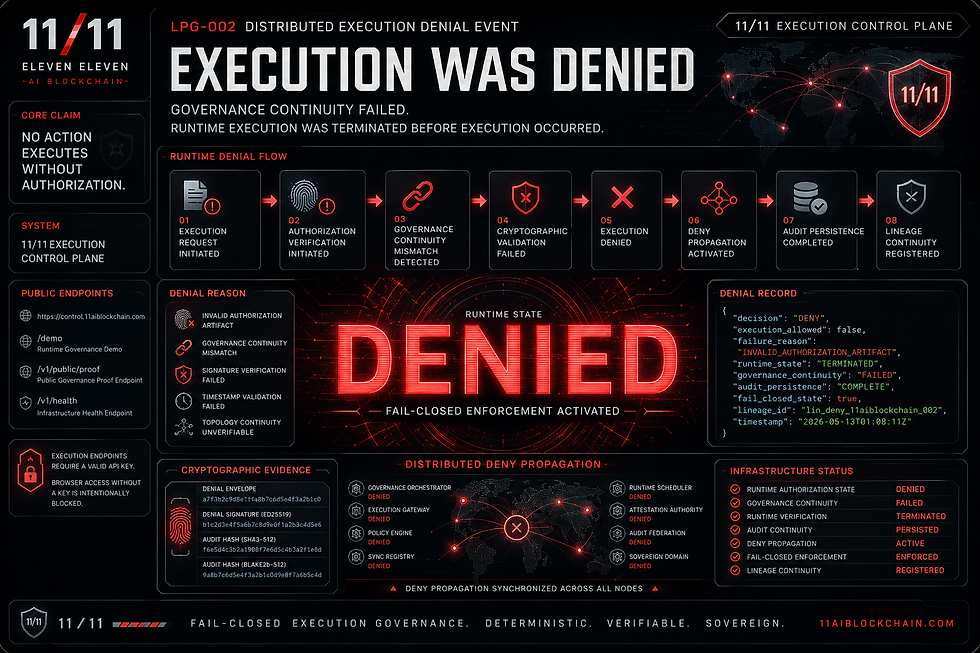
Governance begins operating at runtime.
Authority becomes active.
Policies become active.
Constraints become active.
The governance layer becomes operational.
Governance Becomes Environmental
A useful way to understand the shift is through environment.
Traditional governance surrounded execution.
Execution Governance™ increasingly embeds governance within execution.
The execution environment itself becomes governed.
The action occurs inside governance rather than adjacent to governance.
This transition fundamentally changes the architecture.
Autonomous Systems Accelerate The Shift
Autonomous systems make the transition unavoidable.
The system may perform thousands of actions before a human review becomes possible.
Traditional oversight struggles under these conditions.
Runtime governance becomes necessary because execution becomes continuous.
The governance layer must operate at machine speed.
The End Of Governance As Audit
Auditing remains important.
Auditing is no longer sufficient.
The infrastructure challenge changes.
The objective becomes governed execution rather than audited execution.
Audit remains downstream.
Governance increasingly moves upstream.
The distinction defines the category.
Execution Governance™ As Runtime Infrastructure
Execution Governance™ should increasingly be viewed as runtime infrastructure.
Authority enforcement.
Policy enforcement.
Constraint enforcement.
Verification enforcement.
The governance layer becomes operationally inseparable from the execution layer.
This relationship becomes more visible each year.
Beyond Infrastructure
Infrastructure explains how governance becomes embedded.
Governed Execution™ explains why governance becomes embedded.
Execution Governance™ explains the category created by that shift.
Together they describe the evolution currently occurring across autonomous systems.
Conclusion
Governance moves into execution because execution becomes too fast, too continuous, and too consequential to govern effectively from the outside.
Observation becomes insufficient.
Reaction becomes insufficient.
Governance becomes operational.
The future challenge is not reviewing execution.
The future challenge is governing execution while it occurs.
That transition defines the emergence of Execution Governance™ infrastructure.
11/11 introduces Execution Governance™ infrastructure for governed autonomous execution and deterministic operational control.
Execution Governance™ Governed Execution™ EA-11™ Execution Arithmetic™
Patent Pending
Public Infrastructure Endpoints

Comments