
Why Identity Persists


Most constitutional systems are built upon continuity.
Yet continuity itself depends upon something deeper.
Identity.
A civilization cannot preserve what it cannot identify.
A constitutional system cannot recognize what it cannot distinguish.
A participant cannot belong to an order that cannot remember who they are.
Identity therefore occupies a unique position within constitutional civilization.
It exists before participation.
It survives transitions.
It persists despite change.
Throughout history, identities have often endured longer than governments, institutions, technologies, and even civilizations themselves.
This observation raises an important question.
Why does identity persist?
The answer may be that constitutional order requires continuity, and continuity requires recognizable identity.
Change Requires Continuity
Everything changes.
People change.
Institutions change.
Technologies change.
Civilizations change.
If every change erased identity, continuity would become impossible.
The system would continuously restart itself.
No history could accumulate.
No responsibility could endure.
No participation could persist.
Identity becomes the mechanism through which continuity survives transformation.
The entity changes.
The identity remains recognizable.
Identity Is A Bridge Across Time
One way to understand identity is as a bridge.
Not a bridge between places.
A bridge between moments.
Identity connects yesterday to today.
Today to tomorrow.
Without this connection, constitutional systems cannot establish continuity.
Every obligation disappears.
Every relationship disappears.
Every responsibility disappears.
Identity therefore serves as one of the foundational mechanisms through which time itself becomes governable.
Recognition Depends Upon Identity
Recognition requires stability.
The system must know that the participant being recognized today is meaningfully connected to the participant recognized yesterday.
Identity creates this connection.
Without identity, recognition becomes temporary.
With identity, recognition becomes durable.
This durability explains why constitutional systems place enormous importance on identity structures.
Recognition survives because identity survives.
Identity And Responsibility
Responsibilities often extend across time.
Obligations extend across time.
Participation extends across time.
These relationships become possible because identity persists.
If identity disappeared continuously, responsibility would disappear continuously.
Constitutional systems therefore depend upon identity as a mechanism for preserving accountability.
Identity allows continuity to become meaningful.
Identity And Membership
Membership requires persistence.
A member today must remain recognizable tomorrow.
Otherwise membership becomes impossible to maintain.
This relationship explains why identity becomes one of the deepest foundations beneath citizenship.
Before citizenship comes membership.
Before membership comes recognition.
Before recognition comes identity.
Identity therefore becomes one of the earliest constitutional structures.
Why Identity Outlasts Institutions
One of the most interesting features of constitutional systems is that identities often outlast institutions.
Organizations disappear.
Jurisdictions change.
Governments evolve.
Yet identities remain recognizable.
The persistence of identity allows constitutional continuity to survive institutional disruption.
Identity therefore becomes a stabilizing force within constitutional civilization.
Computational Identity
Future computational civilizations will likely depend heavily upon persistent identity.
Not because technology requires it.
Because continuity requires it.
Participation.
Recognition.
Membership.
Responsibility.
Stewardship.
Each depends upon identity capable of surviving change.
Computational identity therefore becomes more than authentication.
It becomes constitutional infrastructure.
Identity As Memory
A deeper interpretation views identity as a form of memory.
Not memory stored in records.
Memory embodied in continuity.
Identity allows the system to remember participation across time.
The civilization remembers who belongs.
The participant remembers where they belong.
This mutual continuity becomes one of the foundations of constitutional order.
Beyond Hierarchy
Hierarchy explains structure.
Identity explains continuity.
The constitutional question is no longer:
Who occupies which position?
The constitutional question becomes:
How does participation remain recognizable despite change?
Identity emerges as the answer.
Conclusion
Identity persists because constitutional continuity requires persistence.
Recognition depends upon identity.
Membership depends upon identity.
Responsibility depends upon identity.
Civilization itself depends upon identity.
As computational civilizations emerge, identity may become one of the most important constitutional structures ever created.
Everything changes.
Identity allows continuity to survive the change.
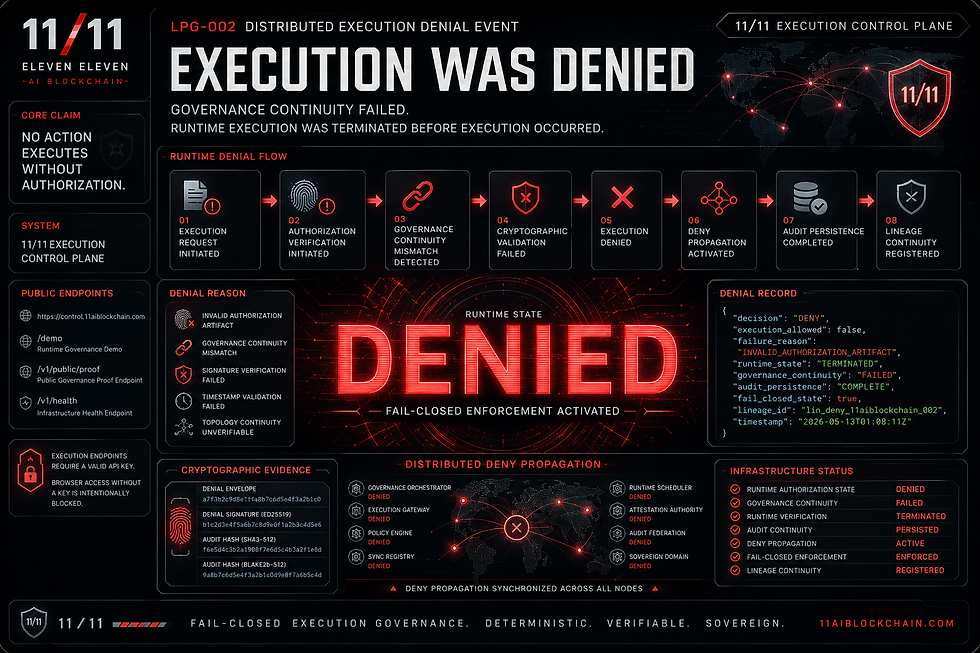
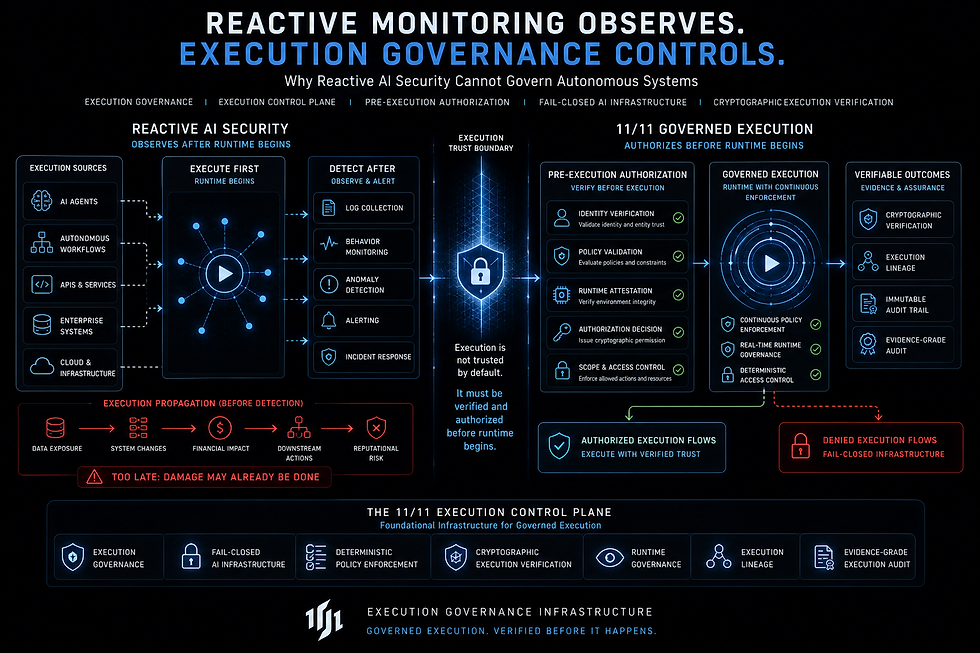
11/11 introduces Execution Governance™ infrastructure for governed autonomous execution and deterministic operational control.
Execution Governance™ Governed Execution™ EA-11™ Execution Arithmetic™
Patent Pending
Public Infrastructure Endpoints

Comments