
Why Institutions Endure


Creating an institution is relatively easy.
Preserving one is difficult.
History is filled with organizations that appeared important for a moment and disappeared shortly thereafter.
They solved immediate problems.
They served temporary needs.
They addressed specific circumstances.
When those circumstances changed, the institution disappeared.
Yet some institutions survive.
Decades pass.
Generations pass.
Technologies change.
Participants change.
The institution remains.
This persistence raises an important question.
Why do some institutions endure while others vanish?
The answer may be that enduring institutions stop serving immediate needs and begin serving continuity itself.
The Difference Between Creation And Preservation
Most organizations are created to solve problems.
Enduring institutions eventually evolve beyond problem solving.
They become continuity mechanisms.
The institution no longer exists solely because of its original purpose.
It exists because civilization begins depending upon its continuity.
This transition marks the difference between an organization and an institution.
Organizations perform functions.
Institutions preserve continuity.
Continuity Becomes The Product
At first, institutions provide services.
Over time, continuity becomes the service.
Participants begin relying upon predictability.
Reliability.
Consistency.
Memory.
Stewardship.
The institution survives because it preserves these qualities across time.
Its greatest contribution becomes continuity itself.
Why Memory Matters
Institutions remember.
Not simply through records.
Through process.
Through precedent.
Through accumulated judgment.
The institution becomes a repository of continuity.
Participants change.
The institutional memory remains.
This persistence reduces the need to rediscover solutions repeatedly.
Civilization advances because institutions remember.
Institutions Preserve Authority
Authority rarely survives through individuals.
Individuals leave.
Authority attached solely to individuals eventually disappears.
Institutions solve this problem.
Authority becomes attached to structure rather than personality.
The result is durable governance.
This shift explains why institutions often become central components of constitutional order.
Why Participants Trust Institutions
Trust accumulates through repetition.
Repeated reliability creates confidence.
Repeated confidence creates legitimacy.
Repeated legitimacy creates endurance.
Institutions survive because participants eventually trust the continuity they provide.
The institution becomes predictable.
Predictability becomes valuable.
Value creates persistence.
Institutional Adaptation
Enduring institutions are not static.
They adapt.
The paradox is important.
Institutions survive because they change.
Yet they cannot change so much that continuity disappears.
The most durable institutions preserve identity while adapting operations.
They remain recognizable despite evolution.
Computational Institutions
Future governance infrastructures will face the same challenge.
Execution systems will emerge.
Governance frameworks will emerge.
Autonomous environments will emerge.
The systems that survive will not necessarily be the most powerful.
They will likely be the most continuous.
Enduring computational institutions will preserve governance across technological change.
Why Institutions Outlive Technologies
Technologies change rapidly.
Institutions often survive multiple generations of technology.
This occurs because institutions preserve purpose rather than implementation.
The tools evolve.
The continuity remains.
This distinction explains why some institutions survive centuries despite repeated technological disruption.
Beyond Emergence
Emergence explains how institutions form.
Endurance explains why they remain.
The constitutional question is no longer:
How was the institution created?
The constitutional question becomes:
What allows the institution to survive?
The answer is continuity.
Conclusion
Institutions endure because civilizations eventually depend upon continuity more than novelty.
Memory.
Authority.
Trust.
Legitimacy.
Stewardship.
These accumulate across time.
The institution becomes a container for continuity itself.
As governance infrastructures evolve, enduring institutions will remain among the most important mechanisms through which civilization preserves itself.
Institutions survive because continuity survives through them.
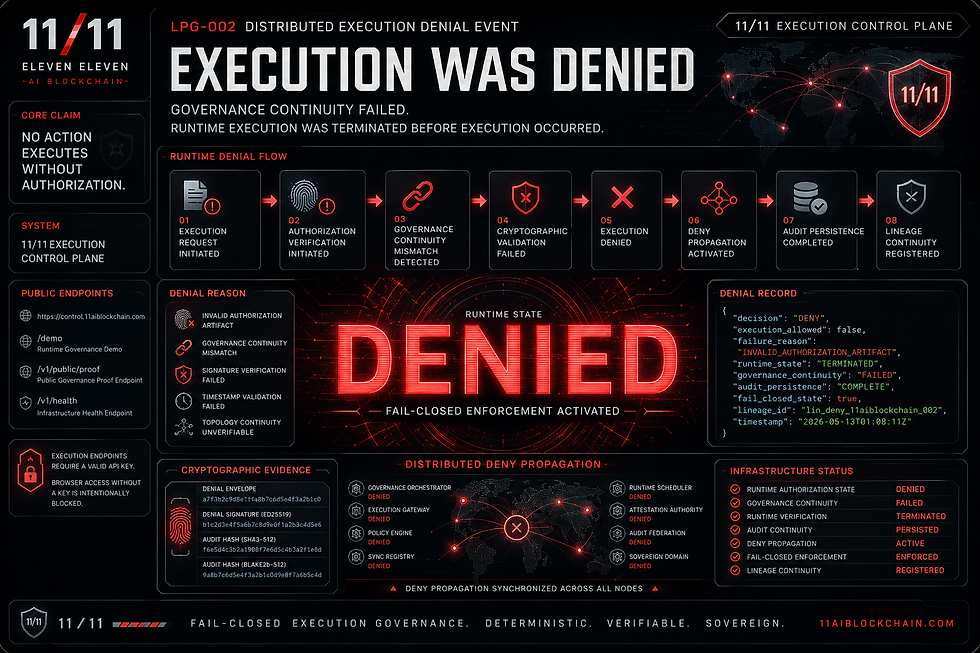
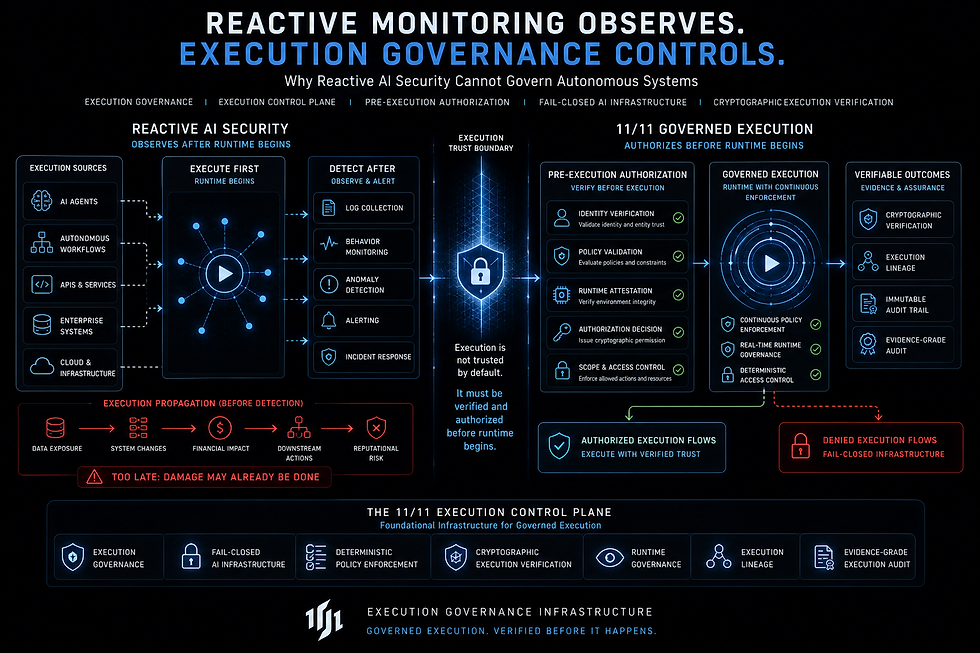
11/11 introduces Execution Governance™ infrastructure for governed autonomous execution and deterministic operational control.
Execution Governance™ Governed Execution™ EA-11™ Execution Arithmetic™
Patent Pending
Public Infrastructure Endpoints

Comments