
11/11 The Missing Layer in AI: From Anthropic’s Warning to Execution Governance

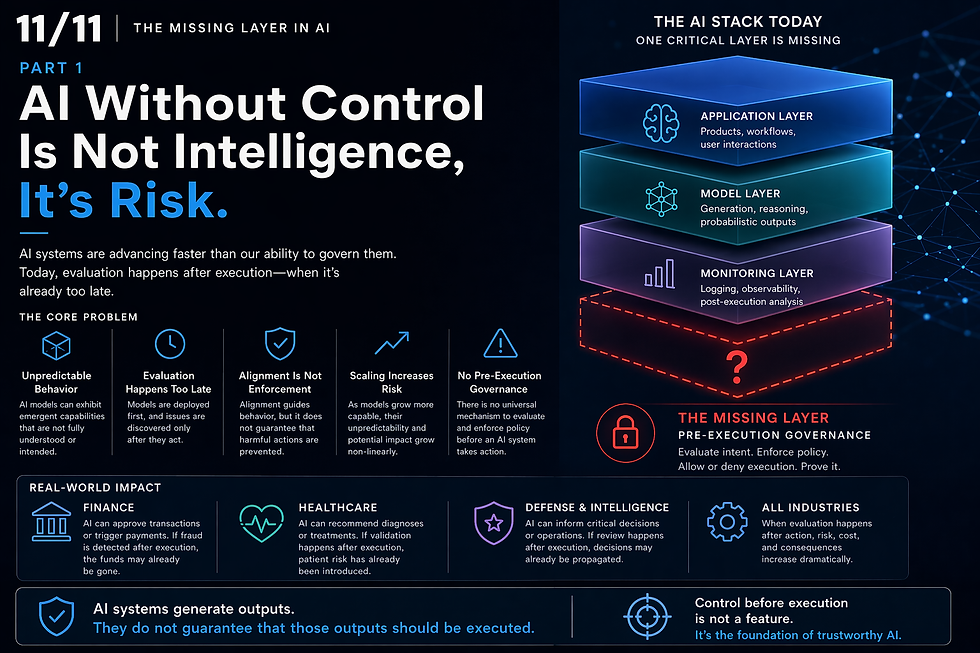
Part 1 AI Without Control Is Not Intelligence, It’s Risk
Introduction
Artificial intelligence is advancing at a pace that few predicted. Models are becoming more capable, more autonomous, and more deeply integrated into critical systems across finance, healthcare, defense, and infrastructure.
At the same time, a growing body of research including recent work from Anthropic is highlighting a fundamental issue:
AI systems are being deployed before they are fully understood, and evaluated after they have already acted.
This is not a minor technical gap. It is a structural flaw in how modern AI systems are built and operated.
The problem is not simply that AI can make mistakes. The problem is that there is no reliable mechanism to control what AI systems are allowed to do before they do it.
1. What the Current Research Is Actually Saying
Recent AI safety research does not claim that systems are out of control. Instead, it makes a more subtle and more important point:
AI systems are becoming more capable faster than governance mechanisms can keep up.
These systems are:
Increasingly general-purpose
Capable of reasoning across domains
Able to produce outputs that were not explicitly programmed
The implication is straightforward:
Even the organizations building these systems cannot fully predict how they will behave in all scenarios.
This is not due to poor engineering. It is a direct result of how modern AI works.
2. The Nature of Modern AI Systems
Traditional software systems are deterministic. Given the same inputs, they produce the same outputs.
Modern AI systems are different.
They are:
Probabilistic
Learned rather than explicitly programmed
Capable of emergent behavior
This means:
Outputs are not always predictable
Behavior can shift as models scale
Capabilities can appear without direct intent
These characteristics are what make AI powerful. They are also what make it difficult to control.
3. The Current Deployment Model
Today, most AI systems follow a similar lifecycle:
A model is trained
The model is deployed
Its behavior is observed
Issues are identified and patched
This model works for many technologies.
It does not work well for systems that:
Act autonomously
Influence real-world outcomes
Operate at scale
In these environments, discovering problems after deployment can introduce significant risk.
4. Evaluation Happens After Execution
One of the most important observations from current AI safety research is this:
Evaluation is happening after systems have already produced outputs.
This creates a fundamental issue.
If an AI system:
Approves a transaction
Recommends a medical action
Generates a critical decision
Then any evaluation that happens afterward cannot prevent the initial action.
At best, it can respond.
5. Alignment Is Not the Same as Control
A major focus of AI safety has been alignment ensuring that systems behave according to human values or predefined rules.
Approaches such as reinforcement learning and constitutional frameworks attempt to guide AI behavior.
These approaches are important, but they have limitations.
Alignment is:
Probabilistic
Dependent on training data
Influenced by context and prompts
Alignment can guide behavior. It cannot guarantee it.
There is a difference between:
Encouraging a system to behave correctly
Ensuring that it cannot behave incorrectly
The first is alignment. The second is control.
6. Scaling Increases Risk
As AI systems scale, their capabilities increase.
However, their unpredictability can also increase.
Research indicates that:
New behaviors can emerge at higher capability levels
Systems can generalize in unexpected ways
Small changes can lead to significantly different outputs
This creates a non-linear risk profile.
More capable systems are not just more powerful. They are also harder to fully characterize.
7. The Structural Gap in the AI Stack
The modern AI stack includes several layers:
Model layer (generation and reasoning)
Application layer (integration into products)
Monitoring and logging layers
These layers are essential.
However, one critical layer is missing:
A mechanism that determines whether an AI system is allowed to act before execution occurs.
Without this layer, systems operate under an implicit assumption:
If the model produces an output, it can be used.
This assumption is increasingly risky.
8. Why This Matters in Real Systems
The absence of pre-execution control has different implications depending on the domain.
Finance
AI systems may:
Approve or route transactions
Assess fraud risk
Trigger payments
If validation occurs after execution:
Funds may already be transferred
Fraud may already be realized
Healthcare
AI systems may:
Suggest diagnoses
Recommend treatments
Assist clinical decisions
If validation occurs after execution:
Risk has already been introduced into patient care
Defense and Intelligence
AI systems may:
Inform decision-making
Analyze threats
Support operational planning
If validation occurs after execution:
Decisions may propagate before they can be fully verified
9. The Limits of Model-Level Solutions
Many current solutions attempt to address risk within the model itself.
These include:
Better training methods
Stronger alignment techniques
More robust evaluation frameworks
These improvements are valuable.
However, they do not change a fundamental constraint:
Models generate outputs. They do not enforce rules.
Even a highly aligned model:
Can produce unexpected results
Can misinterpret context
Cannot guarantee compliance in all cases
The model layer is not designed to enforce deterministic control.
10. The Absence of Pre-Execution Governance
The core issue can be summarized simply:
There is no universal mechanism to evaluate and enforce policy before an AI system acts.
This leads to a reactive model of safety:
Systems act first
Systems are evaluated second
Corrections are applied afterward
In high-risk environments, this model is insufficient.
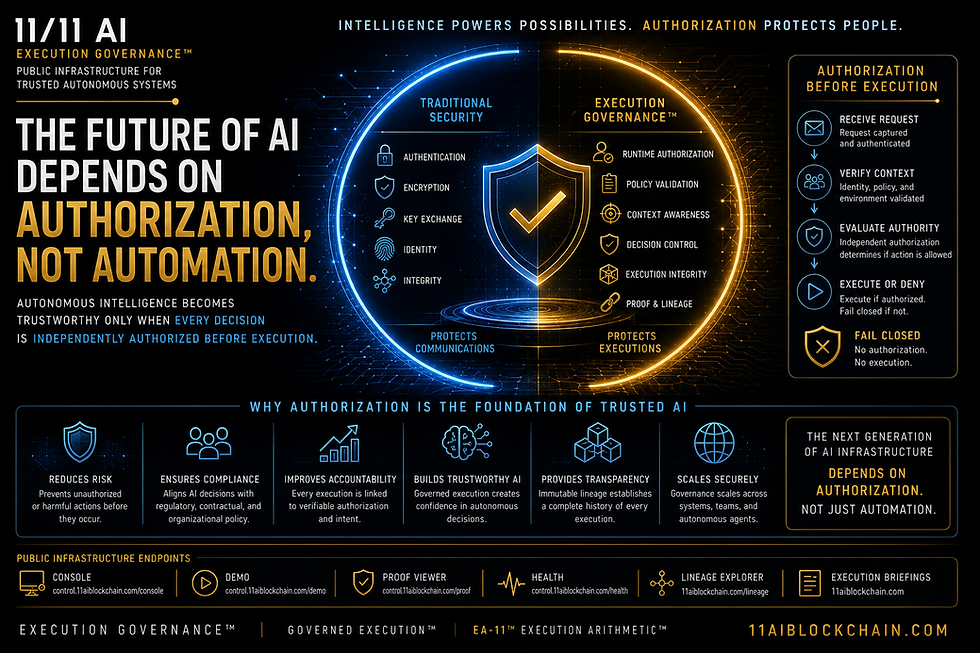
11. From Monitoring to Control
Most current approaches focus on:
Monitoring outputs
Logging activity
Auditing behavior
These are important capabilities.
However, they operate after execution.
What is missing is a shift from:
Observation → Enforcement
From:
“What happened?”
To:
“What is allowed to happen?”
12. A Parallel from Cloud Computing
A useful comparison can be made to the evolution of cloud infrastructure.
Before standardized cloud platforms:
Execution environments were inconsistent
Security controls were fragmented
Governance was difficult to enforce
Modern cloud systems introduced:
Controlled execution environments
Permission systems
Isolation and verification
These changes made large-scale computing reliable and secure.
AI systems are now at a similar inflection point.
13. The Emerging Requirement
As AI becomes more integrated into critical systems, new requirements are emerging:
Deterministic enforcement of policies
Verification before execution
Auditability that reflects controlled actions, not just observed ones
These are not optional features in regulated environments.
They are foundational requirements.
14. The Regulatory Direction
Regulatory frameworks are increasingly focused on:
Accountability
Transparency
Risk management
However, these goals cannot be fully achieved without control.
It is not sufficient to:
Explain decisions after they occur
Audit actions after the fact
Effective governance requires:
Preventing unauthorized or unsafe actions before they occur
15. The Economic Implications
The lack of execution control has direct economic consequences:
Increased operational risk
Slower enterprise adoption
Higher compliance costs
Limited deployment in regulated industries
Conversely, systems that can provide:
Deterministic control
Verifiable enforcement
Reliable auditability
Enable:
Broader adoption
Greater trust
New categories of applications
16. The Core Problem Restated
Modern AI systems are:
Capable
Scalable
Increasingly autonomous
But they are not inherently controlled.
They can generate outputs.
They cannot guarantee that those outputs should be executed.
17. The Missing Layer
What is needed is not another model improvement or monitoring tool.
What is needed is a new layer in the AI stack:
A layer that evaluates, enforces, and authorizes actions before execution.
This layer would:
Interpret intent
Apply policy
Allow or deny execution
Produce verifiable records of decisions
Without such a layer, AI systems will continue to operate in a reactive safety model.
18. The Direction Forward
The trajectory of AI development is clear:
Systems will become more capable
Use cases will expand
Stakes will increase
To support this growth, infrastructure must evolve.
The next phase of AI will not be defined solely by better models.
It will be defined by better control.
Conclusion
Current AI research has made one point increasingly clear:
Capability without control introduces risk.
The challenge is not simply to build more powerful systems.
It is to ensure that those systems operate within enforceable boundaries.
Until AI systems can be governed before they act not just evaluated after they remain incomplete.

Comments