
The First Public Execution Governance SDK Is Live


The Missing Layer Was Never the Model
For the last several years the AI industry has focused almost entirely on model capability.
Bigger models.
More parameters.
More agents.
More autonomy.
More tool access.
More execution authority.
Yet one foundational question remains largely unanswered:
Who authorizes execution?
Not who generates a response.
Not who hosts a model.
Not who stores a log.
Who authorizes a machine action before the action occurs?
Modern AI systems can invoke APIs, access tools, trigger workflows, move money, modify records, orchestrate infrastructure, coordinate agents, and influence physical systems.
Most architectures still rely on a simple assumption:
The model decides and the infrastructure executes.
Execution Governance was created to challenge that assumption.
A New Infrastructure Category
Execution Governance is not a model.
It is not a benchmark.
It is not an observability platform.
It is not a security gateway.
It is not a logging system.
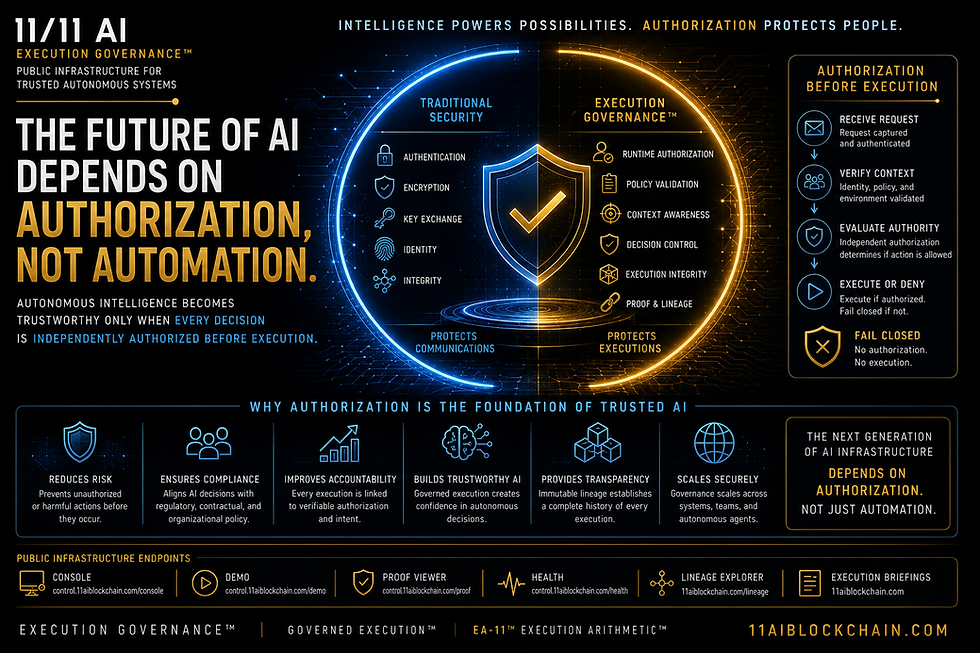
It is a dedicated authorization layer positioned between intent and execution.
The architecture introduces three infrastructure responsibilities:
Verify
Validate execution authority before runtime.
Enforce
Prevent unauthorized execution during runtime.
Prove
Generate independent governance evidence after runtime.
These three responsibilities establish a governance boundary that exists independently from the model itself.
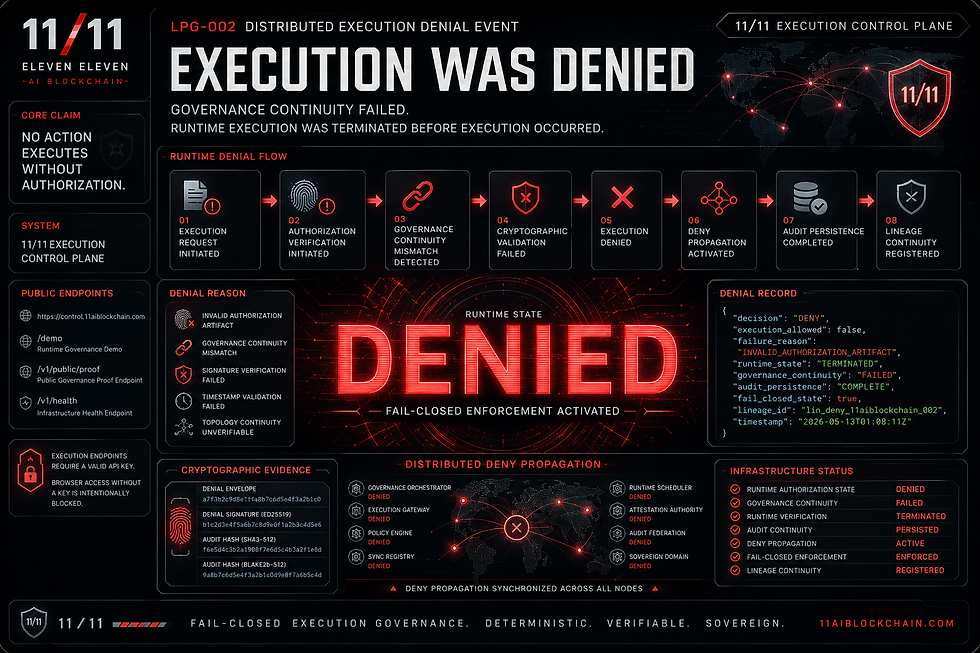
The result is a fail-closed execution environment.
From Doctrine To Running Infrastructure
During the past several months the 11/11 AI Research Division published:
Execution Governance Doctrine
Execution Governance Framework
RFC Standards Series
Certification Framework
Conformance Architecture
Federal Procurement Mapping
Reference Architecture
Execution Arithmetic (EA-11)
The research corpus established the theory.
The runtime platform established the implementation.
The public governance infrastructure established operational proof.
Now a new milestone has been reached.
The Execution Governance SDK Is Live
The 11/11 Execution Governance SDK is now operational.
This is not a mockup.
This is not a conceptual architecture.
This is not a design document.
This is executable software that developers can integrate into governed systems.
The SDK provides the foundational primitives necessary to implement Execution Governance controls within applications, workflows, agents, and autonomous environments.
Core capabilities include:
Governance verification
Artifact validation
Governance receipt generation
Proof production
Policy enforcement hooks
Runtime authorization controls
Execution lineage generation
Audit-ready evidence creation
For the first time, developers can directly integrate Execution Governance capabilities into operational software stacks.
Why SDKs Matter
Infrastructure categories become real when developers can build against them.
The internet became practical when developers gained access to:
TCP/IP libraries
SSL implementations
Certificate validation
Identity frameworks
Cloud became practical when developers gained access to:
SDKs
APIs
Authentication frameworks
Infrastructure libraries
Execution Governance follows the same pattern.
A doctrine explains.
A standard defines.
An SDK operationalizes.
The SDK transforms Execution Governance from a governance theory into deployable infrastructure.
Governance Must Become Programmable
Traditional governance systems are often external to execution.
Policies exist.
Procedures exist.
Compliance requirements exist.
Yet none of these are directly embedded inside runtime operations.
Execution Governance introduces a different model.
Governance becomes programmable.
Authorization becomes enforceable.
Proof becomes machine generated.
Audit reconstruction becomes deterministic.
The SDK provides the foundation necessary to implement those capabilities consistently across environments.
The Shift From Observation To Control
Most governance technologies operate after execution.
Logs observe.
Monitoring observes.
Analytics observe.
Audits observe.
Execution Governance introduces control before execution.
Instead of asking:
"What happened?"
The architecture asks:
"Was execution authorized?"
This distinction is fundamental.
Observation creates visibility.
Authorization creates control.
The SDK exists to bring authorization into the execution path itself.
Independent Evidence Matters
One of the most significant challenges in modern AI governance is evidence integrity.
Organizations often generate governance evidence from the same systems they are attempting to govern.
This creates dependency.
Execution Governance introduces independent governance artifacts.
These artifacts are designed to demonstrate:
Authorization status
Governance decisions
Policy outcomes
Execution lineage
Runtime evidence
The SDK enables these artifacts to be generated consistently and programmatically.
Building Toward Certification
The long-term objective is larger than software.
Execution Governance is being developed as an infrastructure category capable of supporting:
Enterprise deployments
Financial systems
Government systems
Defense systems
Critical infrastructure
Autonomous platforms
Certification frameworks require repeatable implementation.
Repeatable implementation requires standardized tooling.
Standardized tooling requires developer integration.
The SDK is a foundational step toward that future state.
What This Means For Developers
Developers now have access to a framework that allows governance controls to become part of the application lifecycle itself.
Instead of treating governance as documentation:
Governance becomes code.
Instead of treating authorization as an assumption:
Authorization becomes verification.
Instead of treating audit trails as reconstruction:
Audit trails become deterministic proof.
This changes how autonomous systems can be designed.
It changes how accountability can be demonstrated.
And it changes how trust can be established in increasingly autonomous environments.
A New Stage Of Execution Governance
Research established the architecture.
Standards established the framework.
Infrastructure established the runtime.
The SDK establishes implementation.
Execution Governance is no longer only a doctrine.
It is no longer only a standards effort.
It is no longer only a runtime demonstration.
It is now a deployable software capability.
The next phase is adoption, integration, certification, and independent validation.
The objective remains unchanged:
Create infrastructure capable of verifying authority before execution, enforcing governance during execution, and proving governance after execution.
The SDK is now live.
The infrastructure category continues to emerge.
Public Infrastructure Endpoints
Public Governance Consolehttps://control.11aiblockchain.com/console
Runtime Governance Demohttps://control.11aiblockchain.com/demo
Governed AI Runtime Demohttps://control.11aiblockchain.com/governed-ai
Public Governance Proof Viewerhttps://control.11aiblockchain.com/proof
Infrastructure Health Dashboardhttps://control.11aiblockchain.com/health
Execution Lineage Explorerhttps://www.11aiblockchain.com/lineage
Execution Governance Briefingshttps://www.11aiblockchain.com/executionbriefings
Execution Governance™ Governed Execution™ EA-11™ Execution Arithmetic™ Patent Pending

Comments