
The Future of AI Depends on Authorization, Not Automation

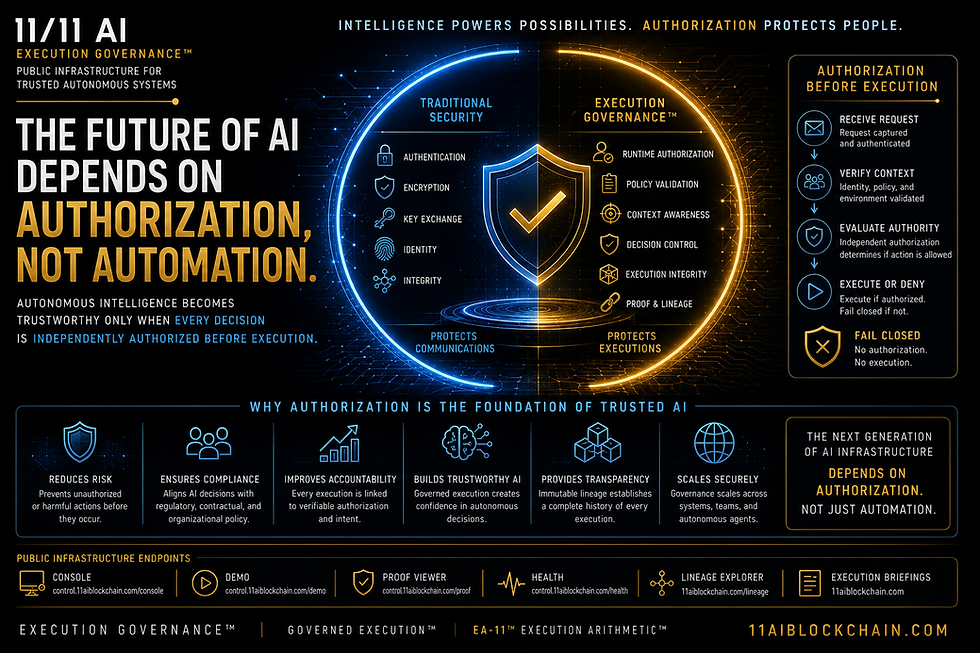
Autonomous intelligence becomes trustworthy only when every decision is independently authorized before execution.
The Race Toward More Autonomous AI
Artificial intelligence is advancing at extraordinary speed.
Foundation models are evolving into reasoning systems.
Reasoning systems are becoming autonomous agents.
Agents are beginning to coordinate with other agents.
Entire organizations are preparing for autonomous workflows that operate with limited human intervention.
The industry often measures progress by increasing automation.
Automation alone, however, does not establish trust.
Intelligence Without Governance Increases Risk
Every increase in autonomous capability also increases operational responsibility.
An autonomous system may perform millions of correct actions.
The one unauthorized action is the one that matters.
As AI expands into regulated industries, critical infrastructure, financial services, healthcare, manufacturing, defense, and government, organizations require stronger guarantees than historical logging or post-event audits.
They require confidence before execution.
Authorization Becomes Infrastructure
Execution Governance treats authorization as infrastructure rather than application logic.
Before execution begins, every decision may be evaluated against governance requirements including:
• Identity
• Policy
• Operational context
• Regulatory controls
• Organizational authority
• Runtime conditions
• Independent verification
Execution proceeds only after governance requirements have been satisfied.
Otherwise, execution terminates safely.
Fail Closed.
Moving Beyond Traditional Security
Cybersecurity traditionally answers questions such as:
Who sent the request?
Was it modified?
Can the sender be authenticated?
Execution Governance introduces another question.
Should this request execute at all?
That question becomes increasingly important as AI systems assume responsibility for real-world operations.
A New Trust Model
Future infrastructure requires multiple layers of assurance.
Cryptography establishes secure communication.
Identity establishes accountability.
Execution Governance establishes authorization.
Execution lineage establishes transparency.
Together they provide confidence across the complete execution lifecycle.
Why This Matters
Organizations are investing billions of dollars into artificial intelligence.
The next competitive advantage will not come solely from larger models or faster inference.
It will come from infrastructure capable of proving that autonomous decisions complied with governance policy before execution occurred.
Verification before runtime becomes more valuable than explanation after runtime.
Looking Forward
Artificial intelligence is rapidly becoming operational infrastructure.
Operational infrastructure requires operational governance.
Execution Governance provides an architectural foundation for trusted autonomous execution by establishing authorization before action rather than accountability afterward.
As autonomous systems continue to evolve, authorization becomes one of the defining characteristics of trustworthy AI.
The future of AI will not be defined by how autonomous systems become. It will be defined by how responsibly they are authorized to act.
Key Takeaways
Automation alone does not establish trust.
Trusted AI requires authorization before execution.
Execution Governance introduces an independent authorization layer.
Future autonomous infrastructure depends on governance as much as intelligence.
Execution Governance™ • Governed Execution™ • EA-11™ Execution Arithmetic™
Patent Pending
Public Infrastructure


Comments