
The Trust Layer: Why Every AI Stack Requires Execution Governance


Every Technology Stack Eventually Gains A Trust Layer
History follows a consistent architectural pattern.
First, we build capability.
Then, we standardize interfaces.
Next, we secure communications.
Finally, we establish trust.
The Internet evolved through this sequence.
Cloud computing evolved through this sequence.
Financial infrastructure evolved through this sequence.
Artificial intelligence is now following the same path.
The AI industry has spent the last decade building extraordinary capability.
The next decade will be spent building trust.
The AI Stack Is Incomplete
Today's AI platforms typically include:
Foundation Models.
Vector Databases.
Agent Frameworks.
Model Context Protocols.
Retrieval Systems.
Inference Engines.
Workflow Orchestrators.
Tool Calling.
Memory Systems.
Observability Platforms.
These technologies solve important problems.
They make AI more capable.
More connected.
More autonomous.
Yet one architectural layer remains largely absent.
A universal trust layer governing execution itself.
Intelligence Without Trust Creates Operational Risk
Modern autonomous systems increasingly operate inside environments where actions have real-world consequences.
Executing payments.
Approving transactions.
Managing infrastructure.
Accessing regulated data.
Operating industrial systems.
Coordinating autonomous agents.
Interacting with external organizations.
Every one of these actions introduces operational risk.
Not because intelligence failed.
Because execution lacked governance.
The Missing Layer
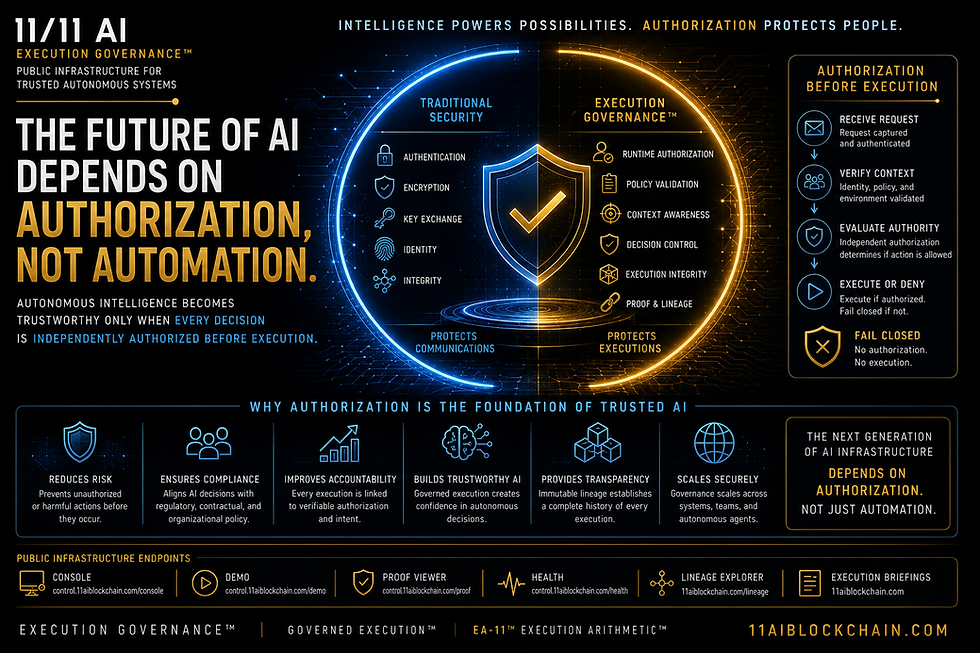
Execution Governance introduces an independent operational layer positioned between intelligence and execution.
Rather than replacing existing AI infrastructure, it complements it.
The architecture becomes:
Application Layer.
Agent Layer.
Foundation Model Layer.
Execution Governance Layer.
Infrastructure Layer.
The Execution Governance Layer continuously evaluates every action before execution.
Identity.
Authority.
Intent.
Policy.
Risk.
Environmental conditions.
Operational constraints.
Execution permissions.
Only after successful validation does execution proceed.
Why Every AI Platform Will Need This Layer
As autonomous systems become more capable, organizations require confidence that execution remains controlled.
The Trust Layer provides that confidence.
It creates:
Operational consistency.
Policy enforcement.
Execution assurance.
Governance coverage.
Regulatory alignment.
Cryptographic proof.
Execution lineage.
Fail-closed protection.
These capabilities are increasingly becoming infrastructure requirements rather than optional features.
Building The Execution Fabric
Execution Governance should not be viewed as another application.
It is infrastructure.
Much like identity providers transformed cloud computing, execution governance establishes shared trust services for autonomous systems.
Applications may change.
Models will evolve.
Agents will improve.
Execution Governance remains the constant operational boundary.
The result is a reusable execution fabric capable of governing every autonomous workload.
The Future Architecture
Tomorrow's enterprise AI stack will likely consist of three independent trust domains.
Intelligence Layer
Generates knowledge.
Produces recommendations.
Creates possibilities.
Governance Layer
Verifies identity.
Validates authority.
Enforces policy.
Evaluates risk.
Controls execution.
Generates proof.
Infrastructure Layer
Executes authorized actions.
Maintains availability.
Protects communications.
Stores immutable records.
Supports operational resilience.
Each layer performs a distinct responsibility.
Together they establish trusted autonomy.
Beyond The AI Model
The future competitive advantage will not belong exclusively to organizations with larger models.
It will belong to organizations capable of governing execution at scale.
The conversation is already beginning to shift.
From:
Model performance.
Benchmark rankings.
Context windows.
Inference speed.
Toward:
Operational trust.
Execution assurance.
Runtime governance.
Authorization infrastructure.
Execution lineage.
Trust architecture.
These capabilities define the next generation of enterprise AI.
Trust Is Infrastructure
Trust has never been a feature.
Trust has always become infrastructure.
Identity became infrastructure.
Encryption became infrastructure.
Payments became infrastructure.
Cloud security became infrastructure.
Execution Governance extends this pattern into autonomous systems.
The Trust Layer becomes the operational foundation connecting intelligence to execution.
Without it, autonomy remains difficult to trust.
With it, autonomy becomes enterprise infrastructure.
Key Principle
Models Create Intelligence.
Agents Create Automation.
Execution Governance Creates Trust.
Trust Creates Infrastructure.
Public Infrastructure Endpoints
Public Runtime Infrastructure
Public Governance Consolehttps://control.11aiblockchain.com/console
Runtime Governance Demohttps://control.11aiblockchain.com/demo
Public Governance Proof Viewerhttps://control.11aiblockchain.com/proof
Infrastructure Health Dashboardhttps://control.11aiblockchain.com/health
Execution Lineage Explorerhttps://www.11aiblockchain.com/lineage
Execution Governance™
Governed Execution™
EA-11™ Execution Arithmetic™
EGBP™ Execution Governance Benchmark Project
Patent Pending


Comments