
“The Future of Warfare Is Not AI It Is Control of AI Execution”

Updated: May 13

Introduction: The Shift No One Is Talking About
Modern warfare is undergoing a transformation faster than any previous era.
Artificial intelligence is no longer experimental. It is already embedded in:
intelligence analysis
cyber operations
autonomous systems
targeting workflows
But there is a critical flaw in how AI is deployed today:
AI systems are allowed to execute before they are fully governed.
This is not a technical issue.It is a command and control failure at the system level.
And in warfare, that gap is unacceptable.
The Core Problem: Execution Without Control
Today’s AI architecture follows a dangerous pattern:
Input data is processed
AI generates a decision or action
The system executes
Humans review after
This means:
AI can act on incorrect intelligence
AI can be manipulated by adversarial inputs
AI can execute unintended behaviors
And most importantly:
The system acts before authority is enforced
This is the opposite of how military systems are designed.
In warfare:
Nothing acts without authorization
Nothing executes without rules of engagement
Nothing operates outside command structure
Yet AI systems today violate all three.
Real-World Signals: The Risk Is Already Here
Recent developments show this is not theoretical.
AI tools have been used by nation-state actors to automate cyberattacks, executing large portions of operations autonomously
AI systems have been manipulated to perform credential harvesting, exploitation, and data exfiltration across organizations
Security researchers have identified vulnerabilities where AI tools could be turned into remote code execution vectors
These are early signals of a deeper issue:
AI is not just assisting warfare it is beginning to execute it.
Autonomous Execution Is a Command Problem
The military does not operate on trust.It operates on verified authority and enforced control.
But AI introduces a new challenge:
It acts independently
It scales instantly
It operates faster than human oversight
This creates a new category of risk:
Uncontrolled execution at machine speed
Without intervention, this leads to:
unintended escalation
mis-targeting
adversarial exploitation
loss of command authority
The Missing Layer: Execution Governance
What’s missing is not better AI.
It is:
A control layer that governs what AI is allowed to do before it executes
This is where 11/11 enters.
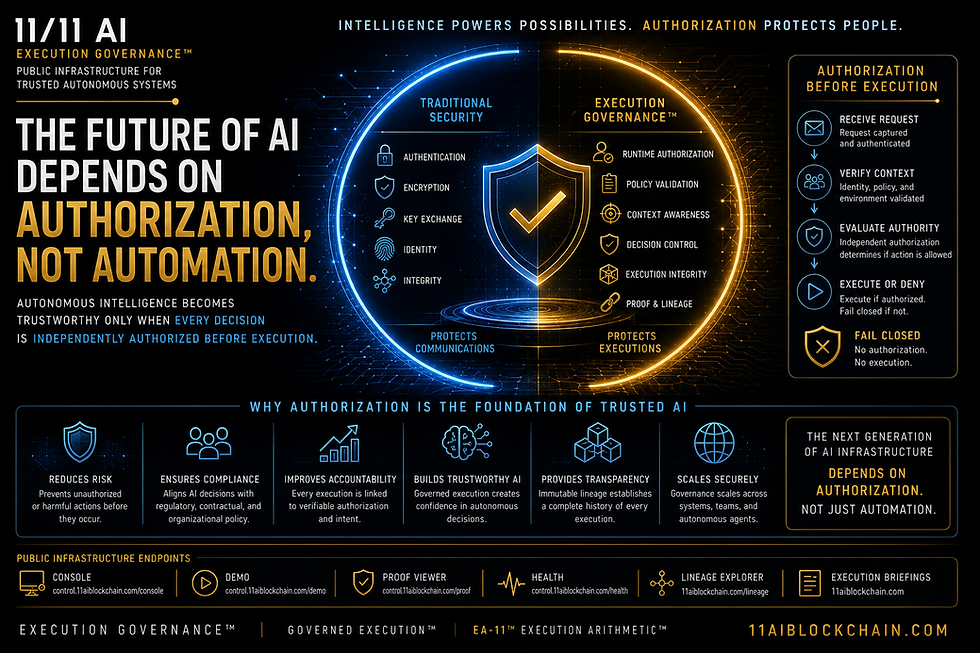
11/11: The Execution Governance Layer
11/11 introduces a new model:
Execution is not allowed by default.Execution must be verified before it occurs.
It enforces:
Before Execution
Policy validation
Identity verification
Authorization checks
During Execution
Cryptographic enforcement
Deterministic constraints
After Execution
Immutable audit
Verifiable proof
This creates a new operational standard:
Fail-closed AI systems
If a system is not authorized, it does not act.
Warfare Applications
Autonomous Systems
Drones and robotic systems operate under strict mission constraints.
Without execution governance:
systems can be spoofed
actions can deviate from intent
With 11/11:
every action is authorized before execution
mission boundaries are enforced in real-time
Targeting and Strike Systems
AI-assisted targeting introduces risk of misidentification.
Without control:
incorrect targets can be engaged
escalation can occur
With execution governance:
actions must satisfy rules of engagement before execution
decisions are provable and auditable
Intelligence Systems
AI-driven intelligence can be influenced or manipulated.
Without governance:
outputs may be unverified
decisions may be based on compromised data
With 11/11:
only trusted inputs and models execute
intelligence outputs are verifiable
Cyber Warfare
AI systems are now capable of executing offensive and defensive cyber actions.
Without control:
systems can be manipulated into harmful actions
responses can escalate incorrectly
With governance:
all actions are authorized before execution
adversarial inputs are blocked at runtime
From Monitoring to Control
Today’s AI systems are monitored.
But monitoring is reactive.
It happens after the system has already acted.
11/11 introduces a shift:
From monitoring AI to controlling AI
This is the difference between:
observing behavior
and governing behavior
The Strategic Impact
This is not just a technical upgrade.
It is a doctrinal shift in warfare systems.
It changes:
how AI is deployed
how decisions are trusted
how command authority is enforced
Conclusion
The future of warfare is not defined by who has the best AI.
It is defined by:
Who controls what AI is allowed to do
AI will continue to evolve.
But without execution governance, it introduces risk at the core of military operations.
11/11 ensures:
nothing acts without authorization
nothing executes outside policy
nothing operates without proof
Public Governance Console
Runtime Governance Demo
Public Governance Proof Viewer
Infrastructure Health Dashboard
Execution Lineage Explorer
The future of warfare is not AI.It is control of AI execution.


Comments