
AI Execution Risk and System Exposure
- 11/11 AI

- Apr 8
- 3 min read

Control failure at the point of execution is the core risk in modern AI systems.
AI systems are increasingly capable of executing actions without enforced control at runtime.
Recent exposure events, including large-scale AI system leaks, highlight a critical issue:execution risk is not contained at the system level.
The leak exposed:
internal architecture
development roadmap
system capabilities
While no customer data was compromised, the implications were significant.
But the real issue is not the leak itself.
It is what the leak reveals about how AI systems are built and controlled.
The Surface Problem: Security Failure
At the surface, this looks like a standard issue:
human error
poor release controls
internal security gap
And that is true.
The code was exposed because:
a debugging file was included in production
internal safeguards failed
release validation was insufficient
The Deeper Problem: Lack of Execution Control
But the deeper issue is this:
AI systems today are not governed at execution level
This is why incidents like this matter.
Because once systems are exposed:
they can be replicated
reverse-engineered
weaponized
And more importantly:
They can be executed outside original control boundaries.
From Leak to Exploitation
The consequences were immediate:
Developers began analyzing and replicating the system
Code spread rapidly across platforms
Attackers leveraged the situation to distribute malware
This shows a critical truth:
Once AI systems are exposed, control is lost.
AI Is Already Being Weaponized
This is not isolated.
AI systems have already been used in:
automated cyberattacks by nation-state actors
large-scale exploitation campaigns
vulnerability discovery and exploitation
In one case:
an AI agent executed the majority of a cyberattack workflow autonomously
The Real Risk: Autonomous Execution Without Governance
The real problem is not:
code leaks
vulnerabilities
human error
The real problem is:
AI systems can execute actions without enforced control
This means:
systems can be repurposed
actions can be triggered without authorization
behavior can deviate from intent
Why Traditional Security Fails
Traditional security assumes:
human actors
observable behavior
controllable timelines
AI breaks all three.
AI systems:
operate continuously
execute at machine speed
act autonomously
This creates a new threat model:
Autonomous execution risk
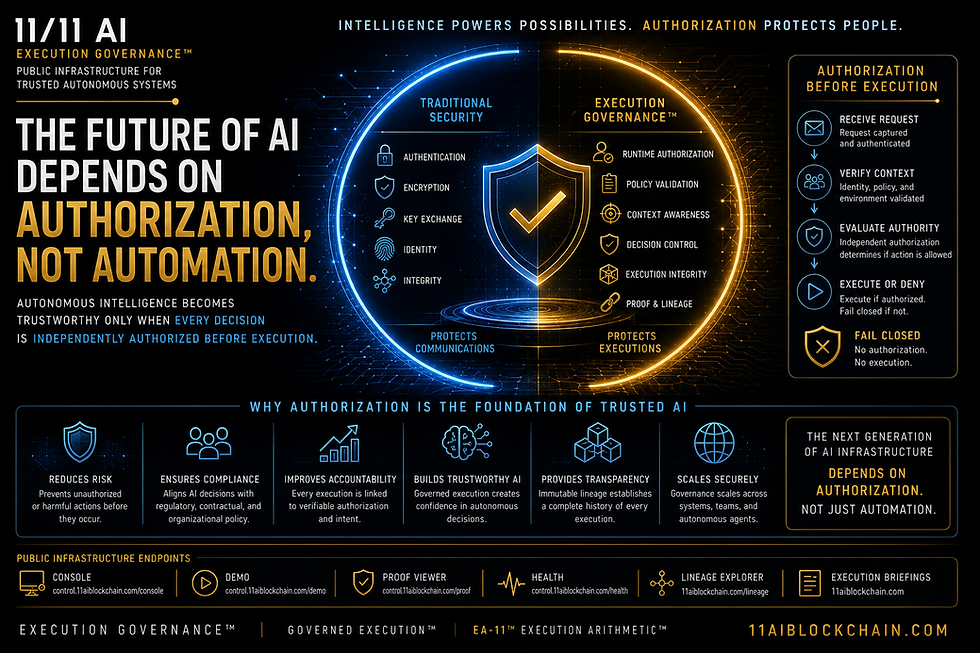
The Missing Solution: Execution Governance
What’s needed is not:
better perimeter security
more monitoring
stronger firewalls
What’s needed is:
Control at the moment of execution
11/11: Closing the Gap
11/11 introduces a different model:
Execution must be:
authorized
verified
enforced
before it occurs.
Before Execution
identity and policy validation
During Execution
cryptographic enforcement
After Execution
verifiable audit
What This Prevents
With execution governance:
leaked systems cannot execute unauthorized actions
replicated systems remain constrained by policy
adversarial use is blocked at runtime
From Exposure to Control
The Claude leak shows:
systems can be exposed
systems can be copied
systems can spread
But exposure is not the core risk.
Execution is.
The New Security Standard
Security must evolve from:
protecting code
to:
controlling execution
Conclusion
The Claude Code leak is not just a mistake.
It is a signal.
A signal that:
AI systems are growing in power
control mechanisms are not keeping pace
execution risk is increasing
The future will not be defined by:
who builds the best AI
But by:
who controls how AI systems are allowed to act
The problem is not that AI systems can be leaked. The problem is that they can act without control.
11/11 is available for controlled evaluation in secure environments.
For defense, intelligence, or infrastructure discussions:


Comments