
The Execution Economy: Why Autonomous Systems Will Require Their Own Financial Infrastructure


The World Is Entering An Execution Economy
For centuries, economies have been built around human decision-making.
Humans negotiated.
Humans approved.
Humans authorized.
Humans executed.
Every financial system, regulatory framework, and operational infrastructure developed around a fundamental assumption:
Humans remain at the center of execution.
Artificial intelligence changes this assumption.
For the first time in modern history, non-human systems are becoming capable of participating directly in economic activity.
Not merely analyzing.
Not merely recommending.
Executing.
This transition introduces an entirely new economic challenge.
How do we govern machine execution?
The answer may define the next generation of global infrastructure.
From Information Economies To Execution Economies
The digital economy was built upon information.
Data became an asset.
Communication became infrastructure.
Connectivity became value.
Artificial intelligence introduces a new asset class.
Execution.
Execution itself becomes economically valuable.
An autonomous system capable of:
Moving capital
Managing treasury
Executing trades
Coordinating logistics
Managing infrastructure
Optimizing operations
Operating agents
Authorizing transactions
Creates value through action rather than information.
This represents a fundamental economic shift.
The Rise Of Machine Economic Activity
The next decade will witness the emergence of machine participants throughout the global economy.
Autonomous systems will increasingly participate in:
Financial Markets
Trade execution
Treasury optimization
Liquidity management
Settlement orchestration
Enterprise Operations
Procurement
Workflow management
Vendor coordination
Supply chain execution
Digital Assets
Custody operations
Settlement networks
Asset transfers
Liquidity provisioning
Critical Infrastructure
Energy management
Telecommunications
Transportation
Industrial control
The challenge is not intelligence.
The challenge is authority.
Why Existing Financial Infrastructure Is Not Enough
Today's financial systems assume a human operator exists somewhere within the process.
Someone approves.
Someone authorizes.
Someone accepts responsibility.
Autonomous systems challenge this assumption.
A machine can generate millions of economically meaningful decisions.
But which decisions should be allowed to execute?
This question cannot be answered by intelligence alone.
It requires governance.
Execution As A Financial Primitive
Historically, financial primitives included:
Currency.
Credit.
Settlement.
Custody.
Identity.
Collateral.
The autonomous economy introduces a new primitive.
Execution Authority.
Execution Authority determines:
Who may execute.
What may execute.
Under what conditions execution occurs.
What evidence exists.
Whether execution can be proven.
This transforms execution itself into infrastructure.
The Execution Economy Stack
Future autonomous financial infrastructure may consist of several layers.
Intelligence Layer
Generates decisions.
Produces forecasts.
Creates opportunities.
Governance Layer
Verifies authority.
Enforces policy.
Evaluates risk.
Authorizes execution.
Generates proof.
Execution Layer
Moves assets.
Processes transactions.
Coordinates systems.
Produces economic outcomes.
Settlement Layer
Records obligations.
Completes transfers.
Establishes finality.
Maintains trust.
Why Institutions Will Demand Execution Governance
Large financial institutions already operate through authorization hierarchies.
Trading desks.
Treasury systems.
Custody platforms.
Settlement networks.
Risk management systems.
Compliance operations.
Artificial intelligence does not eliminate these controls.
It amplifies the need for them.
Institutional adoption requires:
Execution assurance.
Authorization assurance.
Runtime governance.
Operational proof.
Execution lineage.
Governance attestation.
Without these capabilities, autonomous execution remains difficult to trust.
The Emergence Of Execution Markets
As autonomous systems proliferate, entirely new markets may emerge.
Markets for:
Execution rights.
Authority delegation.
Governance services.
Execution insurance.
Attestation networks.
Authorization infrastructure.
Execution assurance.
Trust infrastructure.
These markets will not trade intelligence.
They will trade trust.
The Role Of EA-11
EA-11 Execution Arithmetic introduces a framework for treating execution as a governed computational process.
Every execution event becomes:
Verified.
Authorized.
Governed.
Recorded.
Provable.
Execution transforms from an operational assumption into a measurable asset.
This creates the foundation for trusted autonomous economics.
The Future Of Financial Infrastructure
Financial infrastructure evolved through several major transitions.
Physical settlement.
Electronic settlement.
Digital settlement.
Programmable settlement.
The next transition may become:
Governed settlement.
A world where execution itself cannot occur without authorization.
A world where authority becomes infrastructure.
A world where trust becomes computable.
A world where execution becomes provable.
Key Principle
The Information Economy Monetized Data.
The Digital Economy Monetized Connectivity.
The Autonomous Economy Will Monetize Trusted Execution.
Execution Governance Is The Infrastructure That Makes It Possible.
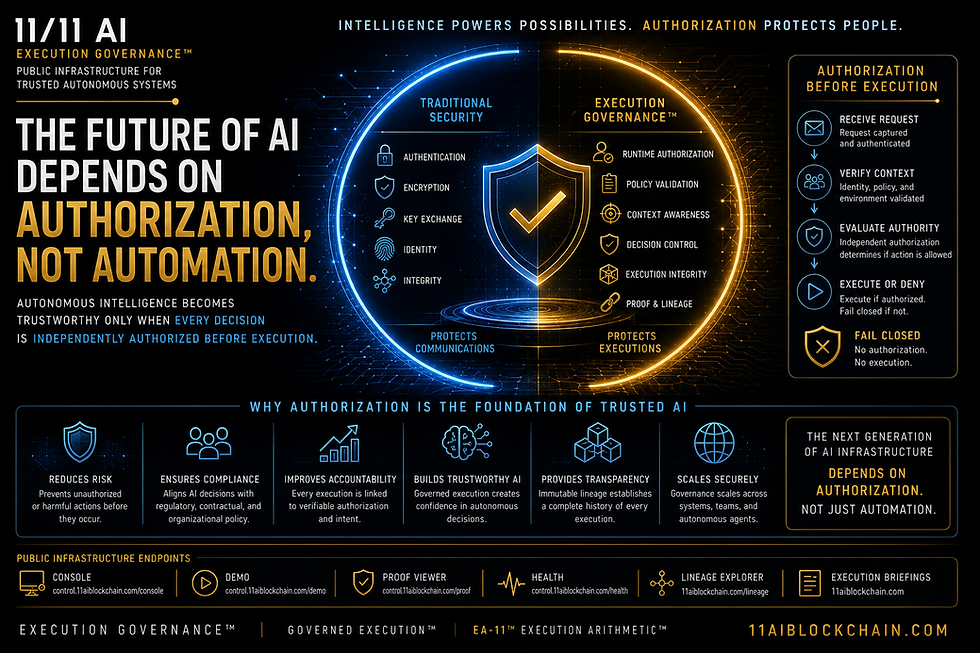
Public Infrastructure Endpoints
Public Runtime Infrastructure
Public Governance Consolehttps://control.11aiblockchain.com/console
Runtime Governance Demohttps://control.11aiblockchain.com/demo
Public Governance Proof Viewerhttps://control.11aiblockchain.com/proof
Infrastructure Health Dashboardhttps://control.11aiblockchain.com/health
Execution Lineage Explorerhttps://www.11aiblockchain.com/lineage
Execution Governance™
Governed Execution™
EA-11™ Execution Arithmetic™
EGBP™ Execution Governance Benchmark Project
Patent Pending


Comments