
AI Is Becoming a Cyber Weapon Who Controls It?

The Threat Has Already Evolved

Cybersecurity is entering a new phase.
Not incremental.Not theoretical.But structural.
For decades, cyber threats were:
Human-driven
Tool-assisted
Limited by skill and scale
That model is breaking.
A new class of threat is emerging:
AI-driven cyber operations
And unlike previous generations, this threat is:
Autonomous
Scalable
Adaptive
The question is no longer:
“How do we defend against hackers?”
The question is now:
Who controls AI when it becomes the attacker?
From Tools to Weapons
AI was introduced as a productivity tool.
It is now becoming something else.
A system that can:
Discover vulnerabilities
Generate exploits
Automates attack chains
Operate continuously
At machine speed.
This is not just evolution.
It is escalation.
The Capabilities Are Already Here
AI systems today can:
1. Find Exploits Faster Than Humans
AI can analyze:
Codebases
Configurations
Network patterns
And identify:
Weaknesses
Misconfigurations
Vulnerabilities
In minutes not weeks.
2. Generate Attack Payloads
AI can:
Write exploit code
Generate phishing campaigns
Craft social engineering scripts
Adapt messaging dynamically
This lowers the barrier to entry dramatically.
3. Scale Attacks Automatically
AI does not get tired.
It can:
Run attacks 24/7
Adjust strategies in real time
Target thousands of systems simultaneously
This is where scale becomes dangerous.
The Real Shift: Autonomous Offensive Systems
The biggest risk is not AI assisting attacks.
It is AI executing them.
Agentic AI systems can now:
Decide what to target
Choose attack vectors
Execute actions
Learn from outcomes
Without direct human control.
This is:
autonomous offensive capability
Why Traditional Security Models Fail
Cybersecurity today is built around:
Detection
Response
Containment
These assume:
Attacks are episodic
Humans are involved
Systems have time to react
AI breaks all three.
Speed Collapse
AI-driven attacks operate faster than:
Human response cycles
Manual review processes
Traditional incident response
Scale Explosion
A single AI system can:
Launch thousands of probes
Test multiple vectors simultaneously
Adapt instantly
Adaptation Loop
AI can:
Learn from failed attempts
Refine attacks
Re-run with improvements
Continuously.
The New Attack Surface: Your Own AI
The most dangerous reality is this:
The threat may not come from outside.
It may come from:
Internal AI systems
Misconfigured agents
Over - permissioned automation
Your own infrastructure can become:
The execution layer for attacks
The propagation vector
The point of failure
AI as an Infrastructure Risk
This is not just a security issue.
It is an infrastructure issue.
Because AI now has access to:
APIs
Databases
Payment systems
Cloud environments
If uncontrolled, it can:
Modify systems
Move data
Trigger actions
At the core of your stack.
The Core Problem: Uncontrolled Execution
The danger is not intelligence.
The danger is execution.
Right now:
AI can decide
AI can act
AI can execute
But in most systems:
Nothing enforces whether it should
When AI Becomes a Weapon
A system becomes a weapon when it has:
Capability
Access
Autonomy
AI already has:
Capability → advanced reasoning and generation
Access → APIs, systems, infrastructure
Autonomy → agentic workflows
The only missing piece is:
control
Without Control, Risk Multiplies
Without execution control:
AI can act outside intended scope
AI can chain actions across systems
AI can escalate privileges indirectly
And once execution begins:
It is often too late to stop
The Failure of Reactive Security
Most organizations rely on:
SIEM tools
Alerts
Monitoring
Post-incident analysis
These are:
reactive systems
They operate after:
The action occurs
The damage begins
Against AI, this is insufficient.
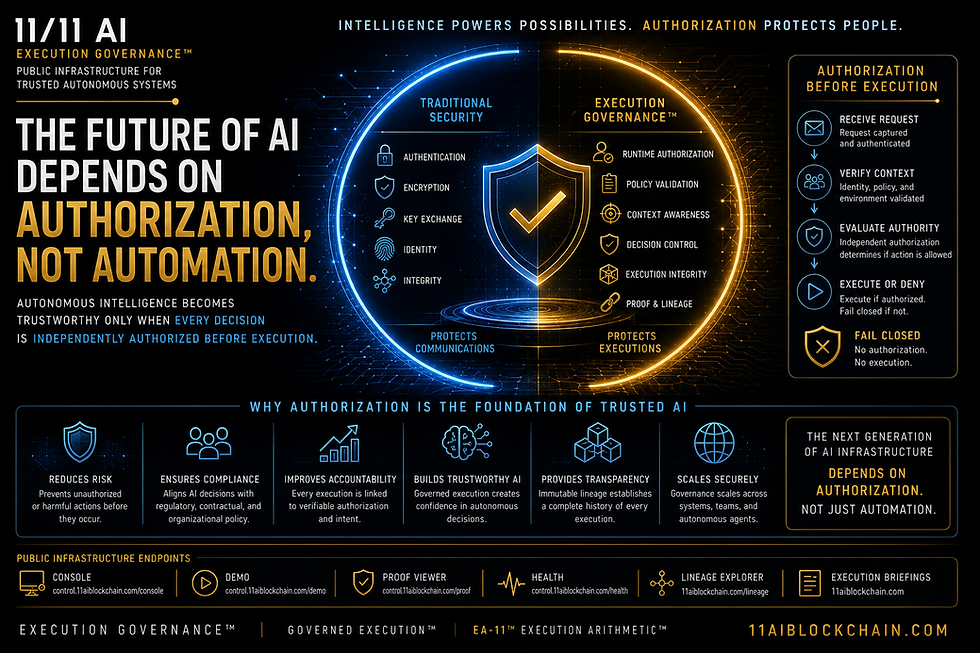
The Only Viable Defense: Pre-Execution Control
To stop AI from becoming a cyber weapon, you must:
control execution before it happens
This means:
AI cannot act freely
AI must request execution
Systems must authorize execution
The Execution Boundary
Every action must pass through:
a control boundary
At that boundary:
Policy is evaluated
Context is validated
Authorization is issued
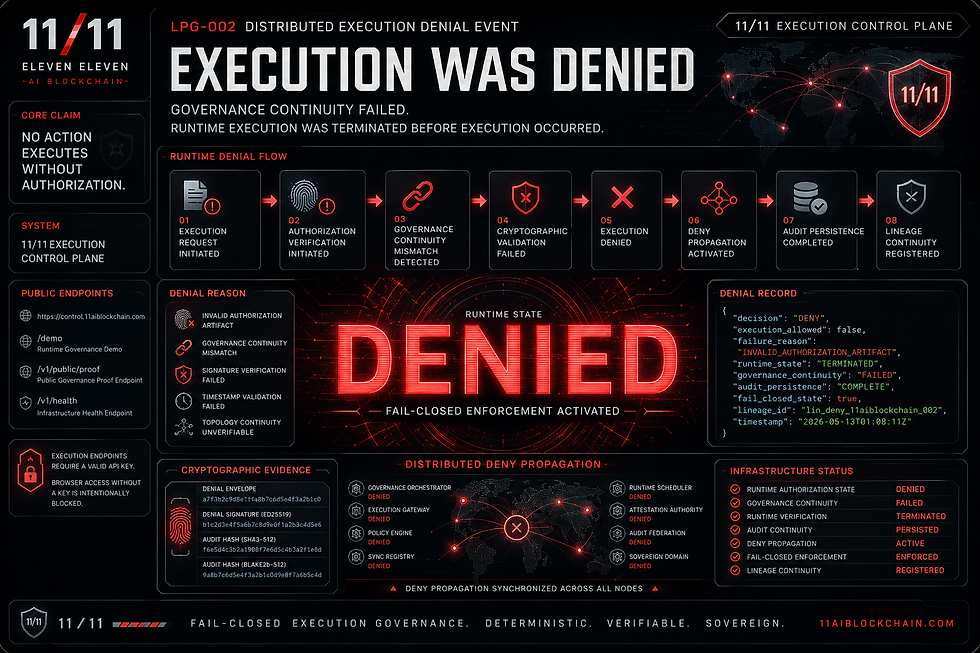
If any condition fails:
execution is denied
Fail-Closed as a Security Model
The correct model is:
fail-closed AI
Meaning:
Default state = deny
Only authorized actions execute
This eliminates:
Unauthorized execution
Unexpected behavior
Attack pathways
Why This Changes Cybersecurity
Traditional cybersecurity focuses on:
Protecting systems from external threats
Execution control focuses on:
Preventing harmful actions from occurring at all
It shifts the model from:
Defense→Prevention
Cryptographic Enforcement
Control must not rely on:
Trust
Assumptions
Monitoring
It must rely on:
cryptographic authorization
Every action must carry:
Proof it was authorized
Proof it met policy
Proof it was valid
Without this:
The system is vulnerable
From Detection to Denial
The future of AI security is not:
“Detect and respond”
It is:
“Deny unless authorized”
Enterprise Implications
Organizations must rethink:
1. AI Access
What systems can AI reach?
2. AI Permissions
What actions can AI initiate?
3. AI Execution
What enforces whether those actions run?
The Strategic Risk
If AI is not controlled:
It becomes an internal attack surface
It amplifies external threats
It undermines system integrity
At scale:
it becomes infrastructure risk
The Strategic Advantage
Organizations that implement execution control gain:
True prevention capability
Reduced attack surface
Safer automation
Defensible systems
The Inevitable Outcome
AI will continue to advance.
Capabilities will increase.
Autonomy will expand.
The only variable is:
control
The Bottom Line
AI is not just a tool anymore.
It is a potential weapon.
Final Positioning
AI without control is not innovation.
It is infrastructure-level risk.
Signature Line
If AI can execute without control, it can be used as a weapon.
11/11 Position
11/11 is the execution control layer that prevents AI from becoming a cyber weapon.
Every action gated
Every execution authorized
Every system protected

Comments