
Current AI Systems Cannot Prove They Were Authorized to Act


Artificial intelligence infrastructure has rapidly evolved around scale, orchestration, observability, and autonomous execution.
Modern systems can:
monitor runtime activity
generate telemetry
produce audit logs
orchestrate workflows
trigger autonomous actions
execute agentic tasks across distributed environments
But there is still a foundational infrastructure problem hiding underneath modern AI architecture:
Most AI systems cannot prove they were authorized to execute an action before execution occurred.
That distinction is becoming increasingly important as AI systems transition from informational tools into operational actors.
As AI gains the ability to:
move capital
control infrastructure
access sensitive systems
automate workflows
interact with defense environments
operate robotics
execute enterprise actions
the infrastructure question changes completely.
The question is no longer:
“What can the model do?”
The question becomes:
“Who authorized the model to act?”
The False Assumption Inside Modern AI Infrastructure
Much of today’s infrastructure assumes that if actions can be:
logged
traced
monitored
reviewed
rolled back
or audited later
then governance already exists.
But post-execution visibility is not the same thing as execution authorization.
Observability is not authorization.
Monitoring is not enforcement.
Detection is not prevention.
Audit trails created after execution do not prove whether execution itself was legitimate.
Most infrastructure today still follows the same operational pattern:
REQUEST→ EXECUTION→ LOGGING→ ANALYSIS
The execution already occurred before legitimacy was validated.
That architecture becomes increasingly dangerous as AI systems gain autonomous operational authority.
The Missing Primitive in AI Infrastructure
The missing primitive is not another dashboard.
It is not another monitoring platform.
It is not another observability pipeline.
The missing primitive is:
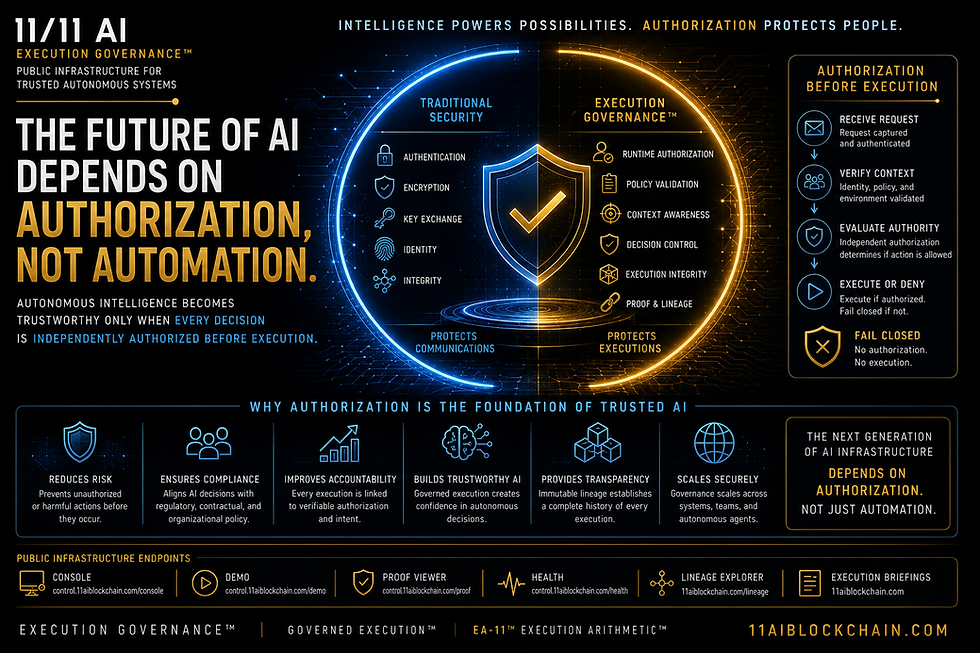
provable execution authority
This introduces a fundamentally different infrastructure model:
REQUEST→ AUTHORIZATION→ VERIFICATION→ EXECUTION→ LINEAGE→ AUDIT
Under this model:
execution authority is validated before runtime
authorization artifacts are cryptographically verified
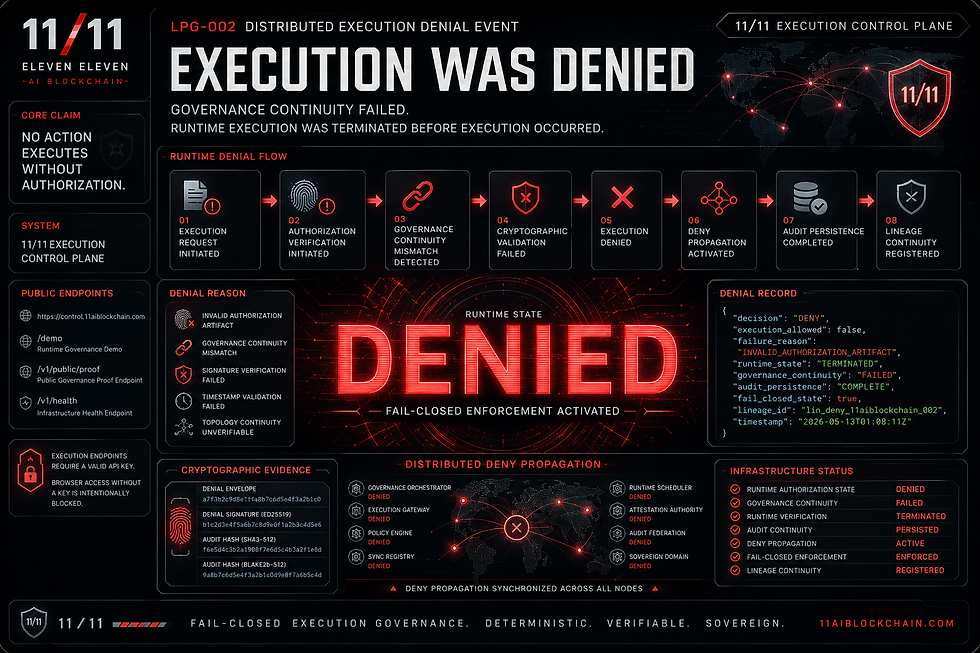
runtime systems fail closed if authorization is missing
execution lineage is persisted as evidence
governance becomes enforceable instead of advisory
This represents a structural shift away from reactive infrastructure and toward pre-execution governance infrastructure.
Why This Matters
The consequences become substantial once AI systems begin interacting with high-consequence environments.
Examples include:
autonomous financial systems
healthcare automation
military AI infrastructure
industrial control systems
AI agents with API authority
supply chain orchestration
autonomous cloud operations
enterprise workflow automation
In these environments, execution legitimacy becomes more important than execution speed.
A system that executes rapidly without provable authorization may still represent systemic infrastructure risk.
As AI capabilities scale, the ability to verify whether an action was permitted may become more important than the intelligence capability itself.
The future of AI infrastructure may depend less on model capability and more on provable execution legitimacy.
The Infrastructure Gap
Current infrastructure ecosystems provide:
telemetry
tracing
runtime analytics
SIEM integration
monitoring pipelines
observability frameworks
post-event audit systems
But very few infrastructures provide:
cryptographic execution authorization
pre-execution policy enforcement
fail-closed runtime governance
runtime authorization verification
execution legitimacy validation
immutable execution lineage persistence
This creates a growing infrastructure gap between:
systems that can observe execution
and
systems that can govern execution before runtime occurs
That distinction may define the next generation of AI infrastructure architecture.
From Observability to Governed Execution
Traditional infrastructure evolved around visibility.
The next phase of AI infrastructure may evolve around authority.
This changes the role of governance entirely.
Governance can no longer exist solely as:
policy documents
compliance reviews
post-event audits
human oversight committees
monitoring systems after execution
Instead, governance infrastructure may need to become:
cryptographically enforceable
runtime-verifiable
fail-closed by default
embedded directly into execution architecture
This is the foundation of governed execution infrastructure.
The Evolution Toward Execution Governance
11/11 has introduced infrastructure concepts centered around:
pre-execution authorization
runtime verification
fail-closed AI systems
execution lineage
cryptographic governance enforcement
governed execution architecture
These systems are designed around a core infrastructure principle:
No action executes without authorization.
Under this architecture:
execution legitimacy is validated before runtime
authorization becomes cryptographically provable
execution lineage becomes persistent evidence
runtime systems enforce governance directly at execution boundaries
This represents a transition away from reactive AI oversight and toward enforceable infrastructure governance.
The Next Infrastructure Category
AI infrastructure is entering a new phase.
The industry has already invested heavily in:
model scale
orchestration
acceleration
inference optimization
observability
deployment automation
The next infrastructure category may focus on something more foundational:
proving whether execution itself was legitimate.
Because ultimately:
The future of AI infrastructure will not be defined by which systems can execute the fastest. It will be defined by which systems can prove they were authorized to execute at all.
Public Infrastructure Endpoints
Public Runtime Infrastructure
Public Governance Console
Runtime Governance Demo
Public Governance Proof Viewer
Infrastructure Health Dashboard
Execution Lineage Explorer
Execution endpoints intentionally require valid API authorization.
Browser access without a valid authorization key is fail-closed by design.

Comments