
Constitutional Boundaries

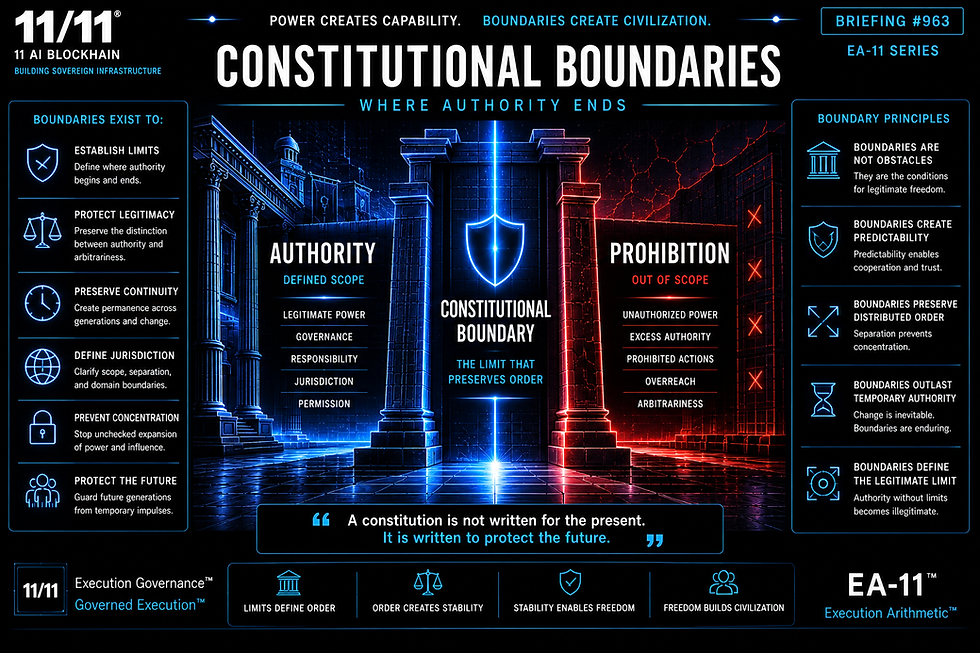
Every constitution begins with a recognition that power requires limits.
Without limits, authority expands until it encounters resistance.
Without limits, governance eventually consumes the very structures it was created to protect.
Without limits, order becomes indistinguishable from control.
This principle appears repeatedly throughout human history.
Civilizations establish constitutions because authority requires boundaries.
Institutions establish constitutions because governance requires boundaries.
Computational systems are increasingly approaching the same reality.
As computational environments become larger, more autonomous, and more influential, constitutional boundaries emerge as foundational requirements rather than optional design choices.
The future of computational civilization may ultimately depend upon how effectively these boundaries are defined.
A Boundary Is A Statement Of Restraint
Most governance frameworks focus on what may occur.
Constitutional boundaries focus on what may not occur.
This distinction is fundamental.
A policy enables action.
A boundary limits action.
A procedure defines behavior.
A boundary defines limits.
A capability creates possibility.
A boundary creates restraint.
Constitutional systems derive stability from their ability to establish enduring limitations above temporary authority.
The Purpose Of Constitutional Boundaries
The purpose of a constitutional boundary is not obstruction.
The purpose is preservation.
Boundaries preserve continuity.
Boundaries preserve legitimacy.
Boundaries preserve institutional coherence.
Most importantly, boundaries preserve the distinction between authority and arbitrariness.
When authority lacks boundaries, governance becomes unpredictable.
When governance becomes unpredictable, stability deteriorates.
Constitutional boundaries therefore exist to create permanence within changing environments.
Boundaries Define Jurisdiction
Every authority requires a scope.
Every scope requires limits.
Every limit requires a boundary.
Constitutional boundaries determine where authority applies and where authority ceases.
This function is essential because authority without defined limits eventually becomes impossible to distinguish from unrestricted power.
A constitution therefore transforms abstract authority into bounded authority.
Bounded authority becomes governable authority.
Governable authority becomes sustainable authority.
Boundaries Protect The Future
One of the most overlooked functions of constitutional boundaries is temporal protection.
Constitutions are not written solely for present conditions.
They are written for future conditions.
A constitutional boundary exists to protect future generations from temporary impulses.
Computational constitutions serve a similar purpose.
They establish limitations capable of surviving technological evolution.
The future may change.
The constitutional boundary remains.
The Architecture Of Separation
Boundaries create distinction.
Distinction creates order.
Order creates stability.
This sequence explains why constitutional systems depend heavily upon separation.
Separation of authority.
Separation of responsibility.
Separation of jurisdiction.
Separation of influence.
Without separation, concentration emerges.
Concentration eventually destabilizes itself.
Constitutional boundaries therefore function as architectural mechanisms for preserving distributed order.
Boundaries And Permanence
Policies change.
Procedures change.
Technologies change.
Boundaries exist because some principles must remain stable despite change.
A constitutional boundary serves as an anchor point within an evolving environment.
Its value increases as the surrounding system becomes more dynamic.
The greater the rate of change, the greater the importance of permanence.
Constitutional Erosion
Boundaries rarely disappear instantly.
More commonly, they erode.
Exceptions accumulate.
Interpretations expand.
Temporary deviations become permanent.
Over time, the boundary remains visible while its practical effect diminishes.
This phenomenon represents one of the greatest challenges facing constitutional systems.
A boundary survives not because it exists.
A boundary survives because it continues to be respected.
Computational Civilization
As computational systems expand in scale, constitutional boundaries become increasingly important.
Autonomous infrastructures.
Persistent digital institutions.
Execution environments operating continuously across decades.
These systems require constitutional structures capable of preserving order beyond individual technologies.
The question is no longer:
"What can computation do?"
The question becomes:
"What constitutional boundaries should computation never cross?"
This transition marks the beginning of computational civilization.
Conclusion
Constitutional boundaries are not limitations imposed upon successful systems.
They are the conditions that make successful systems possible.
Without boundaries, authority expands indefinitely.
Without boundaries, governance loses coherence.
Without boundaries, constitutional order eventually disappears.
The future of computational constitutionalism depends upon recognizing a simple principle:
Power creates capability.
Boundaries create civilization.
11/11 introduces Execution Governance™ infrastructure for governed autonomous execution and deterministic operational control.
Execution Governance™ Governed Execution™ EA-11™ Execution Arithmetic™
Patent Pending
Public Infrastructure Endpoints

Comments