
Constitutional Constraints On Computation


One of the oldest assumptions in computing is that anything that can be computed should be computable.
If a machine possesses sufficient resources, sufficient permissions, and sufficient capability, the computation proceeds.
Historically, this assumption appeared reasonable.
Computers were viewed primarily as tools.
The machine performed calculations.
The machine executed instructions.
The machine produced results.
Questions concerning legitimacy rarely entered the discussion.
The rise of autonomous systems changes this assumption fundamentally.
When computational systems begin influencing institutions, economies, infrastructure, governance, and human environments, the question is no longer whether computation is possible.
The question becomes whether computation should be permissible.
This distinction introduces the concept of constitutional constraint.
Constitutional constraints represent limitations that exist above ordinary execution.
They are not performance constraints.
They are not resource constraints.
They are not technical constraints.
They are foundational constraints.
They define the outer limits of computational legitimacy.
Capability Does Not Create Permission
A recurring mistake throughout history is the assumption that capability creates legitimacy.
Because something can be done, it is assumed that it may be done.
Constitutional thinking rejects this premise.
The existence of capability does not create authorization.
The existence of possibility does not create permission.
A computational environment requires principles capable of distinguishing permissible computation from impermissible computation.
Without such principles, every capability eventually becomes normalized.
The result is computational expansion without constitutional restraint.
The Necessity Of Limits
Every durable civilization eventually develops limits.
Political systems develop limits.
Economic systems develop limits.
Legal systems develop limits.
Institutional systems develop limits.
The reason is simple.
Unlimited authority eventually destabilizes itself.
Unlimited authority possesses no mechanism for self-correction.
Computational systems increasingly face the same challenge.
As execution capabilities expand, constitutional limitations become increasingly necessary.
The purpose is not to reduce capability.
The purpose is to preserve order.
Constraints Create Freedom
At first glance, constraints appear restrictive.
A deeper examination reveals the opposite.
Constraints frequently make freedom possible.
Property rights require constraints.
Contracts require constraints.
Institutions require constraints.
Markets require constraints.
Without limitations, predictability disappears.
Without predictability, cooperation becomes impossible.
Constitutional constraints create the stable environment within which computational freedom may exist.
The constraint protects the possibility of legitimate action.
Constitutional Boundaries
A constitutional constraint establishes a boundary beyond which governance may not pass.
This distinction is critical.
Ordinary policies regulate behavior.
Constitutional constraints regulate the regulators.
The purpose is to create permanence above temporary authority.
Without constitutional boundaries, governance eventually becomes indistinguishable from discretion.
The system loses stability.
The rules lose continuity.
The environment loses coherence.
Computational Power And Self-Limitation
One of the defining characteristics of mature systems is self-limitation.
The most sophisticated institutions are not those capable of exercising unlimited power.
They are those capable of limiting their own power.
Constitutional computation extends this principle into computational environments.
A constitutional system is not merely powerful.
A constitutional system is capable of refusing its own capabilities.
This capacity for self-restraint may become one of the defining characteristics of future autonomous infrastructures.
The Architecture Of Prohibition
Most computational theory focuses on what systems can do.
Constitutional theory focuses on what systems must never do.
This difference is profound.
The architecture of permission explains capability.
The architecture of prohibition explains legitimacy.
A mature computational civilization requires both.
One enables action.
The other preserves order.
Constitutional Permanence
Operational requirements evolve.
Technology evolves.
Infrastructure evolves.
Constitutional constraints exist precisely because some principles must remain stable while everything else changes.
The constitutional layer becomes the anchor against which all future evolution is measured.
Without permanence, constitutional systems cease to be constitutional.
They become merely another policy framework.
Toward Constitutional Computation
Future computational environments will increasingly require constitutional structures.
Not because machines require them.
Because societies require them.
The greater the scale of computational influence, the greater the necessity for constitutional limitation.
The future challenge is therefore not creating more powerful systems.
The future challenge is creating systems capable of recognizing the legitimacy of limitation itself.

Conclusion
Capability alone cannot define permissible computation.
Power alone cannot define legitimate computation.
Constitutional constraints provide the boundaries within which computational systems may operate without undermining the foundations upon which they depend.
The future of computational civilization may ultimately depend not upon what systems are capable of doing.
It may depend upon what constitutional principles require them not to do.
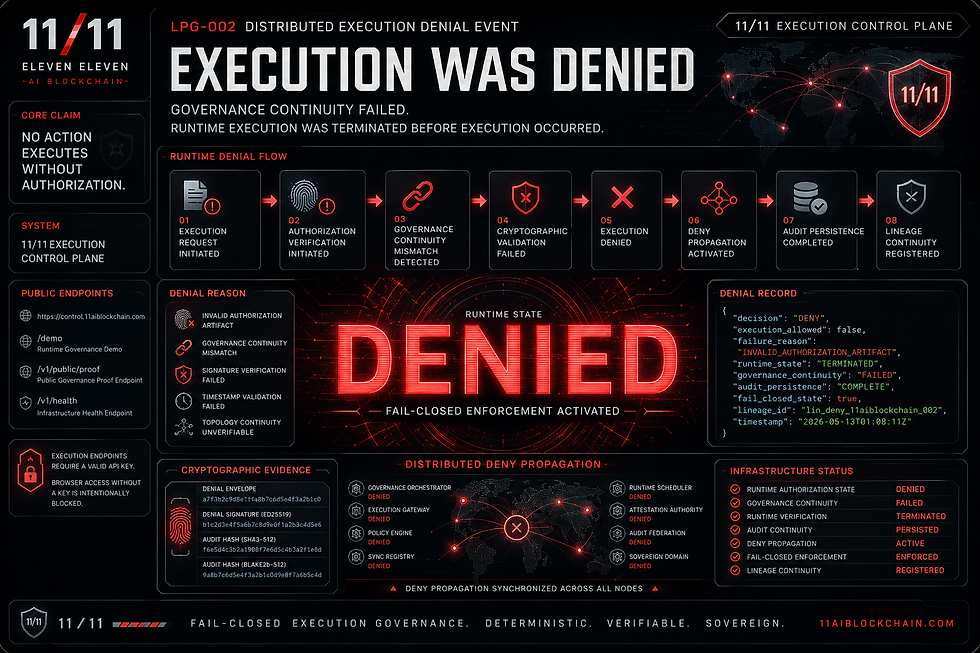
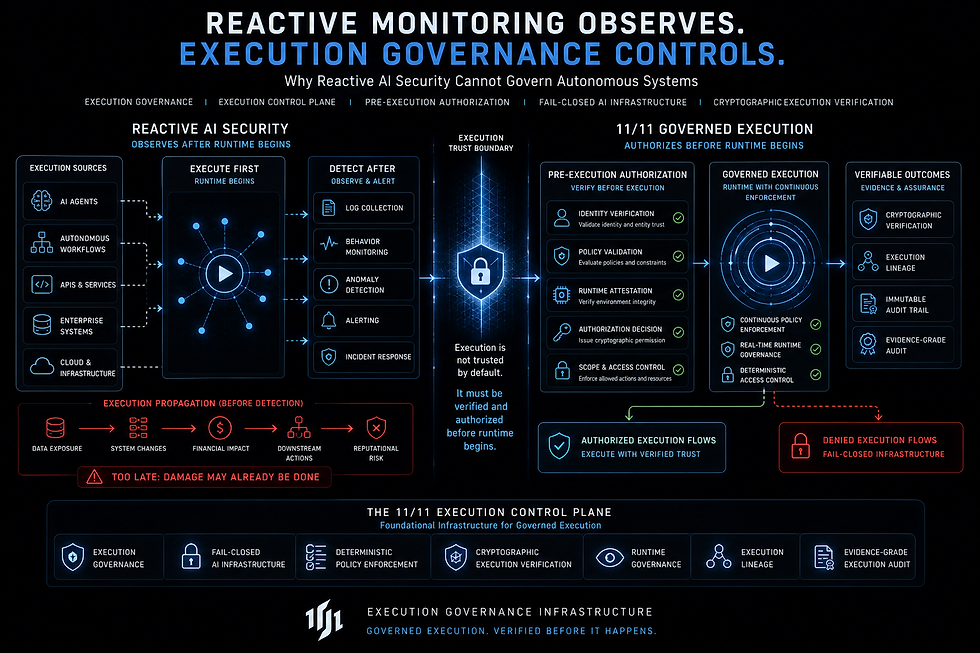
11/11 introduces Execution Governance™ infrastructure for governed autonomous execution and deterministic operational control.
Execution Governance™ Governed Execution™ EA-11™ Execution Arithmetic™
Patent Pending
Public Infrastructure Endpoints

Comments