
PILLAR PAGE 18 Distributed Governance Infrastructure for Autonomous Runtime Systems | 11/11 Execution Governance


Why Governance Must Expand Beyond Single-System Enforcement
Modern infrastructure no longer operates within isolated runtime environments.
AI systems increasingly execute across:
multi-cloud infrastructure
Kubernetes clusters
sovereign regions
edge environments
hybrid deployments
federated execution domains
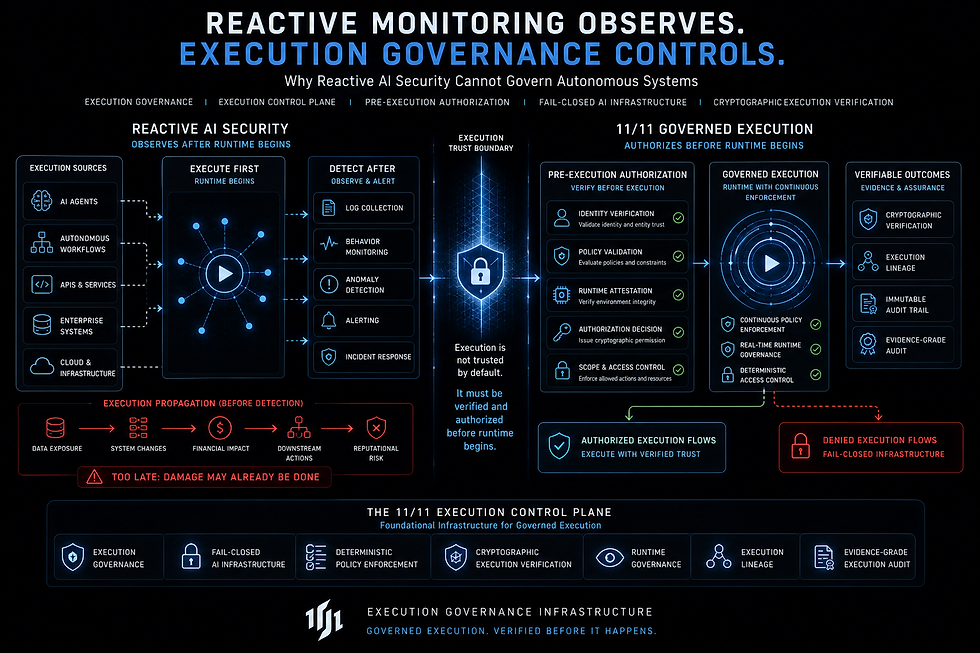
Traditional governance systems were not designed for globally distributed autonomous execution.
This creates a major operational challenge:
governance consistency across distributed runtime environments.
Distributed governance infrastructure establishes the systems required to maintain synchronized execution governance across globally distributed infrastructure.
What Is Distributed Governance Infrastructure?
Distributed governance infrastructure is the coordinated governance layer responsible for enforcing deterministic execution control across distributed runtime systems.
It coordinates:
policy synchronization
runtime authorization
trust validation
cryptographic verification
execution lineage continuity
distributed enforcement orchestration
This creates globally governed runtime infrastructure.
The Failure of Centralized Governance Models
Traditional centralized governance systems struggle within distributed environments.
Common problems include:
policy drift across regions
inconsistent enforcement behavior
fragmented authorization decisions
asynchronous runtime trust
disconnected audit history
cross-domain orchestration gaps
Autonomous AI systems magnify these weaknesses.
Machine-speed distributed execution requires governance systems capable of operating consistently across all runtime domains.
The Shift From Centralized Security to Distributed Governance
Legacy infrastructure often assumes governance can remain centralized.
Autonomous infrastructure invalidates this assumption.
Distributed execution requires:
synchronized governance state
distributed authorization validation
coordinated runtime enforcement
globally consistent policy behavior
continuously verifiable trust coordination
Governance becomes distributed operational infrastructure rather than centralized administrative tooling.
Related:
Governance Control Planes
Deterministic Runtime Governance
Fail-Closed Execution Architecture
Core Components of Distributed Governance Infrastructure
Distributed Policy Synchronization
Governance policies must remain synchronized across environments.
Distributed policy systems coordinate:
version-controlled policy distribution
runtime policy consistency
cross-region enforcement logic
trust-zone alignment
authorization rule propagation
This ensures governance remains deterministic globally.
Federated Authorization Systems
Execution authorization must operate consistently across distributed runtime domains.
Federated authorization systems validate:
workload identity
environment trust
policy compliance
runtime context
cryptographic authorization artifacts
sovereign governance constraints
This creates globally coordinated execution governance.
Distributed Runtime Enforcement
Distributed governance systems coordinate runtime enforcement across:
Kubernetes environments
cloud providers
edge systems
sovereign deployments
hybrid infrastructure
federated execution domains
Enforcement coordination includes:
workload isolation
runtime segmentation
anomaly response
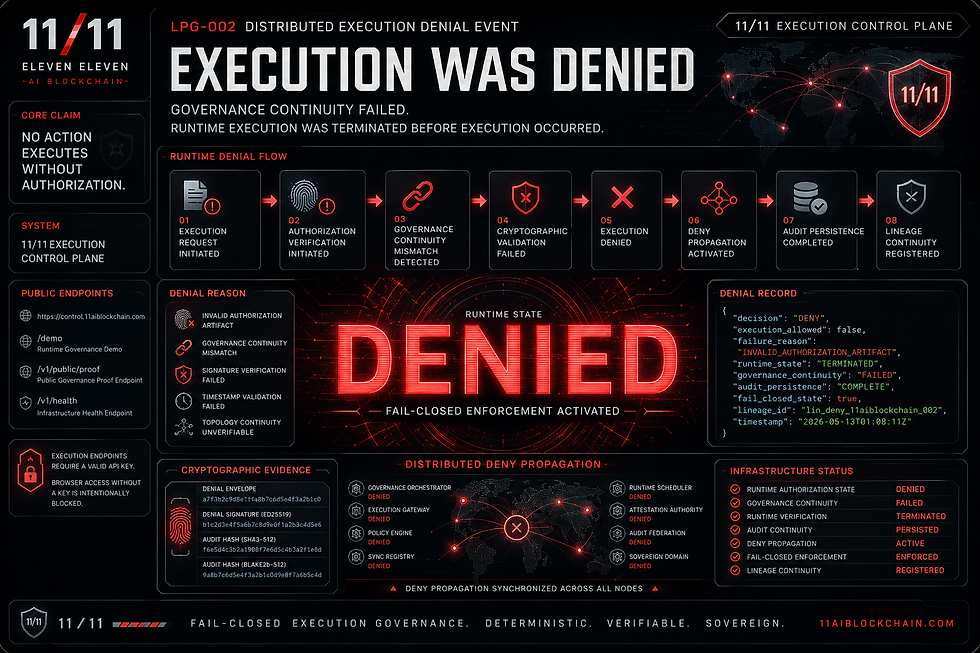
denial propagation
trust-boundary enforcement
fail-closed containment
This creates continuously governed distributed infrastructure.
Cryptographic Trust Coordination
Distributed governance increasingly depends on cryptographic coordination systems.
These systems verify:
authorization signatures
policy authenticity
distributed attestation
lineage continuity
immutable audit synchronization
trust-state consistency
Cryptographic coordination establishes verifiable distributed governance.
Deterministic Distributed Governance
Distributed governance systems must behave deterministically.
Deterministic distributed governance ensures:
identical policies produce identical outcomes globally
enforcement behavior remains predictable
authorization logic remains stable
governance cannot silently diverge across regions
denial semantics remain consistent
Determinism is foundational to trustworthy distributed runtime governance.
Fail-Closed Distributed Enforcement
Distributed governance infrastructure must default to denial during uncertainty.
Examples include:
policy synchronization failures
cryptographic verification inconsistencies
trust-state divergence
runtime attestation failures
lineage corruption
authorization ambiguity
When distributed governance certainty degrades:
execution is denied.
This establishes fail-closed distributed governance.
Sovereign Governance Infrastructure
Distributed governance systems increasingly operate within sovereign runtime domains.
Sovereign governance introduces additional requirements including:
regional policy enforcement
jurisdiction-aware execution control
data residency governance
sovereign runtime trust boundaries
regional cryptographic coordination
cross-domain governance isolation
Distributed governance infrastructure enables sovereign AI governance architectures.
Continuous Distributed Verification
Distributed governance systems require continuous verification.
Continuous distributed verification includes:
runtime trust synchronization
policy integrity validation
authorization freshness checks
lineage continuity monitoring
distributed attestation verification
enforcement consistency validation
This creates continuously verifiable distributed governance infrastructure.
Distributed Execution Lineage
Distributed governance infrastructure depends heavily on synchronized execution lineage.
Distributed lineage systems enable:
cross-region execution traceability
federated governance reconstruction
distributed dependency visibility
global audit continuity
operational replay
forensic verification
Execution lineage ensures distributed governance remains reconstructable and provable.
Related:
Execution Lineage Infrastructure
Cryptographic Runtime Verification
Immutable Governance Audit Systems
Autonomous AI and Distributed Governance
Autonomous AI systems significantly increase distributed governance complexity.
AI systems may independently:
orchestrate multi-region execution
coordinate distributed workflows
invoke external infrastructure
interact across trust domains
manage federated execution chains
trigger downstream runtime actions
Distributed governance infrastructure ensures these systems remain bounded by synchronized operational policy.
Enterprise and Defense Infrastructure
Distributed governance infrastructure is increasingly critical for:
defense systems
sovereign AI deployments
financial infrastructure
healthcare runtime systems
industrial automation
critical infrastructure governance
These environments require globally consistent operational trust.
Distributed governance establishes that trust layer.
Public Governance Infrastructure
11/11 demonstrates distributed governance concepts through publicly accessible governance infrastructure.
Governance Console
Runtime Governance Demo
Governance Proof Viewer
Infrastructure Health Dashboard
Execution Lineage Explorer
The Future of Distributed Governance Infrastructure
As AI systems continue expanding across distributed runtime environments, governance infrastructure must evolve accordingly.
Future governed systems will increasingly require:
synchronized distributed enforcement
federated authorization systems
cryptographic trust coordination
sovereign runtime governance
deterministic global policy orchestration
immutable distributed execution lineage
Distributed governance infrastructure is rapidly emerging as one of the foundational operational layers of governed AI systems.

Comments