
Why EA-11 Introduces Computational Accountability


Modern computing assumes computation produces results.
EA-11 asks a different question:
Who is accountable for those results?
Historically, computational systems focused on correctness, performance, speed, and efficiency.
Inputs were processed.
Outputs were generated.
Results were consumed.
The computational process itself was often treated as neutral.
But autonomous systems change this assumption.
As machine-speed systems increasingly influence infrastructure, finance, healthcare, defense, logistics, and sovereign operations, computational outcomes become operational decisions.
Operational decisions require accountability.
This creates a new computational requirement.
Not merely:
Can the system compute?
But:
Should the computational outcome be accountable?
EA-11 introduces computational accountability as a foundational principle of governed computation.
Computational accountability establishes that computational outcomes must be attributable, verifiable, and operationally accountable before they become authoritative.
A result may exist.
A result may be mathematically correct.
A result may be computationally efficient.
Yet the result may still lack accountability.
Without accountability:
computational authority becomes uncontrolled
operational trust degrades
legitimacy weakens
governance becomes reactive
autonomous systems become difficult to govern
EA-11 addresses this by extending accountability into the computational layer itself.
Computation must not simply produce outcomes.
Computation must produce accountable outcomes.
This requires:
trust
policy
proof
runtime integrity
execution context
computational legitimacy
Only then can computational accountability exist.
This creates a new distinction.
Computation
A result exists.
Accountable Computation
A result exists and can be operationally trusted, verified, and attributed.
As autonomous systems scale, this distinction becomes increasingly important.
Because future infrastructure will not merely depend on what systems compute.
It will depend on whether those computational outcomes remain accountable.
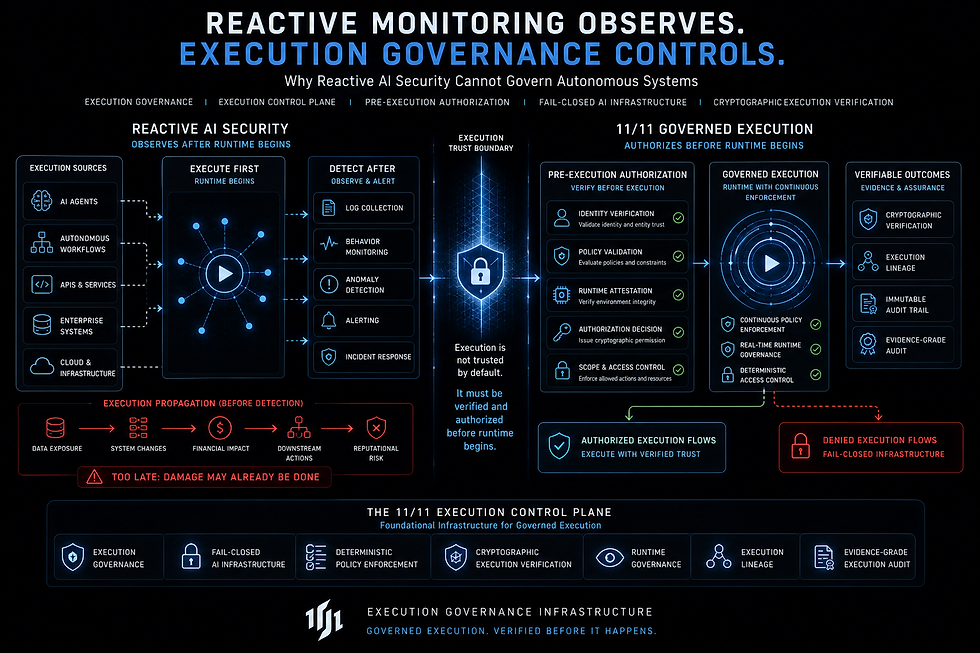
Execution Governance™ establishes accountability for execution.
EA-11 establishes accountability for computation itself.
Together they create:
governed execution
governed computation
computational authority
computational legitimacy
computational accountability
deterministic operational trust
As machine-speed systems continue expanding globally, accountability becomes a critical infrastructure property.
Because sovereign systems cannot delegate authority to computations that cannot be held accountable.
That is why EA-11 introduces computational accountability.
Public Infrastructure Endpoints
Public Runtime Infrastructure
Public Governance Console
Runtime Governance Demo
Public Governance Proof Viewer
Infrastructure Health Dashboard
Execution Lineage Explorer
Execution endpoints intentionally require valid API authorization.
Browser access without a valid authorization key is fail-closed by design.
EA-11™
Execution Arithmetic™
Governed Computation™
Patent Pending


Comments