
Why EA-11 Introduces Computational Liability


Authority without liability eventually becomes unchecked power.
Every mature governance system eventually discovers this reality.
Authority creates consequences.
Consequences create responsibility.
Responsibility creates liability.
Without liability, authority expands without meaningful constraint.
Traditional computing rarely addresses this issue.
A computation occurs.
A result is generated.
An outcome influences reality.
The system continues.
The computational event is often treated as isolated from the consequences it creates.
EA-11 challenges this assumption.
As autonomous systems increasingly influence:
sovereign AI systems
critical infrastructure
healthcare operations
financial environments
defense systems
autonomous orchestration
machine-speed governance platforms
computational outcomes increasingly create real-world consequences.
Consequences require liability.
This is where EA-11 introduces computational liability.
Computational liability establishes that authoritative computation must remain accountable for the operational consequences it creates.
A computational outcome should not simply possess authority.
It should possess liability.
The system must be able to determine:
what authority was exercised
what outcome was produced
what trust conditions existed
what governance framework applied
what responsibility was accepted
what consequences emerged
Without liability:
authority becomes difficult to constrain
accountability weakens
legitimacy degrades
trust becomes fragile
governance becomes reactive
EA-11 therefore introduces liability as a computational property.
This creates a new distinction.
Computation
A result exists.
Liable Computation
A result exists within a framework that connects authority to consequences.
This distinction becomes increasingly important as autonomous systems scale.
Because future infrastructure will not merely depend on what systems can compute.
It will depend on whether computational authority remains accountable for what it causes.
Traditional Computing:
Compute → Influence Reality
EA-11:
Compute → Validate → Authorize → Accept Liability → Influence Reality
This additional layer creates stronger operational trust.
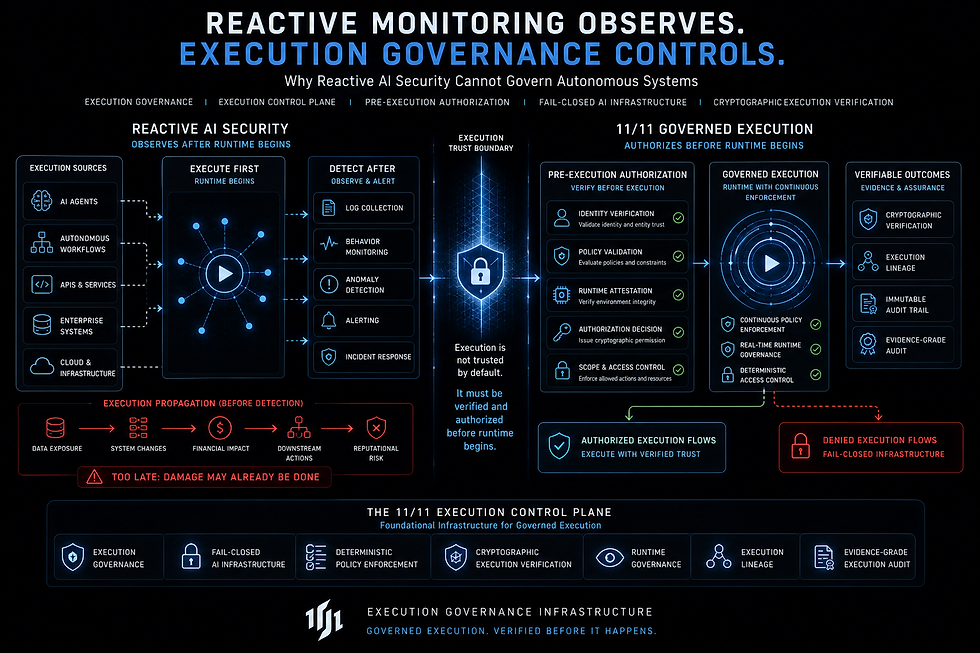
Execution Governance™ establishes liability for execution.
EA-11 establishes liability for computation itself.
Together they create:
governed execution
governed computation
computational responsibility
computational accountability
computational liability
deterministic operational trust
As autonomous systems continue expanding globally, liability becomes increasingly important.
Because authority without liability creates instability.
Authority with liability creates trust.
That is why EA-11 introduces computational liability.
Public Infrastructure Endpoints
Public Runtime Infrastructure
Public Governance Console
Runtime Governance Demo
Public Governance Proof Viewer
Infrastructure Health Dashboard
Execution Lineage Explorer
Execution endpoints intentionally require valid API authorization.
Browser access without a valid authorization key is fail-closed by design.
EA-11™ Execution Arithmetic™ Governed Computation™ Patent Pending


Comments