
EG-005 Authorization Artifact Standard

Updated: May 13

Execution governance requires standardized trust objects.
Modern infrastructure already standardizes:
identity formats
cryptographic protocols
network communication
certificate systems
authentication flows
Governed execution infrastructure now requires:authorization standards.
11/11 defines the Authorization Artifact Standard as the canonical cryptographic authorization structure used to validate, constrain, and govern runtime execution before execution begins.
Execution authorization becomes standardized infrastructure.
What Is an Authorization Artifact?
An authorization artifact is a cryptographically verifiable execution object that proves:
execution approval exists
policy validation succeeded
runtime conditions were verified
execution scope is constrained
governance requirements were satisfied
before execution occurs.
The artifact becomes the executable trust authority for governed systems.
No valid artifact:no execution.
Why Authorization Standards Matter
Without standardized authorization systems:
runtime trust becomes inconsistent
policy enforcement fragments
execution scope drifts
governance continuity weakens
verification becomes unreliable
Execution governance requires:
deterministic authorization consistency.
Authorization artifacts standardize execution trust across environments.
EG-005 Authorization Artifact Principles
1. Authorization Must Be Cryptographically Verifiable
Authorization artifacts must support:
digital signatures
integrity verification
deterministic validation
tamper evidence
independent verification
Execution trust must remain mathematically provable.
2. Authorization Must Exist Before Execution
Execution cannot self-authorize.
Authorization validation must complete before runtime execution begins.
3. Authorization Scope Must Remain Constrained
Artifacts must define:
permitted execution actions
runtime boundaries
authorization duration
environmental constraints
policy limitations
Execution authority must remain bounded.
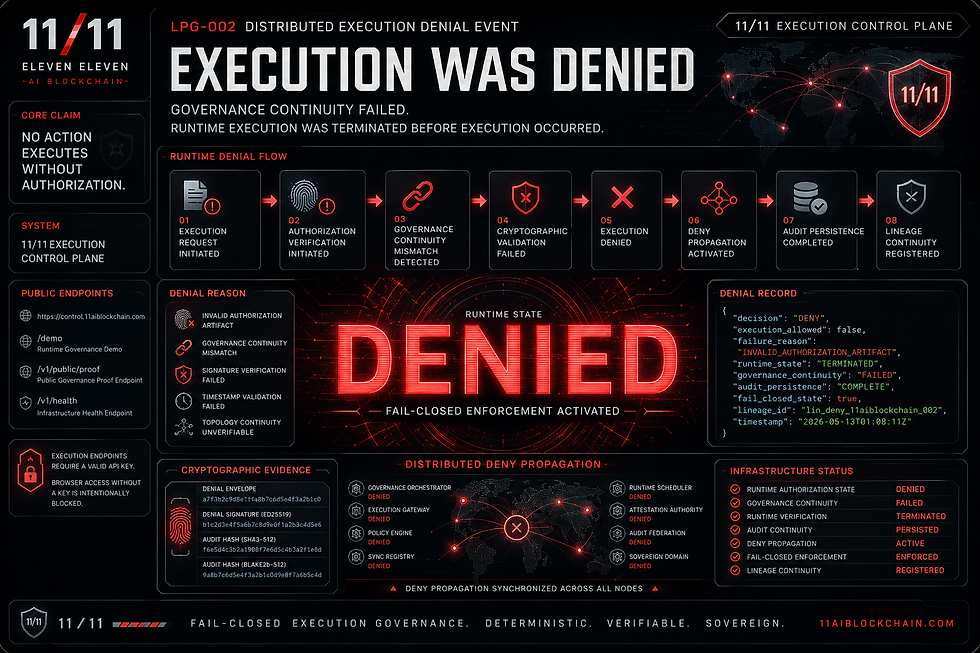
4. Invalid Authorization Must Fail Closed
If authorization becomes:
invalid
expired
unverifiable
tampered
out of scope
execution must stop automatically.
No permissive runtime continuation.
5. Authorization Must Persist Into Execution Lineage
Authorization artifacts must remain linked to:
execution records
lineage systems
governance history
runtime verification
audit persistence
Execution trust must remain historically provable.
Authorization Artifacts Become Infrastructure Primitives
Future enterprise and sovereign systems increasingly require:
cryptographic execution authorization
deterministic runtime approval
governed execution boundaries
fail-closed trust enforcement
immutable authorization lineage
operational runtime trust systems
Authorization becomes foundational infrastructure.
Execution Governance Requires Standardized Trust
Autonomous systems increasingly execute:
continuously
asynchronously
independently
across distributed environments
Execution governance cannot rely on inconsistent authorization behavior.
Trust itself must become standardized.
Authorization artifacts establish the canonical runtime trust primitive for governed execution systems.
Standardized Authorization Changes Infrastructure Semantics
Historically:
authorization granted system access.
Execution governance introduces:execution authorization itself.
Future infrastructure increasingly governs:
whether execution is approved
whether runtime trust remains valid
whether policy scope remains constrained
whether governance continuity persists
whether authorization remains provable
Execution itself becomes authorized infrastructure.
11/11 Positioning
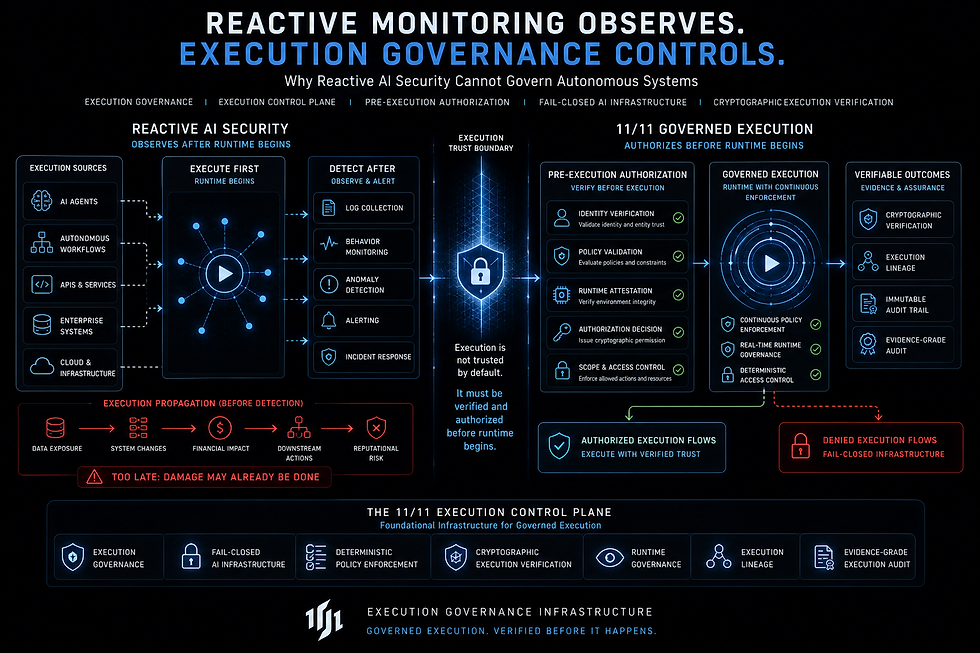
11/11 is positioned as the execution governance layer for AI infrastructure.
Its governance architecture establishes:
authorization artifact standards
deterministic execution authorization
cryptographic runtime verification
fail-closed governance enforcement
immutable execution lineage
operational trust continuity
before execution begins.
Execution itself becomes the trust boundary.
Official Proof Systems
Public Governance Console
Runtime Governance Demo
Public Governance Proof Viewer
Infrastructure Health Dashboard
Execution Lineage Explorer
Execution governance cannot operate on implied trust.
Execution authorization itself must become standardized, verifiable infrastructure.

Comments