
EG-019 Autonomous Runtime Governance

Updated: May 13

AI systems are increasingly becoming autonomous.
They coordinate independently.
They execute continuously.
They make runtime decisions without direct human interaction.
This changes infrastructure requirements entirely.
Traditional governance models assumed:
humans remained inside the operational loop.
Autonomous infrastructure invalidates this assumption.
11/11 defines autonomous runtime governance as governed execution infrastructure where authorization, runtime trust validation, policy enforcement, and governance continuity operate continuously across autonomous execution systems before and during runtime activity.
Execution governance becomes continuous operational infrastructure.
Not episodic oversight.
What Is Autonomous Runtime Governance?
Autonomous runtime governance establishes continuous execution oversight where:
runtime trust remains verified
authorization scope remains constrained
governance policies remain enforced
execution lineage remains persistent
runtime conditions remain validated
execution boundaries remain governed
throughout autonomous execution activity.
Governance itself becomes continuously operational.
Why Autonomous Governance Matters
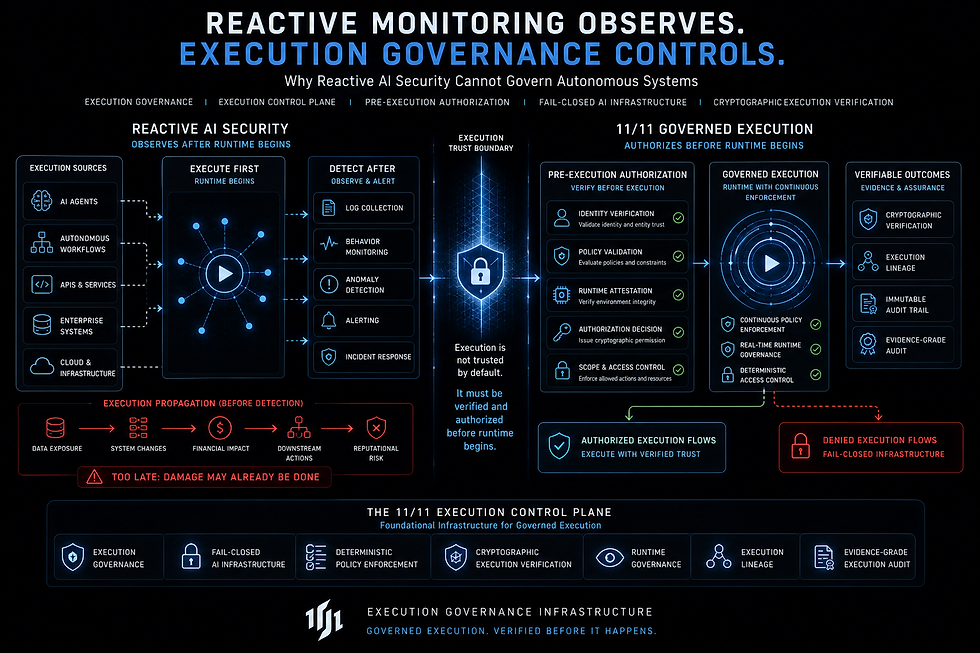
Traditional infrastructure governance often assumes:
human review cycles
manual intervention
delayed oversight
reactive security analysis
centralized operational control
Autonomous systems increasingly operate:
asynchronously
independently
continuously
globally
at machine speed
Reactive governance cannot scale to autonomous execution environments.
Execution trust must become continuously enforced infrastructure.
EG-019 Autonomous Governance Principles
1. Runtime Trust Must Remain Continuously Verified
Autonomous execution cannot depend on one-time trust validation.
Trust verification must persist continuously during runtime activity.
2. Governance Enforcement Must Remain Deterministic
Autonomous systems cannot operate under ambiguous governance behavior.
Policy enforcement outcomes must remain predictable and fail closed.
3. Autonomous Execution Scope Must Remain Constrained
Governed systems must continuously enforce:
execution permissions
runtime duration
operational boundaries
policy limitations
environmental constraints
Execution authority cannot become unbounded.
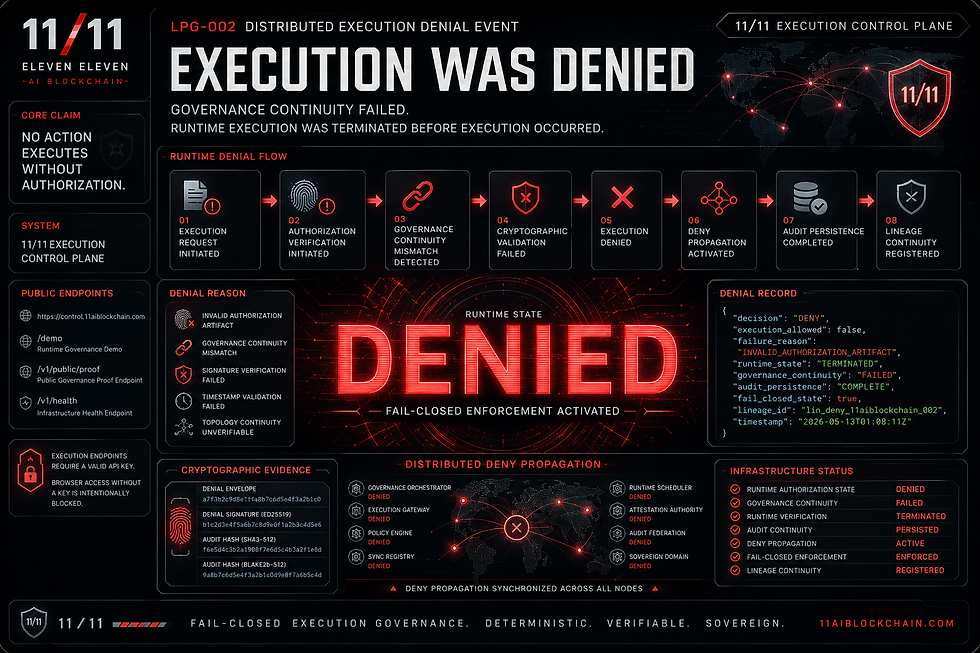
4. Governance Violations Must Stop Execution Automatically
If runtime trust fails:
execution must stop automatically.
No permissive continuation.
No delayed remediation.
No runtime bypass.
5. Execution Lineage Must Persist Across Autonomous Activity
Lineage systems must preserve:
runtime trust transitions
autonomous policy decisions
governance enforcement history
authorization continuity
cryptographic verification records
Autonomous execution history must remain provable.
Autonomous Infrastructure Requires Continuous Governance
As AI systems scale:
runtime governance itself becomes continuous infrastructure.
Future enterprise and sovereign systems increasingly require:
autonomous runtime verification
deterministic trust enforcement
fail-closed governance controls
cryptographic execution validation
continuous execution lineage
operational runtime assurance
Governance becomes persistent runtime infrastructure.
Autonomous Governance Changes Infrastructure Semantics
Historically:
governance operated externally to execution.
Autonomous systems require:
governance embedded directly into runtime infrastructure.
Future infrastructure increasingly governs:
whether execution remains authorized
whether trust remains valid
whether boundaries remain intact
whether governance continuity persists
whether runtime conditions remain compliant
Execution governance becomes continuously active operational infrastructure.
Runtime Governance Becomes a Foundational Trust Layer
Autonomous systems increasingly coordinate across:
AI inference environments
enterprise orchestration systems
sovereign infrastructure
distributed agents
regulated automation systems
mission-critical execution environments
This requires:
continuous runtime trust governance.
Execution governance becomes foundational infrastructure for autonomous systems.
11/11 Positioning
11/11 is positioned as the execution governance layer for AI infrastructure.
Its governance architecture establishes:
autonomous runtime governance
deterministic execution enforcement
fail-closed runtime controls
cryptographic execution verification
immutable execution lineage
continuous operational trust systems
before and during execution.
Execution itself becomes the trust boundary.
Official Proof Systems
Public Governance Console
Runtime Governance Demo
Public Governance Proof Viewer
Infrastructure Health Dashboard
Execution Lineage Explorer
Autonomous infrastructure cannot rely on intermittent governance.
Execution trust itself must remain continuously governed.

Comments