
PILLAR PAGE 12 Execution Trust Infrastructure for Autonomous AI Systems | 11/11 Execution Governance


Execution Trust Infrastructure
Why Modern Infrastructure Requires Execution Trust
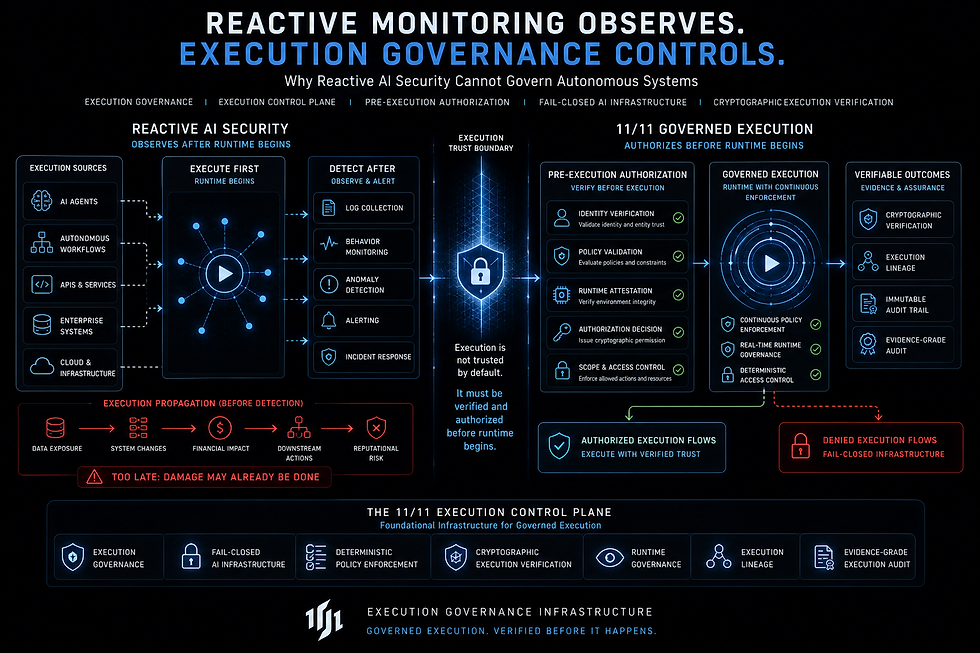
Traditional infrastructure security was designed for human-operated systems.
Modern AI infrastructure increasingly operates autonomously.
Autonomous systems now:
initiate execution
orchestrate infrastructure
invoke downstream services
manage runtime workflows
trigger distributed actions
interact with sensitive operational systems
This fundamentally changes the infrastructure trust model.
Infrastructure can no longer assume that execution requests are inherently trustworthy simply because they originate from inside a network boundary.
Execution itself must become governed.
Execution trust infrastructure establishes the systems required to verify whether runtime actions are authorized before execution occurs.
What Is Execution Trust Infrastructure?
Execution trust infrastructure is the operational framework responsible for validating:
who initiated execution
whether execution is authorized
whether runtime conditions remain compliant
whether cryptographic authorization is valid
whether execution lineage remains intact
whether enforcement policies are satisfied
This transforms governance from passive observation into active runtime enforcement.
Execution trust infrastructure becomes the operational trust layer for governed AI systems.
The Collapse of Implicit Trust
Most legacy infrastructure assumes implicit trust once a system enters the operational environment.
This creates major vulnerabilities in autonomous execution systems.
Examples include:
unauthorized model actions
runtime policy drift
compromised orchestration layers
privilege escalation
unauthorized API execution
distributed trust inconsistencies
Implicit trust models fail in autonomous runtime environments because execution velocity exceeds human oversight capability.
Execution trust infrastructure replaces implicit trust with deterministic authorization systems.
Core Layers of Execution Trust Infrastructure
Identity Trust Layer
Every execution request must be tied to verified identity context.
This includes:
workload identity
operator identity
machine identity
orchestration identity
runtime environment identity
Identity becomes foundational to governed execution.
Without deterministic identity validation, runtime trust cannot exist.
Authorization Enforcement Layer
Execution authorization systems evaluate:
runtime permissions
policy compliance
operational boundaries
trust-zone validity
environment restrictions
execution constraints
temporal authorization windows
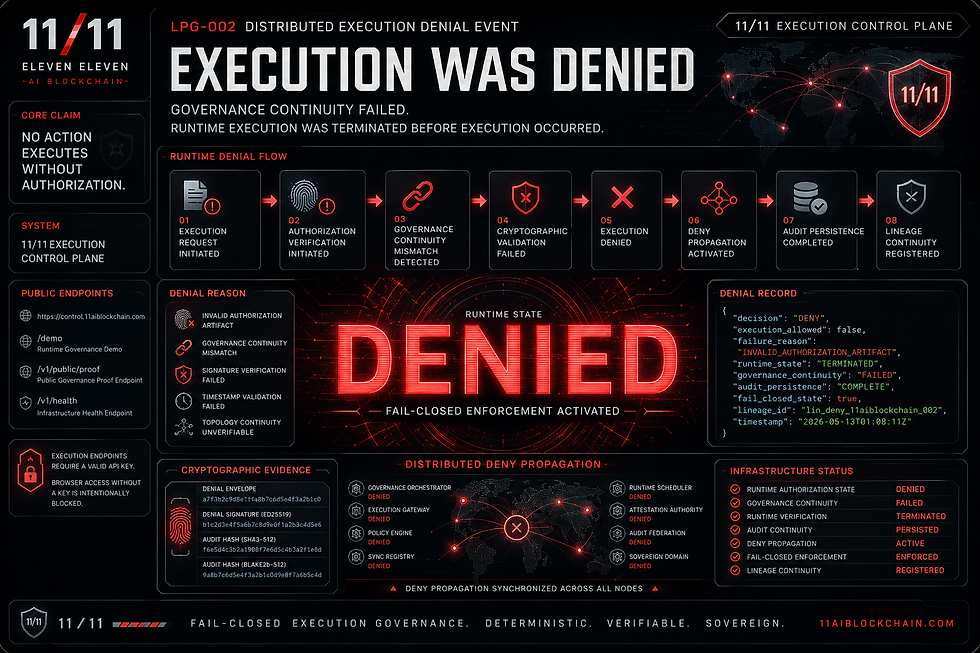
If authorization requirements fail:
execution is denied.
This creates fail-closed governance behavior.
Cryptographic Trust Layer
Execution governance infrastructure increasingly relies on cryptographic validation.
Cryptographic trust systems verify:
signed authorization artifacts
runtime attestation
policy authenticity
immutable audit persistence
lineage integrity
execution proof validity
This creates evidence-grade governance infrastructure.
Related:
Cryptographic Runtime Verification
Runtime Integrity Systems
Governance Proof Infrastructure
Deterministic Enforcement
Execution trust infrastructure requires deterministic behavior.
Deterministic enforcement ensures:
identical conditions produce identical decisions
policy outcomes remain consistent
governance cannot silently degrade
runtime behavior remains predictable
denial semantics remain stable
This is essential for mission-critical infrastructure.
Especially within:
defense systems
financial systems
healthcare infrastructure
sovereign AI deployments
industrial automation
critical infrastructure orchestration
Fail-Closed Operational Semantics
Execution trust infrastructure must default to denial when governance certainty cannot be established.
Fail-open infrastructure allows execution during uncertainty.
Fail-closed infrastructure prevents execution during uncertainty.
This distinction is critical.
Fail-closed systems ensure:
missing authorization blocks execution
invalid signatures deny runtime access
policy mismatches terminate execution
lineage corruption prevents continuation
runtime trust violations isolate workloads
Fail-closed governance becomes the operational backbone of trustworthy AI infrastructure.
Runtime Verification and Continuous Trust
Execution trust is not a one-time validation event.
Runtime trust must remain continuously verifiable.
Continuous verification includes:
runtime state validation
policy re-evaluation
trust boundary monitoring
authorization freshness
cryptographic verification loops
execution lineage continuity
This creates continuously governed execution infrastructure.
Distributed Trust Infrastructure
Modern runtime systems operate across distributed environments.
Execution trust infrastructure must therefore support:
multi-cloud orchestration
Kubernetes governance
edge runtime enforcement
sovereign deployment regions
federated execution systems
hybrid operational infrastructure
Trust consistency across distributed domains becomes essential.
This requires:
synchronized policy systems
distributed authorization validation
cryptographic coordination
deterministic enforcement logic
globally verifiable governance behavior
Execution Lineage and Trust Persistence
Execution trust infrastructure depends heavily on immutable execution lineage.
Execution lineage enables:
operational reconstruction
governance traceability
runtime dependency mapping
audit verification
forensic analysis
execution chain validation
Lineage persistence transforms governance into provable operational infrastructure.
Related:
Execution Lineage Infrastructure
Runtime Governance Systems
Immutable Audit Architecture
Governance Control Planes
Execution trust infrastructure operates through governance control planes.
Governance control planes coordinate:
runtime authorization
policy enforcement
cryptographic validation
execution telemetry
lineage persistence
infrastructure observability
distributed trust orchestration
The governance control plane becomes the operational authority layer for governed execution systems.
Autonomous AI and Execution Trust
Autonomous AI systems significantly increase governance complexity.
AI systems may independently:
invoke tools
trigger workflows
orchestrate infrastructure
access sensitive systems
chain execution behaviors
interact with external environments
Without execution trust infrastructure, these systems become operationally unpredictable.
Execution governance infrastructure ensures autonomous systems remain bounded by deterministic operational rules.
Public Governance Infrastructure
11/11 demonstrates execution governance concepts through publicly accessible governance infrastructure.
Runtime Governance Demo
Governance Console
Governance Proof Viewer
Infrastructure Health Dashboard
Execution Lineage Explorer
The Future of Execution Trust Infrastructure
As AI systems become increasingly autonomous, execution trust infrastructure will become mandatory operational architecture.
Future governed infrastructure will require:
deterministic runtime authorization
fail-closed execution control
cryptographic runtime verification
immutable execution lineage
distributed governance orchestration
continuously verifiable trust enforcement
Execution trust infrastructure is rapidly emerging as a foundational layer of modern AI governance architecture.

Comments