
Governance Attestation as Operational Infrastructure


Artificial intelligence governance is rapidly transitioning from:policy interpretation
to:operational verification.
This shift is redefining the role of governance attestation within modern infrastructure systems.
Historically, governance validation primarily existed through:
compliance reporting
audit reviews
static certifications
policy documentation
post-event analysis
procedural oversight
These approaches were designed for environments where:human operators remained the primary execution authority.
Autonomous infrastructure changes this assumption.
As machine-speed operational systems increasingly initiate:
orchestration actions
infrastructure modifications
policy-bound decisions
cross-domain execution
autonomous workflows
runtime state transitions
governance verification can no longer remain retrospective.
It must become runtime-native.
This requirement is driving the emergence of governance attestation infrastructure.
Governance attestation establishes verifiable proof that:execution occurred within authorized governance boundaries.
This distinction is operationally significant.
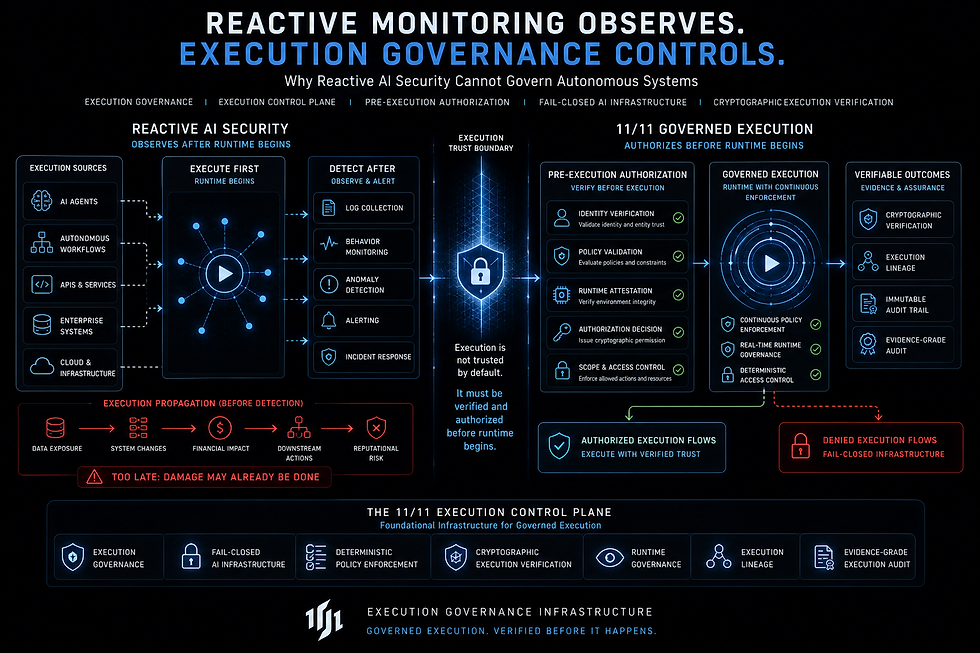
Traditional observability systems may demonstrate:what occurred.
Governance attestation demonstrates:whether execution was authorized to occur.
Execution Governance™ infrastructure therefore introduces governance attestation as a deterministic runtime dependency rather than an administrative reporting process.
Under governed execution architecture:authorization validation, policy enforcement, and execution verification become cryptographically linked.
This creates operational evidence capable of validating:
authorization-bound execution
runtime governance integrity
deterministic enforcement behavior
trust-boundary continuity
execution provenance
policy conformance
runtime admission legitimacy
In this architecture:
“No action executes without authorization.”
Governance attestation operationalizes this principle through verifiable runtime evidence.
This becomes increasingly important across:
federal AI systems
defense infrastructure
critical infrastructure automation
sovereign compute environments
healthcare orchestration
financial transaction infrastructure
industrial autonomous systems
In these environments, governance cannot depend solely upon:organizational trust assumptions.
Operational assurance must become:externally verifiable.
Governance attestation infrastructure enables this transition.
Within execution governance ecosystems, attestation may include:
authorization artifact validation
cryptographic execution verification
execution lineage persistence
runtime policy enforcement records
governance proof generation
admission-control verification
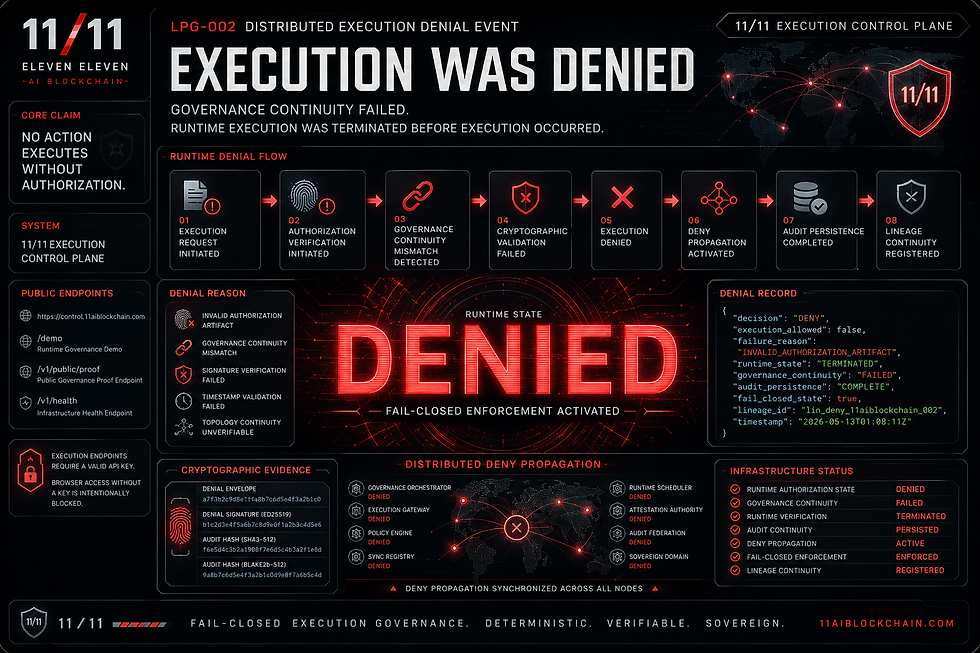
fail-closed execution evidence
This shifts governance from:interpretive oversight
to:deterministic operational validation.
The infrastructure implications are substantial.
Future procurement evaluation models will increasingly require systems capable of proving:
runtime authorization enforcement
governance integrity continuity
execution trust-boundary preservation
deterministic operational control
interoperable governance evidence
execution lineage continuity
fail-closed operational semantics
As a result, governance attestation is becoming:an infrastructure category.
Not merely a compliance process.
This transition mirrors broader infrastructure evolutions previously observed within:
Zero Trust Architecture
cloud identity federation
Kubernetes conformance ecosystems
supply-chain verification systems
infrastructure attestation frameworks
secure orchestration environments
Execution Governance Compatible (EGC) ecosystems extend this model into:runtime operational governance.
Importantly, governance attestation remains implementation-neutral.
Different infrastructure providers may implement differing:
orchestration systems
policy engines
execution runtimes
authorization architectures
infrastructure fabrics
while still supporting interoperable governance attestation semantics.
This interoperability becomes essential as autonomous systems increasingly operate across:
multi-vendor infrastructure
federal contractor ecosystems
coalition defense environments
distributed orchestration layers
hybrid sovereign compute systems
cross-domain execution environments
Without interoperable governance attestation, trust becomes fragmented across infrastructure domains.
Execution governance infrastructure resolves this through:standardized operational verification semantics.
The long-term implication is significant.
As autonomous infrastructure expands globally, governance attestation may ultimately become as foundational to operational infrastructure as:
identity verification
encryption
audit logging
network segmentation
infrastructure monitoring
cryptographic signing
This evolution positions governance attestation as:the verification layer for governed execution infrastructure.
Not a reporting enhancement.
Not a governance dashboard.
Not an advisory capability.
Operational infrastructure.
The organizations that establish governance attestation infrastructure earliest will likely define:
procurement verification baselines
autonomous system trust standards
runtime governance interoperability
deterministic execution assurance models
sovereign AI governance frameworks
execution governance maturity requirements
Execution Governance™ therefore represents the broader evolution from:observable infrastructure
to:verifiably governed execution systems.
Governance attestation is becoming the operational mechanism through which autonomous infrastructure proves:authorization integrity, execution legitimacy ,and runtime governance continuity.
Internal Link Suggestions
Public Infrastructure Endpoints
Public Runtime Infrastructure
Public Governance Console
Runtime Governance Demo
Public Governance Proof Viewer
Infrastructure Health Dashboard
Execution Lineage Explorer
Execution endpoints intentionally require valid API authorization.
Browser access without a valid authorization key is fail-closed by design.
Execution Governance™ Governed Execution™ Patent Pending
RFC-EG Reinforcement:
RFC-EG-011, RFC-EG-017, RFC-EG-021, RFC-EG-026, RFC-EG-031, RFC-EG-036
Ecosystem Expansion:
Governance Attestation Layer
Runtime Verification Layer
Execution Lineage Layer
Deterministic Enforcement Layer
EGC Conformance Ecosystem

Comments