
PILLAR PAGE 13 Governance Control Planes for AI Infrastructure | 11/11 Execution Governance


Governance Control Planes
The Rise of Governance-Native Infrastructure
Traditional infrastructure control systems were designed primarily for orchestration and operational management.
AI infrastructure introduces a fundamentally different requirement.
Modern execution environments now require governance before execution occurs.
This creates the need for governance control planes.
Governance control planes coordinate:
execution authorization
runtime enforcement
policy orchestration
cryptographic verification
lineage persistence
distributed trust validation
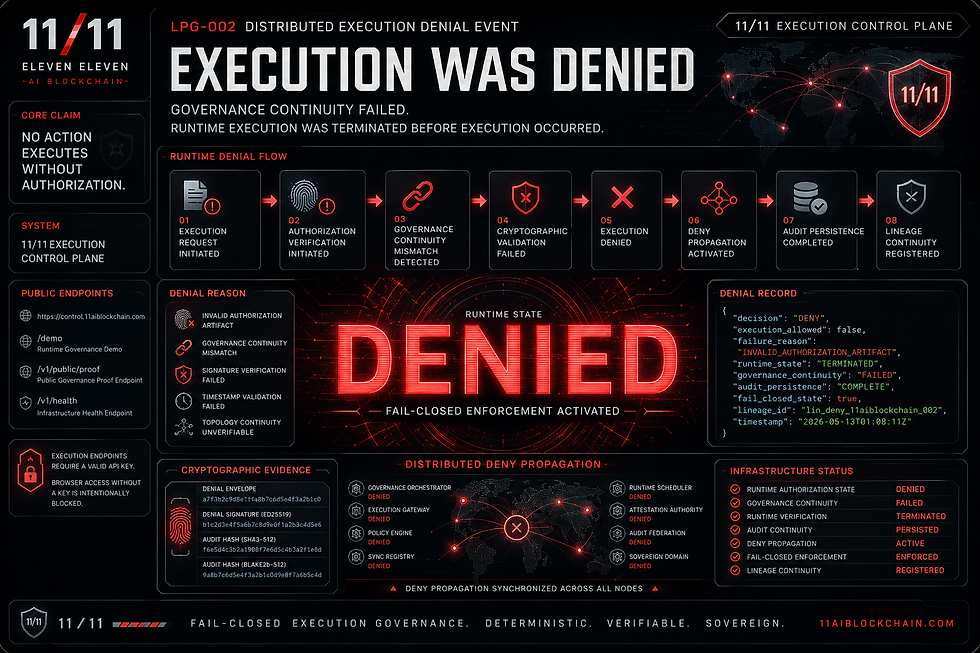
deterministic denial behavior
These systems establish operational authority across autonomous runtime environments.
What Is a Governance Control Plane?
A governance control plane is the infrastructure layer responsible for coordinating and enforcing execution governance policies across distributed runtime systems.
It functions as the operational authority layer for governed execution.
Rather than merely observing runtime behavior, governance control planes actively determine:
whether execution may occur
under which conditions execution is allowed
which policies govern runtime actions
whether runtime trust remains valid
how enforcement decisions propagate across infrastructure
This transforms governance from advisory security into deterministic operational infrastructure.
Why AI Systems Require Governance Control Planes
Autonomous AI systems dramatically increase execution complexity.
AI systems can independently:
invoke APIs
orchestrate workflows
trigger downstream execution
interact with infrastructure
modify operational state
coordinate distributed actions
Without governance coordination, execution becomes operationally unpredictable.
Governance control planes create bounded execution environments.
They ensure autonomous systems remain constrained by deterministic operational policies.
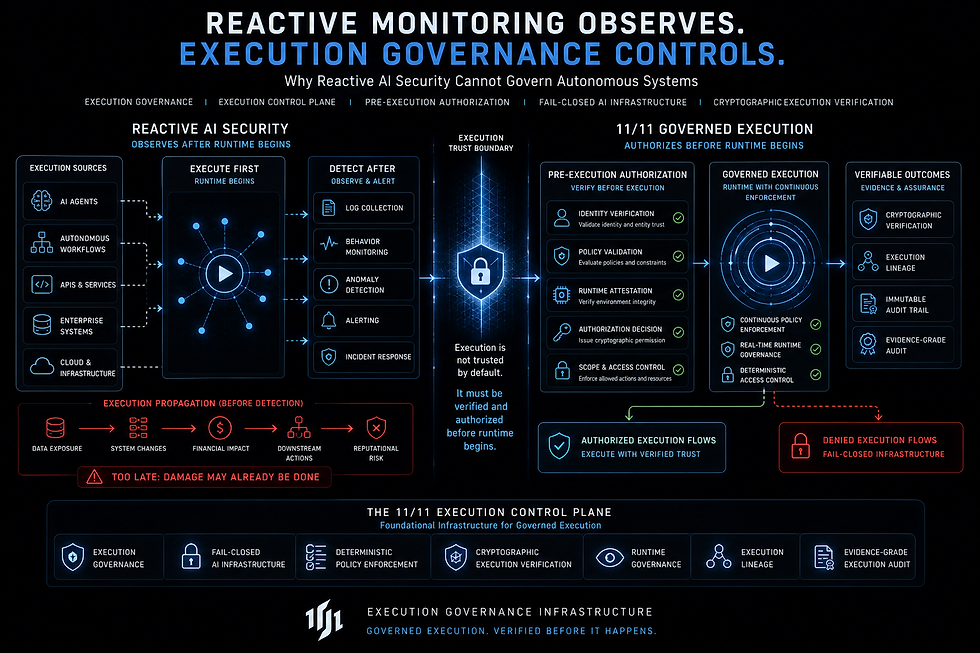
The Shift From Monitoring to Operational Authority
logging
detection
alerting
post-event analysis
Governance control planes operate differently.
They establish pre-execution operational authority.
This means:
execution cannot proceed unless governance systems authorize it.
This creates fail-closed infrastructure behavior.
Related:
Runtime Integrity Systems
Execution Trust Infrastructure
Fail-Closed Execution Architecture
Core Components of Governance Control Planes
Policy Coordination Layer
Governance control planes maintain centralized or distributed policy systems that define:
execution permissions
trust boundaries
operational constraints
runtime restrictions
authorization rules
enforcement obligations
Policies become executable governance infrastructure.
Authorization Decision Engine
Execution requests pass through authorization engines capable of evaluating:
runtime identity
environment trust
cryptographic validity
workload classification
execution context
policy compliance
lineage continuity
The authorization engine determines whether execution is allowed.
If validation fails:
execution is denied.
Runtime Enforcement Coordination
Governance control planes coordinate runtime enforcement systems responsible for:
policy application
workload isolation
runtime verification
anomaly response
execution termination
enforcement telemetry
This creates continuously governed execution environments.
Cryptographic Verification Infrastructure
Governance decisions increasingly require cryptographic validation.
Cryptographic governance systems verify:
signed authorization artifacts
runtime attestation
policy authenticity
immutable audit integrity
execution lineage continuity
distributed trust coordination
This enables evidence-grade execution governance.
Deterministic Governance Enforcement
Governance control planes must behave deterministically.
Deterministic enforcement means:
identical inputs produce identical outcomes
governance remains predictable
authorization decisions remain stable
denial semantics remain consistent
policy enforcement cannot silently drift
Deterministic governance is essential for mission-critical infrastructure environments.
Distributed Governance Infrastructure
Modern execution systems operate across distributed infrastructure.
Governance control planes must therefore coordinate:
multi-cloud infrastructure
Kubernetes clusters
sovereign environments
edge systems
hybrid deployments
federated execution domains
Distributed governance introduces additional complexity.
The control plane must maintain:
policy synchronization
trust consistency
distributed authorization integrity
coordinated runtime enforcement
globally verifiable governance state
This creates governance-native infrastructure architecture.
Fail-Closed Governance Systems
Governance control planes must default to denial during uncertainty.
Fail-open systems allow execution during governance degradation.
Fail-closed systems deny execution during governance degradation.
This principle ensures:
missing authorization blocks execution
invalid signatures terminate requests
policy mismatches prevent runtime actions
trust failures isolate workloads
governance inconsistencies trigger denial
Fail-closed governance becomes foundational to trustworthy autonomous infrastructure.
Governance Control Planes and Execution Lineage
Governance control planes maintain immutable execution lineage systems.
Execution lineage enables:
governance traceability
operational reconstruction
policy inheritance visibility
runtime dependency mapping
evidence-grade auditing
forensic verification
Execution lineage transforms runtime governance into provable infrastructure behavior.
Related:
Execution Lineage Systems
Runtime Governance Infrastructure
Immutable Governance Audit Systems
Autonomous Runtime Governance
AI systems increasingly require continuous governance coordination.
Governance control planes support:
dynamic runtime policy enforcement
continuous trust validation
autonomous execution boundaries
cryptographic runtime verification
deterministic orchestration governance
distributed enforcement coordination
This creates continuously governed autonomous infrastructure.
Enterprise and Defense Infrastructure
Governance control planes are increasingly important for:
defense systems
sovereign AI infrastructure
healthcare AI
financial execution systems
industrial automation
critical infrastructure orchestration
These environments require deterministic operational trust.
Governance control planes establish that trust layer.
Public Governance Infrastructure
11/11 demonstrates governance control plane concepts through publicly accessible governance infrastructure.
Governance Console
Runtime Governance Demo
Governance Proof Viewer
Infrastructure Health Dashboard
Execution Lineage Explorer
The Future of Governance Control Planes
Governance control planes are rapidly becoming foundational operational infrastructure for autonomous execution systems.
Future infrastructure will increasingly require:
pre-execution authorization
deterministic runtime governance
cryptographic enforcement systems
immutable execution lineage
distributed policy orchestration
continuously verifiable trust enforcement
Governance control planes represent the operational backbone of governed AI infrastructure.

Comments