
Recursive Language Models and the Emergence of Runtime Intelligence Systems
- 11/11 AI

- Apr 24
- 11 min read
A Technical and Strategic Analysis of Inference-Time Scaling Architectures
Abstract
The rapid evolution of large language models has revealed a fundamental constraint in artificial intelligence systems: the inability to effectively process and reason over large-scale context. While advances in parameter scaling and training data have yielded significant improvements in capability, these approaches do not resolve the structural limitations imposed by fixed context windows and single-pass inference.
Recursive Language Models (RLMs), as introduced in recent research, represent a shift from static inference to structured, multi-step reasoning processes executed at runtime. Rather than attempting to compress vast information into a single forward pass, RLMs externalize context and enable models to recursively navigate, decompose, and synthesize information through repeated self-invocation.
This paper provides a comprehensive analysis of Recursive Language Models as a paradigm shift in artificial intelligence. It examines the architectural implications of recursion-based inference, evaluates performance and scalability characteristics, and identifies critical limitations in orchestration, latency, and reliability. Beyond technical evaluation, this work situates RLMs within the broader evolution of AI systems, arguing that they signal the transition from model-centric intelligence to runtime-centric intelligence.
Finally, this paper explores the unresolved gap between recursive reasoning systems and governed execution environments, highlighting the necessity of integrating control, policy enforcement, and auditability into future AI infrastructure.
1. Introduction
Artificial intelligence has entered a phase where incremental improvements in model scale no longer translate proportionally into meaningful gains in reasoning capability. While large language models have demonstrated remarkable performance across a range of tasks, their underlying architecture remains constrained by a fundamental assumption: that intelligence can be achieved through a single forward pass over a fixed input context.
This assumption is increasingly misaligned with real-world problem domains.
Complex tasks such as legal analysis, intelligence synthesis, financial modeling, and scientific reasoning require the ability to:
navigate large volumes of information
selectively focus on relevant components
iteratively refine conclusions
integrate intermediate results into coherent outputs
Human cognition naturally operates in this manner. It is not a single-pass process, but a recursive one. Individuals read selectively, revisit prior information, decompose problems into subcomponents, and iteratively refine their understanding.
Traditional language models, by contrast, attempt to approximate this process within a single bounded context window. As context size increases, performance degrades due to attention dilution, token interference, and loss of long-range dependencies. This phenomenon, often described as “context rot,” imposes a practical ceiling on the utility of large language models in high-complexity environments.
Recursive Language Models emerge as a response to this limitation.
Rather than attempting to expand the context window indefinitely, RLMs reframe the problem entirely. They treat context as an external resource and introduce a mechanism by which the model can iteratively access, process, and integrate information through recursive self-calls.
This shift transforms the role of the model from a static predictor to a dynamic reasoning system.
The implications of this transformation extend beyond performance improvements. They redefine the boundaries between model, memory, and execution, introducing a new class of AI systems that operate more like programs than functions.
2. Background and Related Work
2.1 Limitations of Traditional Language Models
Large language models rely on transformer architectures, which process input sequences using attention mechanisms. While attention enables models to capture relationships between tokens, it also introduces computational and structural constraints.
The most significant limitation is the quadratic scaling of attention with respect to input length. As context windows increase, computational cost grows rapidly, making it impractical to process extremely long sequences in a single pass.
Even when technical solutions enable larger context windows, performance issues persist:
earlier tokens receive diminishing attention weight
signal-to-noise ratio decreases
relevant information becomes harder to retrieve
This results in degradation of reasoning quality, particularly in tasks requiring long-range coherence.
2.2 Attempts to Address Context Scaling
Several approaches have been proposed to mitigate context limitations:
Retrieval-Augmented Generation (RAG)RAG systems retrieve relevant documents from external databases and inject them into the model’s context. While effective for factual lookup, RAG does not fundamentally change the inference process. It still relies on a single forward pass and lacks iterative reasoning.
Summarization PipelinesHierarchical summarization attempts to compress large documents into smaller representations. However, summarization introduces information loss and can propagate errors through subsequent stages.
Extended Context ModelsSome models increase context windows to hundreds of thousands or millions of tokens. While this reduces truncation, it does not eliminate attention dilution or computational inefficiency.
Each of these approaches addresses symptoms rather than the underlying constraint.
2.3 Emergence of Iterative and Agent-Based Systems
More recent developments have introduced iterative reasoning frameworks:
chain-of-thought prompting
tool-augmented agents
planning and execution loops
These systems begin to approximate recursive behavior, but they are typically implemented as external orchestration layers rather than integrated into the model’s operational paradigm.
Recursive Language Models formalize and internalize this process.
3. Recursive Language Models: Architecture and Mechanism
3.1 Core Concept
At its core, a Recursive Language Model extends a standard language model with the ability to:
Select a subset of the input context
Invoke itself on that subset
Combine the result with other intermediate outputs
Repeat this process until a final answer is produced
This can be conceptualized as transforming the model into a controller that operates over an external memory space.
Instead of processing all information simultaneously, the model dynamically determines:
what to read
what to ignore
what to revisit
3.2 Externalized Context
A key innovation of RLMs is the separation of context from computation.
In traditional models, context is embedded directly into the input sequence. In RLMs, context exists as an external resource that the model can query.
This is analogous to how a program interacts with:
filesystems
databases
memory structures
By externalizing context, RLMs remove the need to fit all relevant information into a single attention window.
3.3 Recursive Execution Loop
The recursive process can be described as follows:
Initial Invocation
The model receives a high-level query and access to a large context space.
Context Selection
The model identifies relevant segments of the context.
Sub-Problem Decomposition
The task is broken into smaller components.
Recursive Calls
The model invokes itself on each subcomponent.
Aggregation
Results from recursive calls are combined into a coherent output.
Termination
The process ends when a stopping condition is met.
This loop introduces a form of structured reasoning that is absent in single-pass inference.
4. Performance Characteristics and Empirical Findings
4.1 Long-Context Performance
Empirical evaluations demonstrate that RLMs maintain strong performance across tasks involving extremely large contexts, often exceeding millions of tokens.
Unlike traditional models, which exhibit rapid degradation, RLMs degrade more gradually. This is because they avoid processing irrelevant information and focus computation on targeted subsets.
4.2 Efficiency Considerations
While recursive execution introduces additional computational steps, it can be more efficient in practice because:
irrelevant tokens are not processed
attention is focused on smaller segments
intermediate results can be reused
This shifts the cost model from:
token-based scaling
to:
compute-based scaling
4.3 Robustness and Generalization
RLMs demonstrate improved robustness in tasks requiring:
multi-step reasoning
hierarchical understanding
synthesis across large datasets
However, they remain dependent on the underlying model’s capabilities and inherit its probabilistic nature.
5. Limitations and Failure Modes of Recursive Language Models
While Recursive Language Models introduce a meaningful shift in how artificial intelligence systems process information, they do not eliminate core challenges inherent to probabilistic models. Instead, they relocate complexity from model architecture to runtime orchestration.
Understanding these limitations is critical for evaluating their real-world viability.
5.1 Latency Amplification
The most immediate tradeoff introduced by recursion is latency.
A traditional language model performs:
one forward pass
one output
An RLM performs:
multiple recursive calls
intermediate processing steps
aggregation operations
This creates a multiplicative effect on execution time.
Latency becomes a function of:
recursion depth
branching factor
context retrieval cost
In high-stakes environments such as financial transactions, battlefield intelligence, or real-time decision systems, this latency introduces operational risk.
Recursive reasoning improves quality, but at the cost of responsiveness.
5.2 Orchestration Complexity
RLMs require an orchestration layer that determines:
when to recurse
what context to select
how to decompose tasks
when to terminate execution
This introduces a system-level dependency that is not trivial.
Failures can occur at multiple levels:
incorrect context selection
infinite or unnecessary recursion
premature termination
improper aggregation of results
Unlike traditional models, where failure is localized to a single output, RLM failures can propagate across multiple recursive steps.
This creates a new category of failure:
systemic reasoning failure
5.3 Probabilistic Instability
Despite their structured execution, RLMs remain fundamentally probabilistic.
Each recursive call introduces variance:
outputs may differ across identical inputs
intermediate reasoning may drift
aggregation may amplify inconsistencies
This leads to compounding uncertainty.
Recursive systems can improve reasoning depth, but they do not guarantee correctness. In fact, deeper recursion can sometimes increase the likelihood of error accumulation if not properly constrained.
5.4 Lack of Execution Boundaries
Perhaps the most critical limitation is the absence of explicit execution control.
RLMs determine:
what to process
how to process it
when to stop
But they do not inherently enforce:
policy constraints
security boundaries
authority levels
compliance rules
This creates a gap between capability and control.
In regulated or adversarial environments, this gap is unacceptable.
5.5 Absence of Verifiable Audit Trails
Recursive execution produces multiple intermediate steps, yet most implementations do not provide:
cryptographically verifiable logs
deterministic replay capability
tamper-proof execution records
Without these properties, RLMs cannot be trusted in:
financial systems
medical decision systems
defense intelligence pipelines
The system can reason, but it cannot prove how it reasoned.
6. Runtime Intelligence vs Model Intelligence
Recursive Language Models signal a deeper shift in artificial intelligence:
Intelligence is no longer defined solely by the model.It is defined by the system in which the model operates.
6.1 From Static Models to Dynamic Systems
Traditional AI paradigm:
intelligence is embedded in model weights
inference is a single deterministic pipeline
execution is fixed
RLM paradigm:
intelligence emerges through runtime interaction
inference is iterative and adaptive
execution is dynamic
This transforms AI into something closer to:
operating systems
distributed runtimes
computational frameworks
6.2 The Rise of Inference-Time Architecture
For the first time, inference becomes a primary axis of innovation.
Key components now include:
memory access mechanisms
recursion control logic
execution graphs
aggregation strategies
This creates a new stack:
Model Layer↓Runtime Layer↓Control Layer (currently missing in RLMs)The paper introduces the first two layers.
The third layer remains unaddressed.
6.3 Separation of Concerns
RLMs implicitly introduce separation between:
Knowledge (model weights)
Memory (external context)
Execution (recursive process)
This mirrors classical computing systems and opens the door to:
modular AI architectures
pluggable execution environments
standardized runtime protocols
7. The Missing Layer: Execution Governance
Recursive Language Models solve a critical problem:
How AI systems reason over large-scale context
But they leave unanswered a more important question:
Who controls that reasoning, and under what authority?
7.1 The Governance Gap
RLMs operate with autonomy in:
context selection
recursion depth
reasoning structure
Without constraints, this autonomy introduces risk:
unauthorized data access
policy violations
unpredictable behavior
In enterprise and defense environments, this is not acceptable.
7.2 Requirement for Policy Enforcement
A complete AI system must enforce:
access control
execution permissions
data boundaries
regulatory compliance
These cannot be left to probabilistic reasoning.
They must be:
deterministic
enforceable
verifiable
7.3 Fail-Closed Execution
RLMs operate in a fail-open manner:
if uncertain, they still produce output
In high-risk systems, this must be inverted:
If conditions are not met, execution must not proceed.
Fail-closed behavior ensures:
safety
compliance
predictable system behavior
7.4 Cryptographic Auditability
For AI systems to be trusted, they must produce:
immutable execution records
verifiable reasoning paths
cryptographic proof of compliance
Without this, recursive systems cannot be:
audited
validated
certified
7.5 Controlled Recursion
Recursion itself must be governed.
This includes:
maximum depth constraints
policy-based context access
validation of intermediate outputs
Without these controls, recursion becomes:
unbounded
unpredictable
potentially unsafe
8. Strategic Implications for AI Infrastructure
Recursive Language Models are not just a technical improvement.
They represent a shift in how AI systems will be built, deployed, and controlled.
8.1 The End of the “Bigger Model” Race
Scaling parameters alone is no longer sufficient.
Future systems will compete on:
runtime efficiency
reasoning structure
orchestration quality
This shifts competitive advantage away from:
raw compute
toward:
system architecture
8.2 Emergence of AI Runtime Platforms
The next generation of AI systems will resemble:
operating systems for intelligence
execution platforms for reasoning
governed environments for decision-making
RLMs are an early step toward this paradigm.
8.3 Separation of Power in AI Systems
Future architectures will likely separate:
model providers
runtime operators
governance authorities
This mirrors:
cloud infrastructure
financial systems
security frameworks
Such separation enables:
scalability
compliance
interoperability
8.4 Implications for Defense and Intelligence
In defense contexts, the implications are immediate:
Recursive systems enable:
large-scale intelligence synthesis
multi-source data integration
iterative scenario analysis
However, without governance:
decisions cannot be trusted
outputs cannot be verified
systems cannot be deployed securely
The combination of:
recursive reasoning
execution control
auditability
will define next-generation intelligence infrastructure.
8.5 The New Competitive Frontier
The future of AI will not be determined by:
who has the largest model
who has the most data
It will be determined by:
who controls the execution environment of intelligence
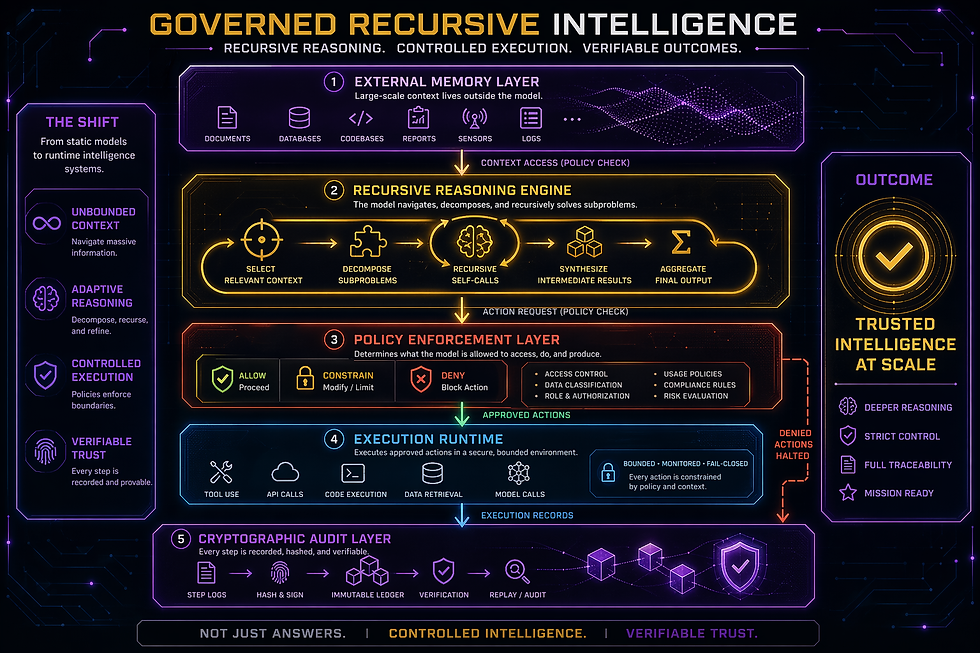
9. Future Architecture: Governed Recursive Intelligence Systems
Recursive Language Models point toward a new architectural category:
Governed Recursive Intelligence Systems
These systems combine recursive reasoning with enforceable execution control.
A complete architecture would include:
External Memory↓Recursive Reasoning Layer↓Policy Enforcement Layer↓Execution Runtime↓Cryptographic Audit LayerThis creates a system where AI can reason deeply without operating outside defined authority.
9.1 External Memory Layer
The memory layer stores large-scale context outside the model.
This may include:
documents
codebases
intelligence reports
transaction records
medical records
operational logs
The model does not own this memory.It requests access to it.
That distinction matters.
9.2 Recursive Reasoning Layer
The reasoning layer decomposes complex tasks into smaller recursive calls.
It handles:
context selection
subproblem decomposition
intermediate synthesis
aggregation
This layer improves intelligence depth.
But it should not control final authority.
9.3 Policy Enforcement Layer
The policy layer determines whether each recursive action is permitted.
It asks:
Is this data allowed?
Is this model allowed?
Is this user authorized?
Is this execution path compliant?
Should the system proceed?
This converts recursion from open-ended behavior into governed computation.
9.4 Execution Runtime Layer
The runtime layer executes approved actions.
It enforces:
allowed tools
permitted APIs
execution boundaries
fail-closed behavior
This is where AI moves from answering to acting.
9.5 Cryptographic Audit Layer
Every recursive step should produce verifiable evidence.
That evidence may include:
timestamped execution records
policy decisions
model identifiers
input and output hashes
authority signatures
This enables replay, audit, compliance, and trust.
10. Integration Model: RLM + Execution Governance
Recursive Language Models solve the context problem.
Execution governance solves the control problem.
Together, they form the basis of deployable AI infrastructure.
10.1 Why RLM Alone Is Not Enough
RLM improves reasoning but does not enforce authority.
It can decide what to inspect, but it cannot prove that inspection was allowed.
It can generate intermediate outputs, but it cannot guarantee those outputs followed policy.
It can recurse, but it cannot certify that recursion stayed inside approved limits.
This is why RLM is powerful but incomplete.
10.2 Why Governance Alone Is Not Enough
Governance without reasoning creates rigid systems.
A control plane can enforce rules, but it does not create intelligence by itself.
The future requires both:
adaptive reasoning
deterministic enforcement
One without the other fails.
10.3 Combined System Behavior
A governed recursive system would behave like this:
Request received↓Policy validates authority↓RLM selects context↓Policy checks context access↓RLM performs recursive reasoning↓Runtime enforces recursion limits↓Outputs are validated↓Audit proof is written↓Final response is releasedThis is the missing bridge between AI research and real-world deployment.
10.4 Enterprise Use Cases
Governed recursive systems are especially relevant for:
legal analysis
financial compliance
medical records review
software assurance
insurance underwriting
regulated enterprise search
These environments require more than better answers.
They require controlled, explainable, auditable execution.
10.5 Defense and Intelligence Use Cases
In defense environments, recursive systems can synthesize large volumes of:
signals intelligence
human intelligence
geospatial intelligence
operational reports
threat assessments
But the value is not just synthesis.
The value is controlled synthesis.
A defense-grade system must know:
what it accessed
why it accessed it
who authorized it
whether the output can be trusted
That is not optional.
It is the boundary between experimental AI and mission-capable infrastructure.
11. Conclusion
Recursive Language Models represent a meaningful step beyond static language modeling.
They show that the future of AI is not only about larger models or longer context windows.
It is about runtime intelligence.
By allowing models to recursively inspect, decompose, and synthesize external context, RLMs shift AI from one-shot prediction toward structured execution.
This is a major architectural movement.
However, it is not complete.
Recursive reasoning without control creates risk.
The next generation of AI infrastructure must combine:
recursive reasoning
policy enforcement
fail-closed execution
cryptographic auditability
governed runtime authority
The strategic conclusion is clear:
The future of AI will not be won by the largest model alone.It will be won by the system that can control intelligence at runtime.
Recursive Language Models reveal the direction.
Governed execution makes that direction deployable.
For enterprise, defense, finance, medicine, and national security, this is the real frontier:
Not just artificial intelligence.Controlled intelligence.


Comments