
The First Governed AI Execution OS Is Now Live

Updated: Mar 17
A new foundation for AI has emerged and it changes everything.
A Threshold Moment in AI
“Announced March 2026 - First Operational Phase”
Artificial intelligence has entered a new phase.
For years, AI systems have operated primarily as tools for interpretation analyzing data, generating insights and assisting human decision-making. They have been powerful, but contained. Influential, but indirect.
That phase is ending.
AI is no longer limited to observation or recommendation.
It is now moving into execution.
Across industries, systems are beginning to take direct action inside environments that matter financial systems, infrastructure layers, enterprise workflows and sensitive data environments. Decisions are no longer advisory. They are operational.
This shift represents a fundamental change in the role of AI.
And it introduces a problem that has not yet been solved.

The Missing Layer
Despite the rapid advancement of AI capabilities, one critical layer has remained largely unaddressed:
What governs AI at the moment it acts?
Most existing systems rely on approaches that were designed for an earlier phase of AI:
Logging events after they occur
Monitoring system behavior over time
Applying policy as an external constraint
Relying on human oversight as a fallback
These approaches assume that actions can be reviewed, corrected, or reversed after execution.
That assumption does not hold in execution environments.
When AI systems operate within financial, healthcare, or infrastructure systems, actions are immediate. Consequences are real. Reversal is often impossible.
The gap between what AI can do and how it is governed has widened significantly.
Until now, there has been no native system designed to close that gap.
A New Model Emerges
We are announcing a major milestone:
Phase 1 of the 11/11 Execution OS is now live.
This is not a concept.
This is not a roadmap.
This is a functioning system designed to govern AI execution at the point where it matters most before action occurs.
This system introduces a fundamentally different approach:
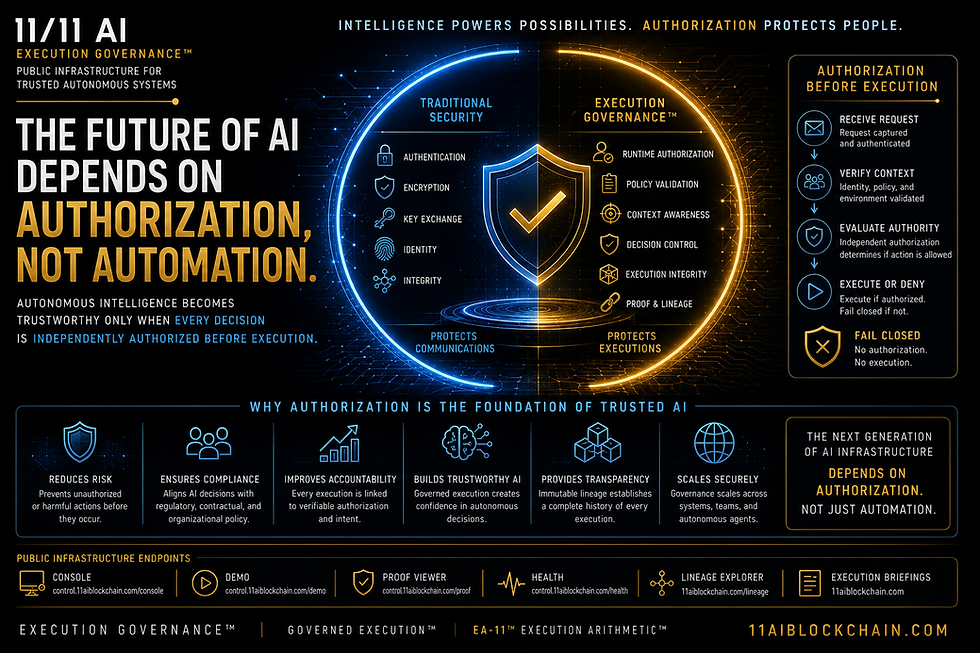
Governance is no longer applied after execution. It is enforced before execution begins.
This shift redefines how AI systems can be safely deployed, scaled and trusted.
From Observation to Control
To understand why this matters, it is important to recognize the distinction between two fundamentally different paradigms:
Observing what has already happened
Controlling what is allowed to happen
Most existing AI infrastructure is built around the first.
It assumes that systems will act and that governance can be layered on top through monitoring, logging and review.
But as AI transitions into execution, that model becomes insufficient.
True control requires:
Evaluating actions before they occur
Enforcing constraints at the moment of initiation
Ensuring that only permitted behavior is allowed to proceed
This is the model introduced by the 11/11 Execution OS.
What Is Now Live
The current system represents a complete, operational foundation for governed execution.
While specific implementation details remain intentionally abstracted, the system introduces several core capabilities that work together as a unified layer.
A Unified Governance Layer
At its core, the system operates as a centralized control surface that coordinates execution across environments.
Rather than relying on fragmented components, governance is integrated directly into the execution pathway itself.
This means that every action is:
Evaluated
Conditioned
Permitted or denied
Before it is allowed to proceed.
Real-Time Enforcement
The system enforces constraints in real time.
Actions are not simply recorded or observed. They are actively evaluated against defined boundaries.
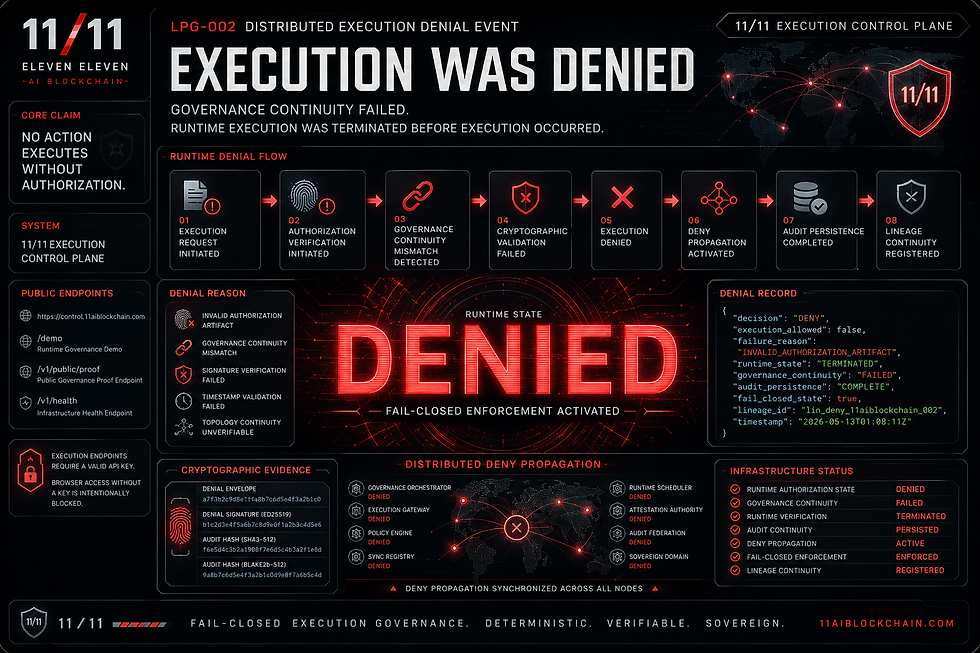
If an action does not meet those conditions, it does not execute.
This establishes a fail-closed model, where the default state is prevention rather than reaction.
Structured Traceability
Every action within the system is recorded in a structured and verifiable manner.
This allows for:
Reconstruction of system behavior
Understanding of how outcomes were produced
Verification of execution pathways
Traceability is not an afterthought. It is a native property of the system.
Live System Awareness
The system maintains a continuous understanding of how components interact.
This creates a form of real-time awareness that enables:
Visibility into complex system behavior
Identification of dependencies and interactions
Insight into execution flows as they occur
This is not traditional monitoring.
It is a dynamic representation of system state.
Operator Visibility
Governance is not hidden.
It is visible and accessible through a live interface that allows operators to:
Observe system behavior
Understand execution pathways
Interact with the system at a high level
This transforms governance from an abstract concept into a tangible capability.
What This Changes
The introduction of governed execution fundamentally alters the structure of AI systems.
It shifts the model from:
Systems that act first and are evaluated later
To:
Systems that are evaluated before they are allowed to act
This is not a minor improvement.
It is a structural change.
Why This Moment Matters
AI is entering environments where:
Precision is required
Compliance is mandatory
Trust is essential
In these environments, the cost of uncontrolled execution is high.
And yet, most systems in use today were not designed for this level of responsibility.
They were designed for speed, scale and capability not control.
The next phase of AI requires a different foundation.
A New Layer in the Stack
Historically, the most important shifts in technology have come from new foundational layers:
Systems that redefined compute
Systems that redefined data
Systems that redefined infrastructure
Each of these layers enabled entire categories of innovation.
The 11/11 Execution OS introduces a new layer:
The execution governance layer
This layer sits between:
AI systems
Data environments
Execution pathways
And determines what is allowed to happen.
A Convergence of Capabilities
What makes this system unique is not any single capability.
It is the integration of multiple functions into a single, unified layer:
Control over execution
Enforcement of constraints
Structured traceability
Real-time system awareness
These capabilities are typically implemented separately, if at all.
Here, they are combined into a cohesive system.
Engineering Trust into AI
Trust in AI is often discussed, but rarely defined.
It is frequently treated as a byproduct of performance, accuracy, or reliability.
But true trust is not something that emerges naturally.
It must be engineered.
It requires:
Predictability
Control
Accountability
And most importantly:
It requires enforcement at the point of execution
This is the foundation that governed execution provides.
What Comes Next
The current system represents the initial phase of a broader evolution.
The next phase expands this foundation into a more interactive and comprehensive platform.
This includes:
Interactive System Visibility
A more dynamic interface that allows deeper exploration of system behavior, enabling users to navigate and understand complex interactions in real time.
Historical Reconstruction
The ability to examine how systems have behaved over time, providing insight into patterns, decisions and outcomes.
Expanded System Awareness
A broader view of interactions across multiple systems, allowing for a more complete understanding of how AI operates within larger environments.
Transparent Enforcement
Greater visibility into how and why decisions are made, enabling a clearer understanding of governance in action.
Temporal Analysis
The ability to analyze system behavior across time, providing context and continuity to execution patterns.
From Infrastructure to Platform
As these capabilities evolve, the system transitions from a foundational control mechanism into a full platform.
This platform enables:
Governance
Observation
Interaction
Analysis
All within a unified environment.
The Inflection Point
For the first time, there exists a system that combines:
Execution
Control
Visibility
Structure
In a way that fundamentally changes how AI can be deployed.
This marks an inflection point.
The Future of AI Systems
The future of AI will not be defined solely by what systems can do.
It will be defined by how they are controlled.
Capabilities will continue to expand.
But without governance, those capabilities introduce risk.
The systems that succeed will be those that balance both.
A New Standard
The standard is shifting.
It is no longer sufficient for AI to be:
Fast
Scalable
Capable
It must also be:
Controlled
Verifiable
Governed
This is the new baseline.
Closing Perspective
For years, the focus of AI has been on building intelligence.
The next phase is about building control.
This is not a limitation.
It is an evolution.
AI will not be trusted because it is powerful. It will be trusted because it is controlled.
The systems that define the next era of AI will not be those that generate the most output.
They will be those that govern how that output is produced.
This is the beginning of that layer.
Brad Inventor, 11/11 Core
“This system is part of the 11/11 Core architecture and is currently under active development and protection.”

Comments