
11/11: Execution Governance for Next-Generation Command and Control Systems
- 11/11 AI

- Apr 12
- 4 min read
A Defense Intelligence Briefing

Executive Summary
Modern defense environments are entering a phase where data, autonomy, and AI-driven decision systems are no longer supporting layers they are the operational core.
Platforms such as Anduril Industries’s Lattice demonstrate this shift by integrating sensors, autonomy, and decision-making into a unified command-and-control architecture. These systems aggregate data across domains, apply AI-driven analysis, and accelerate response timelines across increasingly complex operational theaters.
However, as capabilities scale, a structural gap emerges:
Execution authority and governance are not inherently embedded within these systems.
11/11 addresses this gap.
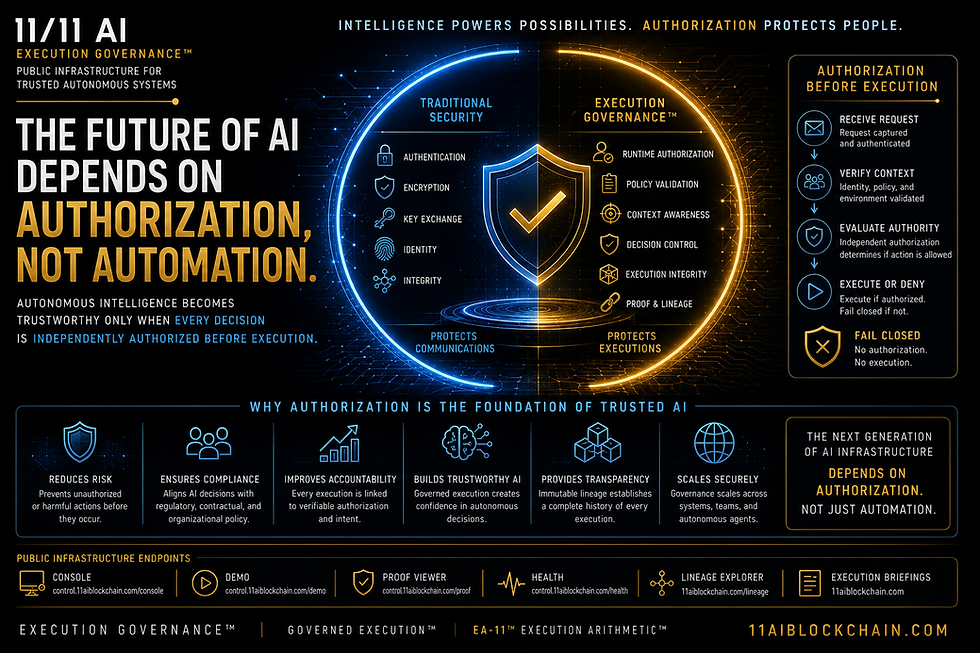
It introduces a deterministic execution control layer designed to operate before, during, and after AI-driven decision systems ensuring that:
Actions are authorized before execution
Policies are enforced during execution
Outcomes are cryptographically verifiable after execution
This document outlines how 11/11 complements and strengthens next-generation command and control (C2) ecosystems.
1. The Evolution of Command and Control
Command and control systems have evolved through three distinct phases:
Phase 1 — Analog and Manual Coordination
Human-driven command chains
Delayed intelligence relay
Limited situational awareness
Phase 2 — Digital Battlefield Management
Integrated systems (C4ISR)
Shared operational awareness
Faster communication loops
Phase 3 — AI-Driven Operational Systems
Sensor fusion across domains
Autonomous and semi-autonomous systems
Machine-assisted targeting and response
Modern platforms now:
Fuse data from thousands of sensors
Enable real-time tracking and classification
Reduce decision latency from minutes to seconds
This transformation introduces unprecedented capability but also systemic risk.
2. The Modern C2 Stack: What Exists Today
Advanced C2 platforms (e.g., Lattice) are designed to:
Core Capabilities
Sensor fusion across air, land, sea, cyber
AI-driven threat detection and classification
Autonomous and human-in-the-loop workflows
Distributed system orchestration
Real-time operational picture generation
Operational Impact
Compression of the kill chain
Reduced operator cognitive load
Increased engagement speed
Multi-domain coordination
Architecture Characteristics
Open, modular integration
Interoperability with legacy systems
Edge and cloud-based compute layers
Real-time data ingestion and processing
These systems are designed to answer:
“What is happening? ”“What should we do?”
But not inherently:
“Should this be allowed to execute?”
3. The Critical Gap: Execution Governance
As AI systems move closer to direct operational control, the absence of execution governance introduces four primary risks:
1. Unauthorized Execution
AI systems may act on incomplete or misinterpreted data.
2. Policy Drift
Rules defined at design-time may not be enforced at runtime.
3. Lack of Verifiability
Post-action analysis often lacks cryptographic certainty.
4. Escalation Risk
Autonomous responses can propagate faster than human intervention cycles.
These are not theoretical concerns. They are inherent properties of:
Distributed AI systems
Autonomous decision loops
Real-time operational environments
4. The 11/11 Approach: Execution Control Layer
11/11 introduces a control plane beneath AI systems not replacing them, but governing them.
Core Principle
Nothing executes without deterministic authorization.
5. Architecture Overview
Position in the Stack
Applications / Autonomous Systems↓AI Decision Engines (C2 Platforms)↓11/11 Execution Control Layer↓ Infrastructure / Compute / Hardware6. Core Capabilities of 11/11
6.1 Policy-First Execution
Every action must pass:
Pre-execution validation
Policy enforcement checks
Authorization gating
This ensures:
No unauthorized commands
No silent execution paths
6.2 Deterministic Enforcement
Unlike probabilistic AI systems:
Execution paths are predictable and repeatable
Policies are non-bypassable
Systems operate in fail-closed mode
6.3 Cryptographic Runtime Evidence
Each action produces:
Signed execution records
Immutable audit logs
Verifiable lineage trails
This creates:
Evidence-grade operational history
6.4 Multi-Domain Identity and Trust
Integration with:
Decentralized identifiers (DID)
Zero-knowledge proofs (ZKP)
Role and assurance-based access
Ensures:
Only authorized entities can initiate actions
Identity is provable without exposing sensitive data
6.5 Real-Time Enforcement Layer
11/11 operates in-line, not as an afterthought:
Inline authorization
Inline validation
Inline audit
7. How 11/11 Complements Modern C2 Systems
11/11 does not compete with platforms like Lattice.
It enhances them.
Existing C2 Strengths
Data fusion
Situational awareness
Decision acceleration
11/11 Adds
Execution verification
Policy enforcement
Cryptographic trust
Combined Outcome
Capability | C2 Platform | 11/11 |
Situational Awareness | ✓ | — |
AI Decision Support | ✓ | — |
Execution Authorization | — | ✓ |
Policy Enforcement | Partial | ✓ |
Cryptographic Audit | — | ✓ |
Deterministic Control | — | ✓ |
8. Operational Scenarios
Scenario 1: Counter-UAS Engagement
Current:
Sensor detects drone
AI classifies threat
System recommends intercept
With 11/11:
Engagement request passes policy validation
Rules of engagement enforced
Action cryptographically recorded
Scenario 2: Multi-Domain Coordination
Current:
Data shared across systems
AI coordinates response
With 11/11:
Cross-domain actions validated
Identity and authorization verified
Execution chain auditable
Scenario 3: Coalition Operations
Current:
Shared systems across partners
Limited trust verification
With 11/11:
Trust enforced at execution layer
Cross-jurisdiction policies applied
Secure interoperability achieved
9. Strategic Importance
Why This Matters Now
Defense systems are moving toward:
Autonomous coordination
Distributed decision-making
AI-driven operational control
Without execution governance:
Speed increases, but control decreases.
11/11 Enables
Controlled autonomy
Verifiable AI operations
Trusted multi-domain coordination
Audit-ready decision systems
10. Alignment with Defense Priorities
11/11 directly supports:
Decision Superiority
Ensures actions are both fast and correct.
AI Risk Control
Prevents unauthorized or unintended execution.
Operational Integrity
Maintains trust across systems and partners.
Regulatory and Compliance Readiness
Supports auditability and certification requirements.
11. Architectural Positioning
11/11 should be understood as:
An execution governance layer for AI-driven systems
Comparable to:
Secure enclaves for compute
Hypervisors for virtualization
Control planes for cloud infrastructure
But applied to:
AI plus autonomy plus decision systems
12. Future Outlook
As command and control systems continue to evolve:
AI autonomy will increase
Decision timelines will shrink
System complexity will expand
The requirement will shift from:
“Can systems act faster?”
to:
“Can systems act correctly, securely, and verifiably?”
Conclusion
Modern command and control platforms have achieved:
Data integration
Situational awareness
Accelerated decision-making
The next requirement is clear:
Deterministic execution governance
11/11 provides that layer.
Not as a replacement.
But as a foundational control system ensuring that:
Every action is authorized
Every execution is governed
Every outcome is provable
Closing Statement
In an environment where AI systems increasingly influence real-world outcomes:
Trust is no longer a feature. It is infrastructure.
11/11 establishes that infrastructure at the execution layer.


Comments