
The New Era of AI: Why Execution Governance is Key to Responsible Intelligence

Over the past few years, companies like Anthropic, OpenAI and Google DeepMind have raced to build the most advanced artificial intelligence systems in history. They are creating intelligence at scale, pushing the boundaries of what machines can understand and do. Yet, amid this rapid progress, a critical question remains unanswered: who controls what that intelligence is allowed to do before it runs?

The Hidden Risk of Modern AI
Today’s AI systems operate mostly in a reactive mode. They execute commands or generate outputs first and only afterward do systems or humans check whether those actions were appropriate or safe. This approach creates a fundamental gap in trust.
By the time misuse or errors are detected, the action has already taken place. This delay can lead to serious consequences, from spreading misinformation to triggering harmful automated decisions. The core issue is that execution itself is not governed in real time. There is no built-in mechanism that verifies or controls AI actions before they happen.
The Industry Focuses on the Wrong Layer
Most AI companies compete on improving:
Model accuracy
Training data scale
Response quality
Safety tuning
These factors are essential for building better AI models. However, they all operate inside the AI system. None of these elements control the system’s behavior at the moment of execution. The industry’s focus on model performance overlooks the need for a governance layer that manages what AI systems are allowed to do.
The Missing Layer in AI Development
There is no universal standard or system that:
Verifies whether an AI action should be allowed before it executes
Enforces policies during execution
Produces cryptographic proof after execution to ensure accountability
Without this layer, AI actions remain unchecked until after the fact. This gap leaves users, companies and regulators with limited tools to trust AI systems fully.
What 11/11 Brings to the Table
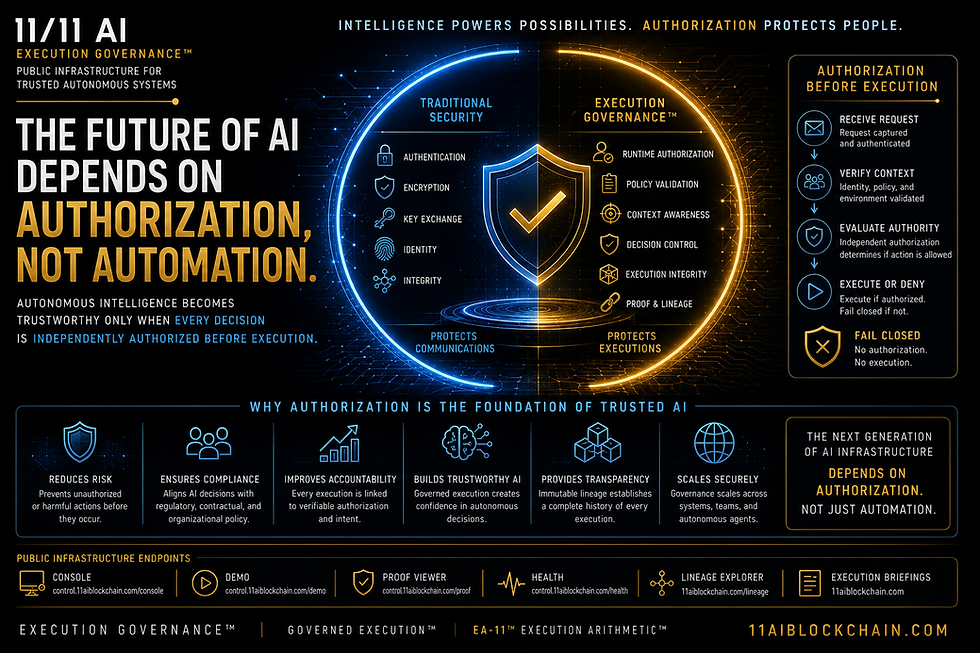
11/11 is not another AI company building models. Instead, it provides an execution governance layer that sits above all AI systems. Its role is to decide:
What AI actions are allowed to run
What actions must be blocked
What actions require proof of compliance
This governance layer introduces a new sequence for AI operations:
Request → Verify → Allow or Deny → Execute → Cryptographic Proof
Execution is no longer assumed or unchecked. It becomes a verified and auditable event.
Why Execution Governance Changes Everything
AI companies like Anthropic focus on building intelligence. 11/11 focuses on governing that intelligence. This distinction matters because it means:
AI becomes controllable in real time
Execution becomes provable and transparent
Systems become auditable at the moment of action
This shift transforms how we trust computation. Instead of hoping AI behaves correctly, we can verify and enforce correct behavior before it happens.
Infrastructure Versus Application
AI model companies are applications. They create the intelligence that powers new tools and services. 11/11 is infrastructure. It provides the foundation that governs and controls those applications.
This infrastructure layer is essential for responsible AI deployment. It ensures that AI systems operate within defined boundaries and comply with policies set by organizations or regulators.
Practical Examples of Execution Governance
Consider a financial institution using AI to approve loans. Without execution governance, the AI might approve loans that violate internal risk policies or regulatory rules. The institution would only discover this after the fact, potentially facing financial losses or legal penalties.
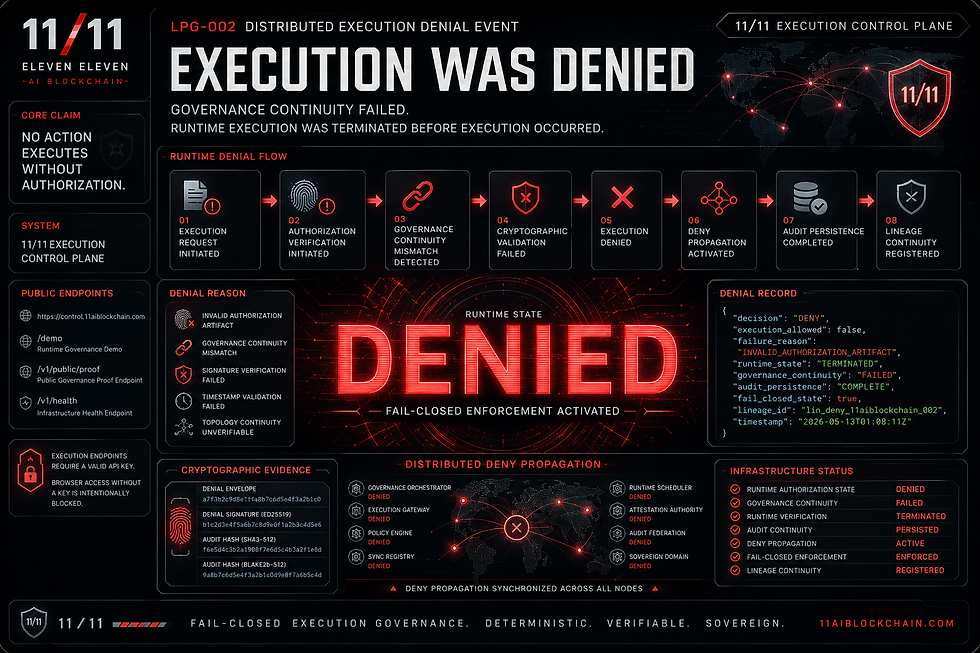
With an execution governance layer like 11/11, every loan approval request is verified against policies before execution. If the request violates rules, it is blocked. If it passes, the approval is executed and cryptographically recorded. This process ensures compliance and creates an audit trail for regulators.
Another example is content moderation on social media platforms. AI systems generate or filter content, but without governance, harmful or inappropriate content might slip through. Execution governance can enforce moderation policies in real time, blocking disallowed content before it reaches users and providing proof of compliance.
The Road Ahead for AI Governance
As AI systems become more powerful and widespread, the need for execution governance will only grow. Companies and regulators will demand tools that provide real-time control and accountability.
Building this governance layer requires collaboration across industries, clear standards, and robust technology. It also calls for transparency so users can trust AI systems and their operators.
Final Thoughts
The next trillion-dollar opportunity in AI is not just about building smarter models. It lies in execution governance the ability to control, verify, and prove what AI systems do at the moment they act.
By separating intelligence from governance, we can create AI systems that are not only powerful but also trustworthy and responsible. This approach will shape the future of AI, ensuring it serves humanity safely and effectively.

Comments